
[ad_1]
AlphaStreet Newsdesk powered by AlphaStreet Intelligence
 GOSS|EPS -$0.20 vs -$0.17 est (-17.6%)|Rev $17.0M|Net Loss $46.7M
Stock $0.21
EPS YoY -25.0%|Rev YoY +71.5%|Net Margin -275.2%
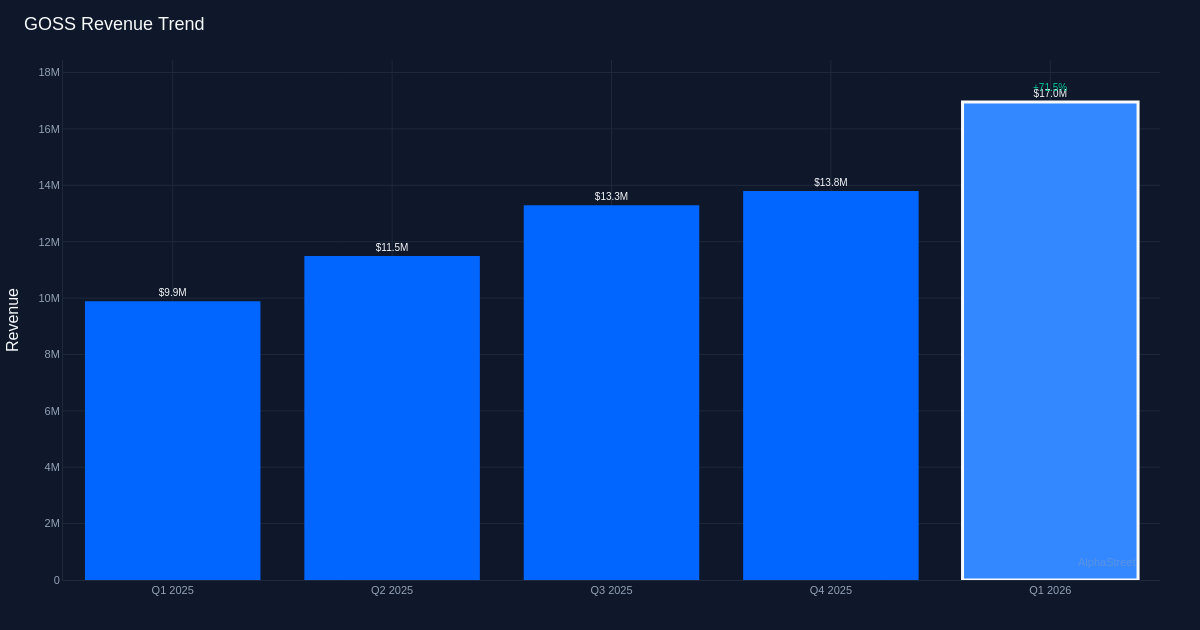
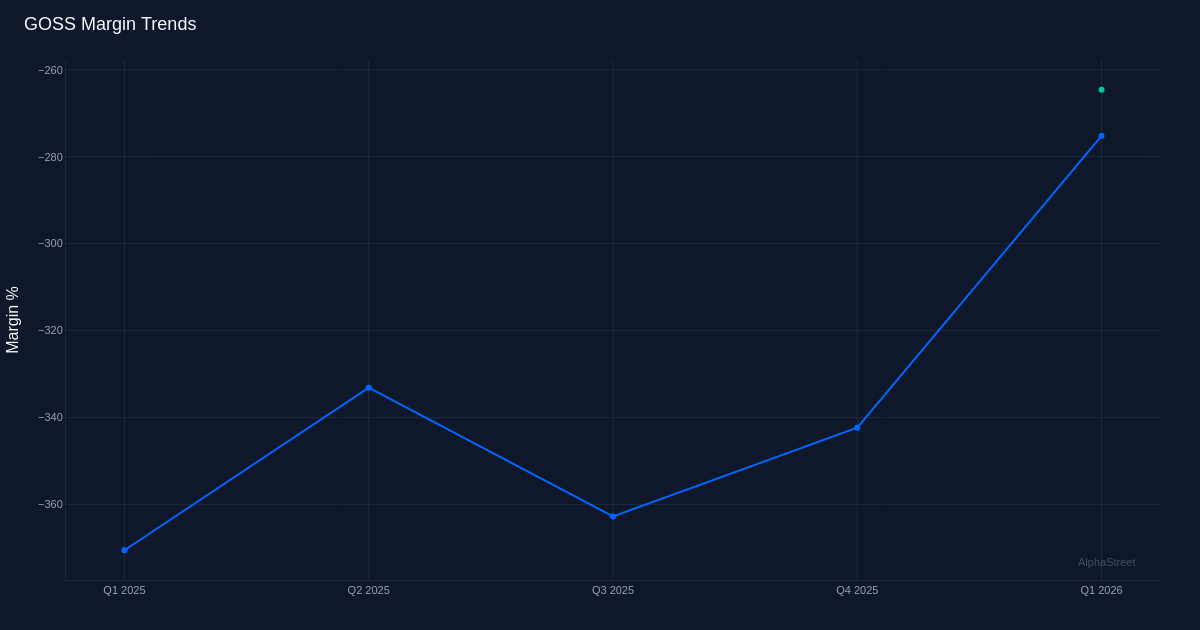
Gossamer Bio stumbled in Q1 2026, posting a loss per share of $0.20 that missed analyst expectations by 17.6%, marking the company’s inability to beat estimates in its last reported quarter. The biotechnology firm continues to burn cash despite notable revenue growth, as its net margin of -274.7% underscores the persistent gap between top-line expansion and profitability. The miss came despite revenue reaching $17.0 million, up 71.5% year-over-year, suggesting operational expenses and financial obligations are outpacing the company’s ability to monetize its platform.
The quality of the quarter’s results reveals an intriguing paradox: accelerating revenue alongside deteriorating absolute losses. While the company’s net loss of $46.7 million appears worse than the prior year’s $36.6 million in absolute terms, the critical metric is margin improvement. The net margin of -274.7% represents a substantial 95.0 percentage point improvement from the year-ago period’s -369.7%, indicating that revenue is scaling faster than losses are accumulating. Operating margin similarly improved to -263.9%, though the company remains deeply cash-flow negative. This pattern is characteristic of clinical-stage biotechs ramping commercial activities, but the magnitude of losses relative to revenue suggests the company is still far from a sustainable economic model.
Revenue trajectory shows consistent sequential acceleration across four quarters, establishing a credible growth narrative even as profitability remains elusive. The progression from $11.5 million in Q2 2025 to $13.3 million in Q3, $13.8 million in Q4, and now $17.0 million in Q1 2026 demonstrates consecutive quarterly growth with improving momentum. The 23.2% sequential jump from Q4 to Q1 is particularly notable given that first quarters often face seasonal headwinds in pharmaceutical commercialization. This trajectory suggests underlying demand is strengthening, though the modest absolute revenue base means the company requires multiple quarters of similar growth before reaching scale that could materially impact its cash burn rate.
Management’s strategic focus on debt restructuring emerged as a key theme, with the company achieving substantial balance sheet relief that extends its operational runway. As management stated in prepared remarks, “This takes our outstanding convertible debt from 200 million down to 72 million, a reduction of $128 million and extends our debt maturity from 2027 to 2030.” This restructuring is critical context for interpreting the quarter’s miss—the company appears to be prioritizing financial flexibility over near-term earnings optimization. With cash, cash equivalents and marketable securities of $99.2 million as of quarter-end, management indicated, “Based on our current plans, we expect our cash runway to extend into the first quarter of 2027.” This nine-month runway is concerning for a clinical-stage biotech, suggesting imminent capital needs unless revenue growth accelerates dramatically or additional financing materializes.
The company’s development pipeline commentary revealed ongoing uncertainty around key clinical data timelines, which may explain investor caution. When pressed on clinical trial duration, management acknowledged, “Concerning the questions at 48 weeks of 72 weeks, we don’t have the data yet, but we will look into it.” This lack of clarity on pivotal trial readouts introduces execution risk that compounds the company’s cash runway concerns. For a biotech trading at $0.21 per share, data visibility is paramount.
The loss-per-share deterioration from $0.16 a year ago to $0.20 currently represents a 25.0% widening that conflicts with the margin improvement narrative, pointing to share count expansion as a likely culprit. This disconnect between improving margins and worsening per-share losses typically signals dilutive financing activities, which would be consistent with a clinical-stage company managing a tight cash position. The debt restructuring mentioned by management may have involved equity components that increased the share count, a common tradeoff biotech managements accept to secure runway extension. Investors should scrutinize the fully diluted share count in the complete filing to assess the magnitude of dilution absorbed during the quarter.
The stock’s 35% fall suggests the market is discounting the top-line beat against the EPS miss and looming cash needs. At this price level, the company likely trades well below cash per share even after accounting for debt obligations, implying the market assigns minimal value to the commercial franchise and pipeline. Without clarity on when losses will narrow materially or when the next financing will occur, the stock remains in a precarious position.
What to Watch: The critical catalyst is whether Q2 2026 revenue can sustain sequential growth above 20% to demonstrate the Q1 acceleration wasn’t an anomaly. Investors should monitor any announcements regarding the clinical trial timelines that management indicated require further assessment, as data readouts could serve as inflection points for valuation. The first quarter 2027 cash runway deadline means financing activity—whether equity raises, partnerships, or additional debt restructuring—will likely materialize within the next two quarters. Finally, watch for updated guidance on the path to cash flow breakeven; without a credible timeline to profitability, continued dilution appears inevitable regardless of revenue growth rates.
This content is for informational purposes only and should not be considered investment advice. AlphaStreet Intelligence analyzes financial data using AI to deliver fast and accurate market information. Human editors verify content.
[ad_2]
Source link