
Faced with the threat of ossification, Bitcoin Core must adopt BIP 300 and 301, integrating the Drivechain solution for continuous security.
This is an opinion editorial by Samuel Greenberg, who believes that Bitcoin is the best hope for achieving a fair world and passing it on to the next generation.
At some point, less than ten years from now, the block subsidy will drop below one bitcoin – and continue to decay with each subsequent halving epoch. This means that the security of the network will depend more and more on transaction costs alone.
We should expect, at the same time, that the world’s powerful fiat institutions will realize what a serious threat Bitcoin is to their hegemony. If the transaction fees are not enough to sustain the widespread and distributed mining activity, then there may be an opportunity for powerful institutions to control enough hash rates to attack the network. We, as a community, must take this threat seriously and refuse to be complacent in the idea that, somehow, the success of Bitcoin is preordained, requiring no more effort than our own.
Since the Blocksize War ended in 2017, improvements to the network have been difficult to implement due to the obsession, rightly so, with main chain security. Given the importance, skepticism towards the proposed improvements to the core Bitcoin code is reasonable and desirable. That said, rejecting all proposals in the name of the precautionary principle is counterproductive if there is a proposal. contribute for network security. Developers should act as custodians aiming to perfect the network, rather than stagnant gatekeepers.
The Challenges Bitcoin Will Face Soon
Bitcoin, like any other protocol, will ossify at some point – however, there are two critical issues that need to be fixed before it hardens permanently. The first is the uncertainty that transaction fees will be sufficient to secure the network as blockchain subsidies decrease over time. The second, which is not directly related to the first, is that developers have no place to innovate useful features and generate fees for the network without permission.
To ensure the continued security of the network, the mining ecosystem must be robust and widely distributed. Miners must find attractive energy sources, be careful in capital planning and maintain operational excellence. Unfortunately, if there is no accessible revenue, all the best practices in the world will not be enough, and the miners will be forced to die and sell their ASICs.
The total revenue received by all miners through all activities (transaction fees, block subsidies etc.) at a given time, or Bitcoin’s “security budget” has been dominated by exponentially decaying block subsidies. We – as a community – have a responsibility to strengthen the network’s security budget, by finding new ways to increase revenue from transaction fees or by working to increase the value of Bitcoin in general or by finding other novel uses for miners. The value and security of the network is directly related to its use, so the solution must increase the use of Bitcoin.
We need to balance the affordability of transactions on the main chain with the importance of a consistent and reliable fee market, so that the network is not vulnerable to attack. Transaction fees generated from the use of Bitcoin as money can only prove to be an unstable source of revenue. This approach (which is currently dominant) could eventually require users to pay hundreds or even thousands of dollars per discrete transaction to be included in a block, undermining Bitcoin’s utility as money.
The most reliable countermeasure is optimization beneficial of the Bitcoin network by enabling the community to develop as many useful tools and applications as possible (all require transaction fees). Drivechain is a possibility to secure the Bitcoin network with permissionless innovation. As we know, innovation is currently being hindered because developers are cautious and conservative, understandably, when considering network improvements in the main chain. Furthermore, there is no procedure to integrate new ideas – the proposer must often work for years gathering social momentum by convincing individuals one by one, using miserable and counterproductive energy.
Importantly, this forces real and fee-paying users to patiently wait for the developer priests to bless the features they want or look elsewhere. This is an egregious misalignment; no group of people should decide what moderate of use. If we believe in the free market, not only in currency, but also in ideas and visions, then we must trust the market to freely decide what is useful.
Introducing Drivechain
In 2015, Paul Sztorc proposed BIPs 300 and 301 (or “Drivechain”), outlining a protocol upgrade that would enable developers to innovate without permission on top of the Bitcoin protocol stack. The vision for Drivechain is to allow users to store and withdraw bitcoins to the sidechain with a one-to-one conversion rate (powered by “Hashrate Escrows” BIP 300). Miners will be able to collect all transaction fees from each of these sidechains in the form of Bitcoin transaction fees, without having to run additional node software (illustrated by BIP 301 “Blind Merged Mining”).
Drivechain requires a soft fork and establishes a clear mechanism to integrate innovations into the network, securely, on the sidechain (“second layer”), while the current functionality of the main chain remains unchanged. Bitcoin users can choose to ignore any and all sidechains. But the development of unlimited features for users can be distributed, all of which can contribute to the security of the Bitcoin network.
This additional utility in the Bitcoin network enabled by Drivechain takes value in two ways: First, as sidechains can only be accessed by placing bitcoins at par, and can always be redeemed at par, its existence is a source of new demand, generating price appreciation instead of dollars. ; and second, by pulling dollars away from competing blockchains into Bitcoin, we generate price appreciation over other cryptocurrencies, all with bitcoin as the money needed to access and use an infinite number of sidechains. Thus, Drivechain expands the area of need for bitcoin as money.
Addressing Drivechain Criticism
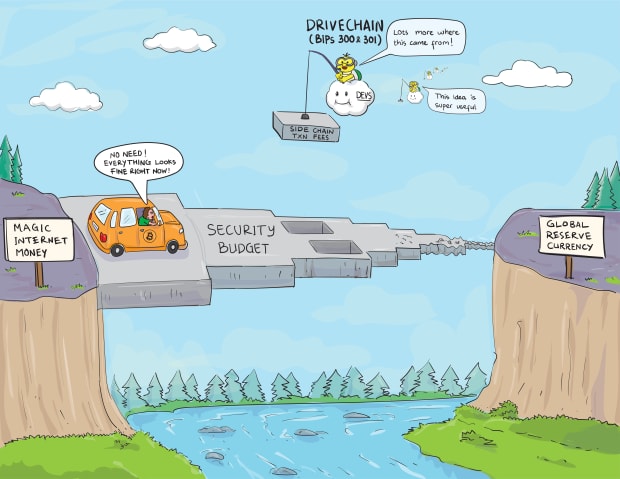
The Bitcoin community should not tolerate competing projects. We need to integrate all the good ideas from all the other projects into the Bitcoin network. We need to have privacy coins, and smart contract coins and other coins that people can dream of.
As sidechains are not vehicles to get-rich-quick (through pre-mining, then the pump-and-dump model), they lead in true open-source coordination; users can give away good ideas for others to build, without worries of missing up. All true solutions will compete for the attention of users based solely on their utility and usefulness. Any use of projects built on the sidechain will benefit everyone who holds bitcoins (corresponding to the scale of use on the sidechain).
There are several common criticisms that the community has leveled at Drivechain supporters, the most common of which is the claim that “miners can steal from the sidechain.” But let’s consider that these sidechains will be a source of income for the miners, so there is no incentive for the miners to destroy them. Additionally, all use of sidechains is voluntary, so users choose to deposit bitcoin knowing there is a theoretical risk involved.
Some important context is that, due to the underlying code of BIP 300, an attack on the sidechain will take six months if a minimum of 51% of miners will collude. The attack must happen during the day, and at any time the network can react to defend itself, only needing 2% of miners to defect (by redirecting the hash rate to other pools). There are several precedents for this, for example, in September 2022 when the Poolin mining pool suspended withdrawals, the hash rate dropped from more than 10% to less than 2% in a few days – the network was able to defend itself. wrong mining pool.
Other common criticisms are dismissals like, “We don’t have to worry about costs” or “The network is great.” Both sides of this attitude are epistemologically overconfident – we have no way of knowing whether the future continues and the survival of Bitcoin is too important to leave hope. If the main chain transaction fee is reasonable, then the sidechain transaction fee is accretive and can only be used to further secure the network.
Bitcoin represents the normative good for humanity – now and in the future. Like the internet decades ago, it is impossible to imagine the good that will come from this technology, and we must always strive to nurture and defend it. Drivechain is a relatively small touch, lightweight, and is a reversible change that unlocks incredible latent potential. Humans have always solved these problems through innovation. We should want Bitcoin to become a more useful tool, applicable to a wider range of problems, all of which can use the core as money.
It will take a lot of courage and effort to establish a consensus for Drivechain to be integrated into Bitcoin Core. But we can be part of the consensus building effort. We can educate ourselves and advocate in our circles. We can show our support and make our voices heard.
This is a guest post by Samuel Greenberg. Opinions expressed are entirely their own and do not necessarily reflect those of BTC Inc or Bitcoin Magazine.