
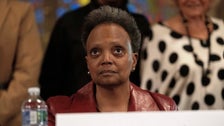
CHICAGO (AP) – Chicago holds its mayoral election on Tuesday, but it will take several weeks – and a runoff election – before a winner is announced. See what happened:
ELECTION TUESDAY
Nine candidates competed Tuesday for the chance to become Chicago’s next mayor. This includes Mayor Lori Lightfoot, who was elected in 2019 and is seeking a second term.
To win office outright, a candidate must receive more than 50% of the vote. That’s unlikely with such a large field, so the race is expected to go to a runoff on April 4 between the top two vote-getters.
The official election is nonpartisan and is not considered or called a primary, although all candidates seek to lead the city, a Democratic stronghold, calling themselves Democrats.
WHO IS RUNNING?
In addition to Lightfoot, US representative candidate Jesus “Chuy” García, former school CEO Paul Vallas, Cook County Commissioner Brandon Johnson, businessman Willie Wilson, state representative Kambium “Kam” Buckner, activist Ja’Mal Green and the City Council. members Sophia King and Roderick Sawyer.
RUNOFFS HAD BEEN HELD BEFORE?
Municipal elections became nonpartisan and the runoff system was implemented in Chicago since 1999. But in fact no mayoral runoff was required until 2015. That’s because Mayor Richard Daley easily won re-election in 1999, 2003 and 2007, getting more than 70% of the vote.
After Daley chose not to run again, former White House chief of staff Rahm Emanuel avoided a runoff in the first mayoral election in 2011. But he was forced to run for the city’s first mayor in 2015, after failing to win a majority in the February election. . Emanuel faced García, whom he defeated.
In 2019, Lightfoot ran against Cook County Board Chair Toni Preckwinkle, a contest Lightfoot won handily.
WHAT IS THE TOP ISSUE?
Public safety has been a major concern in the race. Violent crime has risen in Chicago, as it has in many places, during the pandemic, with the city recording 797 murders in 2021, according to the Chicago Police Department. That’s the highest number in a quarter of a century.
And while murders have begun to decline, and Chicago’s per capita numbers are lower than other Midwestern cities such as St.
Voters are also concerned with rising costs of living, including property taxes, as well as affordable housing, jobs and education.
WHY IS LIGHTFOOT VULNERABLE?
Lightfoot was elected four years ago as an outsider who would curb corruption at City Hall, when several elected officials were investigated and a cleanup of city government became the focus of voters. But once in office, Lightfoot’s tenure was beset by other challenges: the COVID-19 pandemic, protests over police brutality, rising crime, strikes by the Chicago Teachers Union and a dispute with the police union over vaccine mandates for officers.
While the number of homicides has decreased since the pandemic, the annual number is still higher than before Lightfoot took office. He said the city has a strategy to reduce crime and that it works; His rivals say he is not doing enough and that the hand-picked superintendent of police should be fired.
Apart from the law and order issue, Lightfoot has been criticized for his temperament which some say is too much. And some progressives are angry that he has not followed through on campaign promises, such as establishing civilian oversight of police early in his administration.
Now Lightfoot, who first ran for office as a progressive, is “trying to thread this needle that’s in the middle,” with Vallas seeking support from conservative voters and some competing candidates for more left-leaning voters, said Constance Mixon, a professor at Elmhurst University who has lived all his life in Chicago.