
Bitcoin mining is becoming centralized, but how real is the risk of network censorship? And can the protocol called Stratum V2 save the industry?
This is an editorial opinion by Federico Rivi, author of the Bitcoin Train newsletter.
Bitcoin mining within everyone’s reach: household appliances, wearable devices such as smart watches and smart glasses, all can be mined with special microchips. This is the future that many Bitcoiners want.
While that scenario may not be far from the reality that awaits us, for now we are still in Bitcoin. genesis thing and reality yet as Antonopoulos predicted. In fact, mining is becoming centralized.
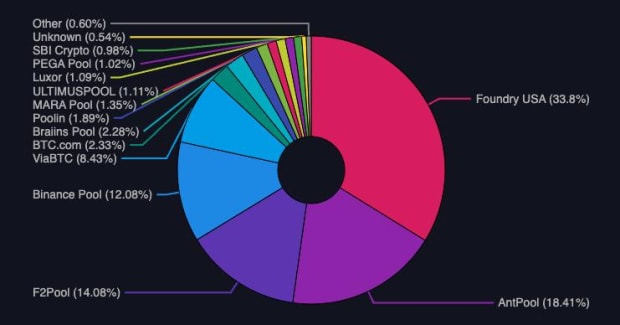
Last month, Foundry USA coordinated 34% of the hash rate alone. If we add Antpool, which represents 18.2% of the total hash rate, we have 52% of Bitcoin’s global computing power in the hands of just two mining pools.
Pointing to this problem with centralization recently was well-known Bitcoin developer Peter Todd:
“Bitcoin is dead.” “The mine is finished.” “They will regulate Bitcoin.” “Censorship is coming.”
I have heard you, but we must remain calm. To understand what the implications are – and what the solution is – we need to step back and revisit the concept of “pool mining.”
The Evolution of Pool Mining
Would you rather receive $100,000 every five years or $20,000 a year? The answer to this question by most explains the emergence of mining pools.
In the long run, the payment is the same, what changes the frequency with which the payment is received. In an environment as competitive as mining, this is especially important. It can determine the survival or bankruptcy of mining farms that – regardless of changes in the price of bitcoin – must keep the machines running by paying for electricity, as well as any loans taken to buy hardware or other expenses.
A mining pool is a server, usually managed by a company, that combines mining farms and individual miners located in different regions, combining computing resources and combining them as a product of a single team, participating in the competition that is bitcoin mining. The high computing power coordinated by the pools makes it possible, compared to the slight possibility of individual miners, to win the proof-of-work competition more often and redistribute the reward to all members in the calculation proportion. the power that has been given.
Consider an example: Running a mining farm that produces 0.025% of the global hash rate – an activity that currently requires a multi-million dollar investment – probabilistically allows miners to write one Bitcoin blockchain block in every 4,000. Considering the average rate of one block produced every 10 minutes, this means that the reward of one block received per month, is currently worth 6.25 bitcoins.
With the same computing power available, however, one can choose to join a mining pool that controls, say, 25% of the global hash rate. Statistically, the pool is likely to mine one block in every four, ie, one every 40 minutes. Mining farms that have decided to join are rewarded in proportion to the computing power provided, so they will always bring the equivalent of one block per month, but are paid on average every 40 minutes (more commonly, pools pay rewards. once a day to reduce costs) .
Joining a pool makes the future more predictable because payouts, although not necessarily higher than quiet mining, are more frequent. The first swimming pool appeared in 2010 under the name Slush Pool, now known as Braiins Pool, and since then, the model has been reduced.
As explained above, much of the computing power of today’s networks is in pools, which are always the point of centralization.
So, what is the current state of mining and what are the risks?
The Rise Of Foundry USA
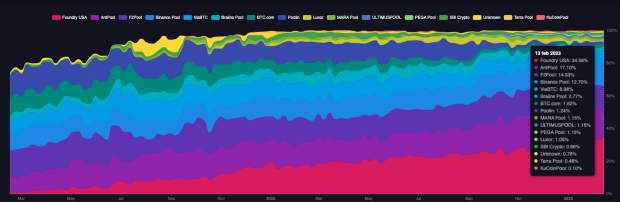
On February 15, 2021, the Foundry USA Pool coordinates 0.98% of the hash rate. Two years later, that figure rose to 34%. What has happened in the interim?
Foundry is a New York-based company wholly owned by Digital Currency Group (DCG), one of the world’s largest “crypto” investment funds. Among Foundry’s various activities is mining, carried out by the Foundry USA Pool business, which has become the de facto benchmark for US institutional miners.
It is no coincidence that Foundry’s growth coincides with China’s mining ban in May 2021. As reported at the time, many miners fled China to join Kazakhstan as well as the United States. One of the preferred destinations is Texas, which is now considered one of the most favorable regions in the world for mining, not least because of its friendly regulations.
In a recent interview, Gabrielle Vernettimining researcher and developer of Stratum V2, told Bitcoin Magazine that “most of the miners located in Texas are in the Foundry.”
There may be another reason behind the American pool: large investments in new ASICs at once (bull market between late 2020 and early 2021) when many competitors can focus more on taking profits. In September 2020, for example, Foundry has signed a partnership with ASIC manufacturer MicroBT to provide priority access to the new M30S ASIC for institutional miners.
Several months can pass from the purchase of an ASIC to the start of operations, especially when the chip is not available. So when the new hardware is ready to go in late 2021, what happens is that Foundry USA gets a lot of market share. From 8.5% in October 2021 to 19% in January 2022, for example.
What are the dangers of mining centralization?
Why does it matter that Foundry USA coordinates 34% of the global hash rate? Because until now, although the pool’s computing power is provided by many different mining farms, candidate block built by a pond. It is the pool that decides which transactions are included in the block. This introduces a point of vulnerability that can cause two problems: censorship of transactions or addresses and a 51% attack. The latter can serve two purposes:
- Denial of service: Deliberate mining of empty blocks that slows down the network by preventing transactions from being approved. With 34% computing power, this will be every third empty block.
- Double spending: Reversal of a transaction made by an attacker and placed in an approved block via a blockchain fork.
The threat is made possible by the current protocol that miners and mining pools use to communicate with each other: Stratum V1.
However, we do know what the solution is and it’s called Stratum V2 (details below). At the moment, Braiins Pool, Foundry USA itself and the team from independent, open-source developers working on it. The latter group included Vernetti.
Is there a possibility that, under a hypothetical US obligation, Foundry USA could start censoring certain transactions?
“On a technical level, it could happen,” Vernetti said. “But to what extent? The longer the censorship remains, the more miners will have to realize this and start shifting their activity to other pools. This is because censoring results in a loss of commission, so miners have an economic incentive to move to a pool that collects the commission instead of avoiding censoring transactions.
Precedent of the MARA Pool
The relevant precedent in this regard dates from May 2021. The pool controlled by Marathon, the MARA Pool, has decided at the beginning of the month to only mine blocks with transactions that comply with OFAC, thus censoring addresses blacklisted by the US Treasury Department. The revolt of the Bitcoin community and the fact that no other miners followed caused the MARA Pool to be turned on in less than a month. In late May, Marathon wrote in a press release that it would no longer filter transactions.
Thus, the danger of censorship appears to be low and, in any case, easily resolved in a short period of time. So how likely is a 51% strike led by Foundry USA?
“The moment a denial-of-service attack is launched, that is, the mining of empty blocks to slow down the transaction approval process, everything will be visible on the blockchain,” said Vernetti. “Then, miners will direct their hash rate to other pools. This is because, without transaction fees, each miner will earn less money for their work. Miners will have an immediate incentive to provide their hash rate to other pools, an operation that only takes minutes. If Foundry USA starts mining empty blocks, in my opinion, it will lose half of its coordinated hash rate in an hour.
“Perhaps the 51% attack aimed at spending twice is more worrying,” Vernetti said. “On a technical level, one can try to spend twice even with a lower hash rate, but again, why? Because it is true that Foundry USA appears to be an institutional pool controlled by the USA, but it is still a business. The economic interest is to keep the network working properly good. A double spend will destroy the status of Bitcoin as an immutable network and I imagine that can cause the price to collapse immediately. The counter incentive will include $ 1 trillion paid by the US to carry out the attack.
Solution: Stratum V2
The risk of censorship and the risk of 51% attacks by mining pools will be eliminated if the new communication protocol between miners and pools is used extensively: Stratum V2.
The protocol allows each individual miner to build his own candidate block, removing this power from the pool. Therefore, the pool will not be able to remove blacklisted transactions from the block, nor will it be able to write an empty block or attempt to spend transactions twice. The responsibility for writing the block is shifted from the pool hands to all miners.
Stratum V2 has been implemented by Brains Pool and periodically tested by Foundry USA itself, but the majority of hash rates are still synchronized by pools using Stratum V1.
What incentives will drive pools to use Stratum V2? What will lead them to voluntarily choose to lose control over the construction of the block?
“The other two fundamental characteristics of the Stratum V2 protocol: security and performance,” replied Vernetti.
“Security: unlike Stratum V1, Stratum V2 is an encrypted protocol. It does not allow hash-rate-hijacking attacks that can be carried out today. In these attacks, hackers become the communication path between miners and mining pools, take the proof of work produced by miners and pretending to be the author of the proof, instructing the pool to send the reward to him. This cannot happen with Stratum V2 because the communication is encrypted and therefore the proof of work given by the miner to the pool is not visible to outside observers. This is the first incentive: with the security , pools can attract more miners than those that do not offer this guarantee.
“Performance: communication between miners and mining pools in Stratum V1 is human-readable, in ASCII code. In Stratum V2, on the other hand, communication is done in binary code. This small factor improves performance due to the conversion time from human-readable characters to binaries are stored, so more packets of information can be transmitted at a given time than in Stratum V1. This is important because it can provide more proof of work that can be decisive for winning the race to write the block. Better performance is a competitive advantage.
This is a guest post by Federico Rivi. Opinions expressed are entirely their own and do not necessarily reflect those of BTC Inc or Bitcoin Magazine.