
Ünal Boybey and his family were left alone to dig his brother’s body out of the rubble in the devastated city of Adıyaman, Turkey. Then they dug a grave.
“Usually municipal workers would do this,” said the 63-year-old as he watched two younger relatives remove clumps of rust-red earth at the flooded New Cemetery. “But they don’t have enough people. And there are too many bodies. We have to do everything ourselves.”
Adıyaman, a city of 300,000 inhabitants that fights against snowy mountains, has suffered terrible damage from the massive 7.8 magnitude earthquake that struck Turkey and Syria on Monday. Countless buildings have been leveled, thousands are dead and food and shelter are in short supply. The country has struggled to cope.
At the university’s teaching hospital, bodies lay on trolleys outside the main entrance as people waited for relatives to bring vehicles to pick them up. The exhausted surgeon in bloody scrubs said he and his colleagues were short on medicine and equipment, and so they amputated limbs of quake victims — they numbered about 100 so far this week — using metal-cutting saws. “There is no Afad,” he said, referring to the government-run disaster agency. “There is no country.”

The Boybey family digs the graves of three brothers in the family cemetery in Adıyman New Cemetery © Laura Pitel / FT
That is not true. In the center of town, a state-owned ambulance zigzags through the rubble. Soldiers from the local barracks have been deployed to direct traffic on the main road, where almost all buildings have suffered damage or collapsed.
Even at the cemetery, where more than 50 cars serving as emergency hearses were waiting to enter, there were few municipal vehicles to transport the bodies. Hacı Yıldırım, the driver of one of them, broke down in tears when he saw the other four bodies being unloaded. “I can’t tell you how much I’ve brought,” the 48-year-old said. “We are in a very bad way.”
In a country with a large and active state, many are shocked and outraged by the sudden vacancy. The governor of Adıyaman was confronted by angry citizens who shouted: “Where is the help?” and “Adıyaman is alone”. Later, the state’s transport minister, who visited the earthquake-hit city, was confronted by an angry mob.
President Recep Tayyip Erdoğan this week acknowledged that there had been problems in sending aid but insisted that it had now been resolved. He also warned against listening to “provocateurs” – what some in the media and the opposition consider to be critical of the government’s response.
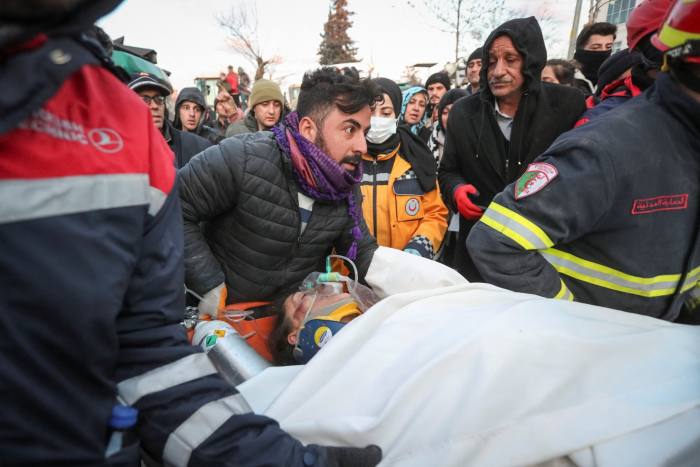
Rescuers carry survivors from the collapsed building © Irakli Gedenidze / Reuters
But in Adıyaman, experienced aid workers were shocked by the lack of coordination. A trained search and rescue volunteer from Istanbul said that, when he arrived in the city on Monday, 14 hours after the earthquake, he asked Afad for guidance on where to go first – and was met with a shrug. “How can you?” he said in disbelief.
A municipal worker from another Turkish province who led the delivery of 10 diggers said the vehicle had been waiting behind a truck for three hours because it was unclear what to do. The man, who like the rescue worker has not been named, said, “In those three hours, how many lives could have been saved? Local government here is weak and disorganized.
In the absence of a state, it has been left to more informal networks to try to fill the gap.
On one street, chefs, students and packaging producers from Ankara hand out pasta, noodles and diapers from the back of a van driven 800km from the Turkish capital after listening to a call from a religious foundation. In another, volunteers from an Islamic charity in Isparta province gave blankets, mattresses and children’s clothes.
But the scene is sporadic, and many have to manage without outside help.
Ayfer Vural, a 42-year-old teacher, took shelter with friends and neighbors in a makeshift tent made of scavenged materials – including a wood-burning stove. “We tried to get one from Afad but he said it wasn’t enough,” he said. Local people have knocked over the walls of supermarkets and grocery stores, he added, to get enough food and water.
The leader of Turkey’s largest opposition party criticized the government’s response to the crisis, claiming the damage was the result of “profiteering” by Erdoğan and his allies in the construction sector, who are accused of misusing taxes to support earthquake preparedness.
In Adıyaman – which is deeply conservative and backed Erdoğan with 67 percent of the vote in the 2018 election – it remains unclear whether the frustration in the response will anger the Turkish president, who faces a re-election bid in three months.

Many private contractors followed suit for damaging building materials or ignoring planning rules. Some lay the blame at the feet of local authorities. Others argue that, with such a large area affected and more than 14,000 dead in Turkey alone, even the best organized country would be overwhelmed.
Asked about the political fallout of the past few days, a woman sitting next to four rows of newly dug graves at the New Cemetery expressed her frustration at the lack of help to reach trapped relatives.
But he said he did not blame the president for his response to the disaster. “This is not Erdoğan’s fault,” he said. “It comes from God.”
