
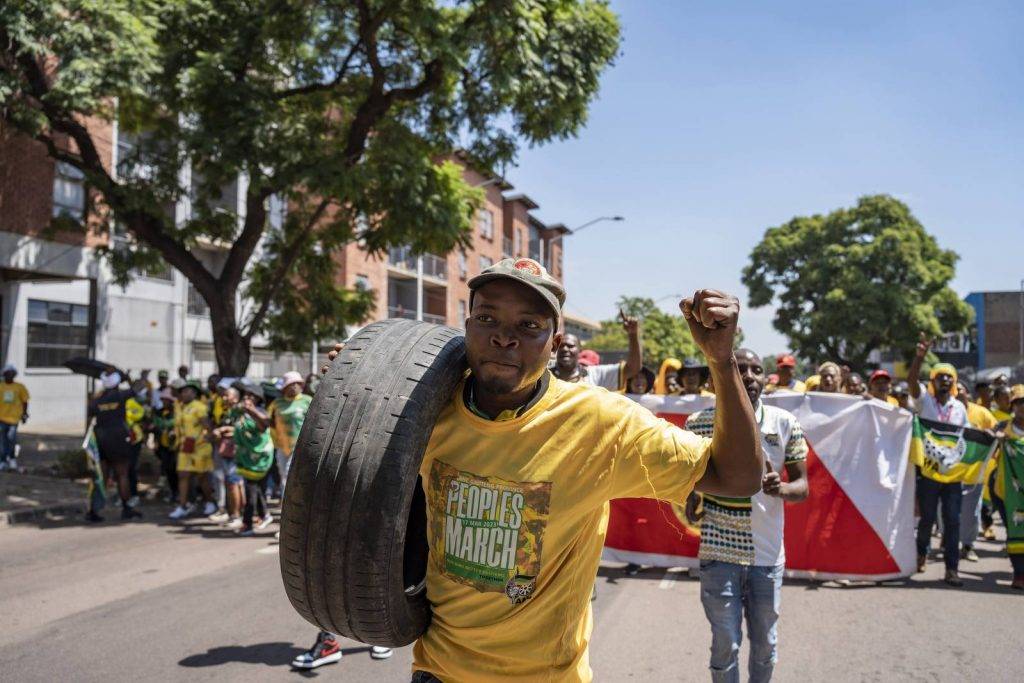
ANC supporters stage an anti-government demonstration to protest the energy crisis, unemployment and cost of living, in Pretoria, South Africa on March 17, 2023. (Photo by Ihsaan Haffejee/Anadolu Agency via Getty Images)
TRecent political events in South Africa have brought to light the question of how political leaders continue to pledge allegiance to the ANC despite the party’s many mistakes.
A classic example is when a parliamentary committee was set up a few years ago to investigate the exorbitant costs of building former president Jacob Zuma’s Nkandla home. Despite the facts, MPs from the ruling ANC party defended corruption and ignored the evidence. Recently, in his debut appearance during a Q&A session, the newly appointed vice president, Paul Mashatile, defended the ANC’s decision to shield President Cyril Ramaphosa from scrutiny over the Phala Phala saga.
This defense reflects the ANC’s past actions and highlights the party’s disregard for transparency and accountability. How is it that a party that was once considered a beacon for democracy in South Africa has fallen from grace?
To answer this question, we can turn to John Gaventa’s theory of power based on Steven Lukes three dimensions of power. According to Gaventa, power is not only about dominance and control but also about calmness and conformity. He argues that people can become complicit in oppression by accepting the status quo and failing to challenge power relations. In other words, people can be oppressed not only by those who hold power but also by accepting that power.
The ANC has been in power since the end of apartheid in 1994. During this time, the party has been accused of many wrongdoings, including corruption, nepotism, and cronyism. Despite these accusations, the ANC held on to power, and its members and leaders defended the party at all costs.
One explanation for this phenomenon is what Gaventa calls the “veil of ignorance”. This refers to the idea that people may not be aware of the full extent of oppression or wrongdoing by those in power. In the case of the ANC, many members and supporters may be ignorant or choose to ignore the party’s mistakes.
Another explanation is what Gaventa calls “civil consent”. This refers to the idea that people can accept the status quo because they believe there is no alternative or the alternative would be worse. This can happen when people feel powerless or believe political action is pointless or ineffective. In the case of the ANC, members and supporters may believe that the party is the only option for democracy in South Africa and that the alternative will be worse – or fear losing the benefits of its current alignment.
The explanation is not the only one. For example, the veil of ignorance may contribute to civil consent, as people who are ignorant of oppression may be more willing to accept the status quo.
The ANC’s ability to maintain power despite its misdeeds may be attributed to Stockholm syndrome. This is a psychological phenomenon where hostages bond emotionally with their captors. In the case of the ANC, members and supporters can feel a sense of loyalty and attachment to the party, even when it acts against its interests.
So how can this cycle of calm and harmony be broken? One of the critical contributions of Gaventa’s theory is its emphasis on the agency of the oppressed and the importance of resistance to power. He argues that those who are in contact with oppressive forces have the agency and capacity to act and that resistance is necessary for social change.
Gaventa suggests that breaking the cycle of complacency and conformity requires increasing awareness of oppressive power structures and encouraging the oppressed to challenge and resist those structures. This can involve education, dialogue and the creation of alternative resources.
Another important aspect of breaking the cycle is collective action and solidarity among the oppressed. By working together and supporting each other, they can increase their power and effectiveness in challenging oppressive structures.
It is also important to create space for the voices and perspectives of oppressed people to be heard and valued. This may include promoting diversity and inclusion in decision-making processes and amplifying the voices of marginalized groups.
Zimkhitha Manyana studies international relations at the University of the Witwatersrand.The views expressed are those of the author and do not necessarily reflect official policy or position Mail & Guardians.