
[ad_1]

Listen to this article
Estimated 4 minutes
The audio version of this article is generated by AI-based technology. Mispronunciations can occur. We are working with our partners to continually review and improve the results.
The United Nations General Assembly on Wednesday voted 141–8 to adopt a resolution backing a world court opinion that countries have a legal obligation to address climate change, with the world’s biggest historical emitter the United States among those opposing it.
Canada, which was a sponsor of the resolution, was among the countries that voted in favour.
The resolution, brought by the Pacific island Vanuatu, affirms a July 2025 advisory opinion by the International Court of Justice (ICJ) that states are obligated to reduce fossil fuel use and tackle global warming.
UN Secretary General António Guterres said the vote, in which 28 countries abstained, underscored that governments are responsible for protecting citizens from the “escalating climate crisis.”

“I welcome the adoption of the General Assembly resolution on the ICJ’s advisory opinion on climate change – a powerful affirmation of international law, climate justice, science & the responsibility of states to protect people from the escalating climate crisis,” he said in a post on X.
While not legally binding, the opinion is expected to be cited in climate-related legal cases worldwide.
Lee-Anne Sackett, is the special envoy for climate justice for Vanuatu, the Pacific island nation that brought the case and resolution forward. She told CBC’s As It Happens Thursday that the vote was a “very intense” moment.
“To be honest, I was shaking with adrenaline the whole time,” she said. “It was really a great relief.”
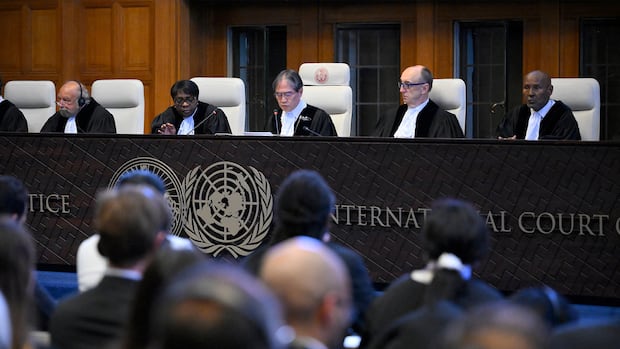
The International Court of Justice has ruled that countries that fail to take measures to protect the planet from climate change may be in violation of international law, and nations harmed by its effects could be entitled to reparations.
Those opposed, abstaining
The United States joined Saudi Arabia, Russia, Israel, Iran, Yemen, Liberia and Belarus in opposing the resolution. COP31 climate summit host Turkey, India, and oil producers Qatar and Nigeria were among those abstaining.
China, the biggest emitter globally now, voted in favour.

The Trump administration has removed the U.S. from the Paris climate agreement and other major environmental accords, and has pursued policies to boost fossil fuel production.
“The resolution includes inappropriate political demands relating to fossil fuels,” U.S. Deputy Ambassador to the UN Tammy Bruce said.
What it means for Canada and the world
Vishal Prasad, director of Pacific Islands Students Fighting Climate Change, which led the campaign for an ICJ opinion, called the vote a commitment to “making it a reality.”
Sackett said it makes countries accountable for their climate pledges and creates legal consequences for failing to do things like regulate fossil fuel companies: “It changes, really, the narrative around this.”
Patricia Galvao Ferreira, an associate professor and member of the Marine and Environmental Law Institute at Dalhousie University, told CBC Halifax’s Information Morning on Tuesday, ahead of the vote, that the resolution is a statement that the the international community “takes the landmark [ICJ] ruling seriously and intends to turn it into action.”
She added that while it has no direct implications, it “puts Canada in an awkward position,” given its fossil fuel subsidies and recent actions to scrap the consumer carbon tax and the oil and gas emissions cap.
The federal and provincial goverments face dozens of lawsuits alleging failure to comply with regulations related to climate or protect Canadians from the impacts of climate change.
Ferreira said the UN vote will give more leverage to those opposing government decisions that impact the climate.
Ecojustice is a climate advocacy group involved in some of those lawsuits. Charlie Hatt, the group’s climate program director, told CBC’s Metro Morning ahead of the vote that Canada’s court system takes “heed of international law in thinking about the content of our own individual constitutional rights.”
He added that it may also be possible for countries like Vanuatu to take countries like Canada to the ICJ for planning to increase their fossil fuel production.
Hatt said one other possible outcome of the vote is that Canada will start to recognize the international momentum around phasing out fossil fuels “and starts to, you know, take a bit more heed of that in terms of its domestic planning and action.”
[ad_2]
Source link