
People help clear debris at a damaged bus station after a shooting, amid Russia’s offensive in Ukraine, in Kherson, Ukraine February 21, 2023.
Lisi Niesner Reuters
A year on from the start of Russia’s full-scale invasion, Ukraine’s economy and infrastructure are in shambles, with the government and its allies planning the biggest rebuilding effort since World War II.
The World Bank estimates that Ukraine’s GDP will shrink by 35% in 2022, and it predicted in October that the population sharing an income below the national poverty line will rise to almost 60% by the end of last year – from 18% in 2021.
The World Bank has now mobilized $13 billion in emergency funds to Ukraine since the war began, including grants, guarantees and related parallel financing from the US, UK, Europe and Japan.
The International Monetary Fund estimates that the Ukrainian economy contracted by 30%, a less severe decline than previously predicted. Inflation has also started to decrease, but will end in 2022 at 26.6% per year, according to the National Bank of Ukraine.
IMF Managing Director Kristalina Georgieva visited Ukraine this week, meeting with President Volodymyr Zelenskyy and NBU Governor Andriy Pyshnyy, among others.
In a statement on Tuesday, Georgieva said she saw “an economy that is running, despite extraordinary challenges,” praising the government’s vision to move from recovery to “a transformational period of reconstruction and EU accession.”
“Shops are open, services are delivered and people are going to work. This is an incredible proof of the spirit of the Ukrainian people,” said Georgieva, also noting that government agencies, economic institutions and the banking system are fully operational.
“Despite the attack on critical infrastructure, the economy has adjusted, and a gradual economic recovery is expected this year,” he added.
This handout photo taken and released by the press service of the President of Ukraine in Kyiv on May 16, 2022 shows Ukrainian President Volodymyr Zelensky (R) and International Monetary Fund (IMF) Managing Director Kristalina Georgieva (on screen) holding a video conference. .
STR | AFP Getty Images
Georgieva reiterated the IMF’s commitment to support Ukraine, and the Washington-based institution has provided $2.7 billion in emergency loans over the past year. However, it is also working with Ukraine on its economic policy monitoring program, a precursor to establishing a full IMF loan program, as Kyiv seeks a $15 billion multi-year support package.
“The international community will continue to play an important role in supporting Ukraine, including helping to address its large funding needs in 2023 and beyond,” Georgieva said.
“The war in Ukraine has had many consequences for local, regional and global economies. Only if we work together as a global community will we be able to build a better future.”
Major infrastructure redevelopment
At the G-20 meeting on Thursday, US Treasury Secretary Janet Yellen urged the IMF to “move quickly” to a fully funded loan program, with Washington preparing to provide up to $10 billion in economic aid in the coming weeks.
The US provided $76.8 billion in bilateral military, economic and humanitarian aid to Ukraine between January 24, 2022, and January 15, 2023, according to Germany’s Kiel Institute for the World Economy.
This includes $46.6 billion in military grants and loans, weapons and security assistance, far exceeding the rest of the world. The UK is the second largest military contributor at $5.1 billion, followed by the European Union at $3.3 billion.
As the conflict enters its second year and shows no sign of abating, with Russia increasingly attacking critical infrastructure and ongoing power shortages, Ukraine’s economy is expected to contract again this year, albeit at a low single-digit rate.
New estimates from the Kyiv School of Economics put the total damage to Ukrainian infrastructure at $138 billion, while Zelenskyy estimated that rebuilding the country could cost more than $1 trillion.
Damage is seen through the windshield of a broken car in Lyman, Ukraine, on February 20, 2023.
Anadolu Agency Anadolu Agency Getty Images
“Since the beginning of Russia’s war against Ukraine, at least 64 large and medium enterprises, 84.3 thousand units of agricultural machinery, 44 social centers, almost 3 thousand shops, 593 pharmacies, almost 195 thousand private cars, 14.4 thousand public transport, 330 hospitals, 595 administrative buildings of state and local administrations have been damaged, destroyed or seized,” the KSE report highlighted.
Meanwhile, Ukraine’s budget deficit has risen to a record $38 billion and is expected to remain elevated, although strong external support from Western governments and the IMF is likely, according to Razan Nasser, an emerging market analyst at T. Rowe Price.
“This should help narrow the funding gap, which will help reduce reliance on monetary funding this year,” Nasser said.
At the January policy meeting, NBU officials discussed several measures aimed at avoiding a return to monetary financing of the budget deficit.
External creditors in August agreed to a two-year freeze on the country’s debt, acknowledging the huge pressure the war was putting on the country’s public finances.
“This will be the first step of the restructuring, with a deep haircut on the debt. It is difficult to predict the size of this debt reduction because it depends on the economic situation of Ukraine when the restructuring is agreed. “said Nasser.
He added that a “political decision” would be needed on how much private lenders should contribute to the cost of reconstruction given the massive damage done to infrastructure so far.
A worker inspects the damage near the railway yard of the freight train station in Kharkiv, which was partially damaged by a missile attack, amid the Russian invasion of Ukraine on September 28, 2022.
Yasuyoshi Chiba AFP Getty Images
“When this war finally ends, the scale of reconstruction and recovery efforts will probably surpass anything Europe has seen since World War II,” he said.
This sentiment was echoed on Wednesday by Deputy Prime Minister Yulia Svyrydenko, who told Politico during an interview in Brussels that reconstruction should begin this year, even though there is no end to the conflict in sight.
“This will be the biggest reconstruction [since] World War II,” he said. “We have to start now.”
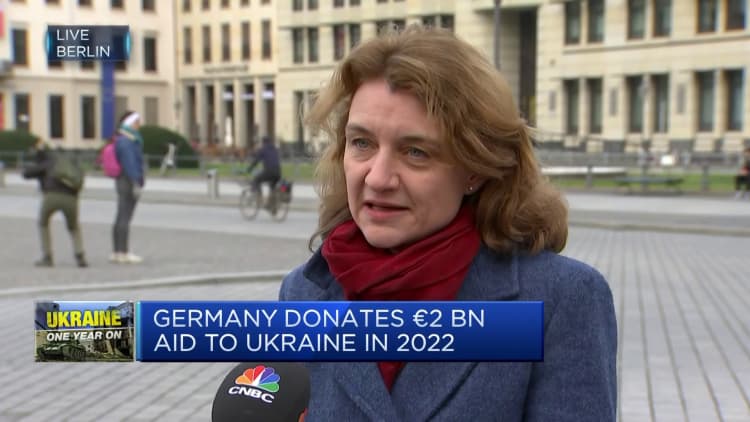
Even starting to rebuild while the war is still going on and Russia continues to target civilian infrastructure may seem counterintuitive, Daniela Schwarzer, executive director of the Open Society, told CNBC on Thursday.
“Ukraine has clearly made a real case, reconstruction must begin in some parts of the country while the war is still going on, because for the country, the damage to the infrastructure – which really happens every day – must be dealt with, otherwise people can do it. No life, no economy can move forward, so there is a big task,” he said.
“We will see in the next few months how the international financial institutions, including Europe such as the International Bank for Reconstruction and the European Investment Bank together with the government and the European Union, plus the United States, but the next important question is how we can finally bring private investment back to Ukraine , because the government cannot rebuild the country.