
People walk outside the Bank of England in the financial district of the City of London, in London, England, January 26, 2023.
Henry Nicholls | Reuters
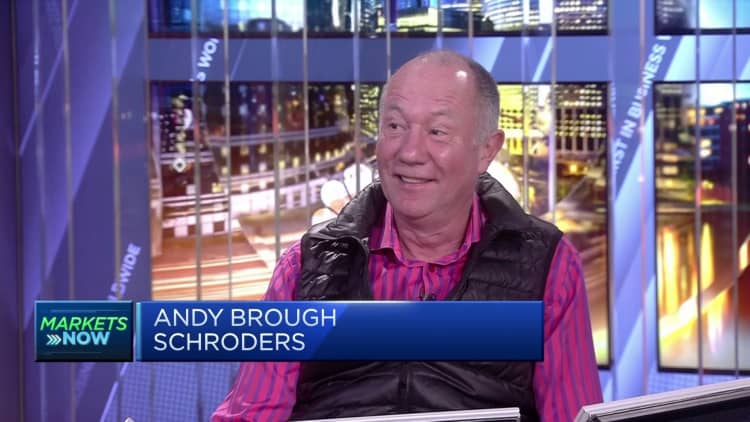
LONDON – Britain has now avoided an anticipated recession, and signs from the business world are that the economy may be doing better than feared, according to veteran Schroders fund manager Andy Brough.
Figures published earlier this month showed that UK GDP contracted by 0.5% in December, as the economy averaged over the last quarter of 2022 to avoid a technical recession.
The Bank of England estimates that the UK economy has entered a shallow recession in the first quarter of 2023 that will last five quarters, however, as energy prices remain high, and rising market interest rates limit spending.
But Brough, head of the pan-European small and mid-cap team at UK asset manager Schroders, said interactions with businesses suggested greater resilience than weak GDP numbers and official forecasts.
“Consumers are still out there spending. Every number is a surprise for the market, isn’t it? I walk up and down the streets or cycle to work. [and] there’s still a lot of people there, and people are still buying houses, still buying cars, still shopping,” he told CNBC’s “Squawk Box Europe” on Wednesday.
“There are seven wonders of the world, and the eighth wonder of the world is how GDP is calculated,” he said, adding that he was “surprised” by the scale of December’s contraction.
In their latest earnings report, UK banks generally increased their loan loss provisions – money set aside to insure customers who default on their debts.
Brough advised the market not to read this as a sign that tightening financial conditions are increasing the risk of default among UK consumers, and said the companies he was talking about were actually “not doing well.”
“Below the company’s x-minus profit right now, we’re seeing good dividend increases, good earnings reports, so basically, I think the economy is in better shape. And it’s very easy to go down like Lloyds Bank and other financial companies and say that it is difficult, but in fact it is a mechanical calculation, this provision.
Lloyds Bank on Wednesday announced a £2 billion ($2.42 billion) share buyback and increased its final dividend to 1.6 pence per share. It is the latest in a string of major UK businesses reporting fourth-quarter earnings and boosting returns on capital for shareholders.
‘Signs of life’ in business investment
Uncertainty about the future relationship between Westminster and Brussels has affected business investment since the UK voted to leave the European Union in 2016, and has also hampered productivity expansion and increased the direct cost of Brexit on Britain’s potential growth.
Real business investment in the fourth quarter of 2022 was only slightly higher than before the Brexit vote, but recent trends look more hopeful, according to Kallum Pickering, senior economist at Berenberg.
“Even from a low base after the downturn associated with the pandemic, real business investment will increase by c10% during 2022 – by 4.8% [quarter-on-quarter] increase in Q4 only,” Pickering said in a research note on Tuesday.
“It remains an open question whether the momentum can remain strong in the coming quarters as the company braces against the headwinds of tight financial conditions and sky-high energy costs, but the company has both the need and the means to further increase investment.”
He added that the outlook “looks good,” if political uncertainty continues to ease – with Prime Minister Rishi Sunak’s government moving away from the populism of his dead predecessors Liz Truss and Boris Johnson, while the main opposition Labor Party has moved to the center in “trust “. pragmatist” Keir Starmer – and Britain avoided a nasty recession.
Pickering also stressed that British businesses “lack confidence, not opportunity,” because the weakness of business investment cannot be attributed to concrete factors, such as difficulties in financing capital expenditure or a lack of technology that can help the production process.
“Non-financial corporations are sitting on deposits equivalent to c23% of annual GDP. Non-financial corporate debt is also low. At c75% of GDP by the end of 2022, debt is at late 1990s levels, well below the peak of the GFC 103 % in 2009 and far below the current Euro zone level of c145%,” he said.
“With the low productivity performance of the post-GFC era – output per worker increased by just 5.5% between Q2 2008 and Q3 2022 – the UK is desperate for a wholesale increase in its capital stock.”
In the six years of “disruption and chaos” since the Brexit vote, the reduced risk of a retaliatory trade confrontation with the EU should provide comfort to UK businesses and financial markets, and Pickering suggests better times ahead.
“It is normal for politics to be awry from time to time and for the economy to suffer as a result. Before the most recent wobble in England, the last one happened in the 1970s, but if it started to get back on track in the early 1980s. the economic performance is improving with fast,” he said.
“With luck, the worst political uncertainty holding back business investment since the Brexit vote is about to end.”
With business investment accounting for around 10% of UK GDP, a recovery to the pre-Brexit-vote growth rate of around 5.5% could add between 5 and 6 percentage points to annual GDP growth over the next few years, Berenberg predicted.
“What can be done? For a while, yes. Faced with persistent labor shortages and many global supply frictions, UK companies need to increase domestic capacity to meet demand,” Pickering said.
“A more settled political time next year could provide an ideal backdrop for him.”