
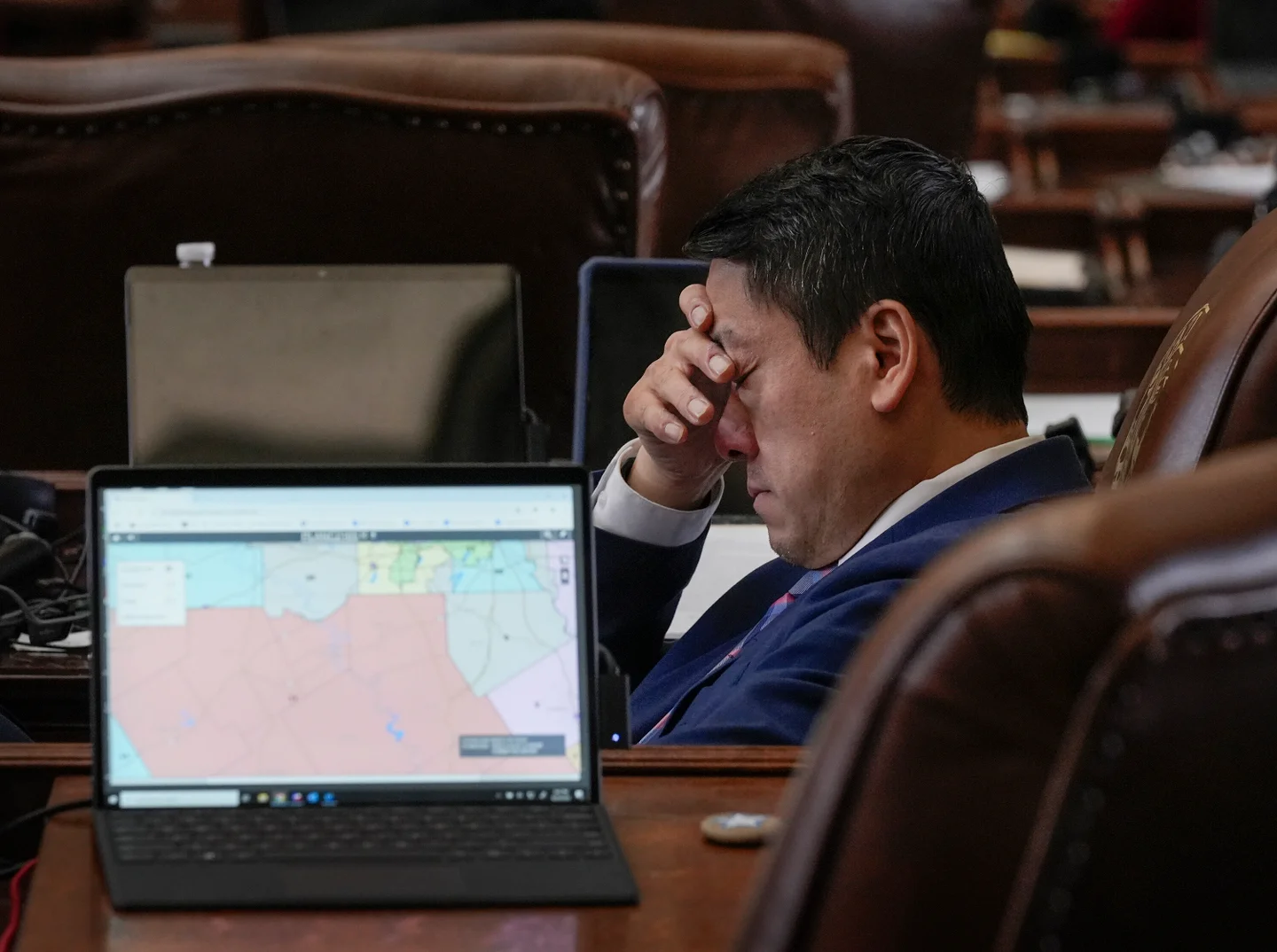
Texas Republicans are on their way to enacting a new congressional district map ahead of the 2026 midterms that creates five new GOP seats: On Wednesday night, the Texas House approved a new set of district maps that strongly favor Republicans. The effort came at the insistence of an increasingly unpopular President Donald Trump, who pressured Texas Gov. Greg Abbott, a Republican, to call a special session in order to eliminate Democratic seats in order to stop them from retaking the U.S. House next year.
But Texas Democrats see potential flaws in the new Republican maps — ones they hope to use to minimize losses with a targeted campaign in some of the new districts.
“The strategy behind this new map is based on two assumptions, both of which we think are incorrect,” said Katherine Fischer, director of Texas Majority PAC, a super PAC that works closely with the Texas Democratic Party in an effort to flip the state blue by 2032.
Those two assumptions are that Trump’s success in Texas in 2024 will automatically translate down ballot, and that Latino voters, who shifted heavily towards Republicans last year, will remain staunch GOP voters, according to a report by Texas Majority PAC released on Thursday.
Neither of those things are a given, Texas Majority PAC argues. Support for Trump, who has always been a fairly unique political figure, does not necessarily translate to support for Republican candidates running for U.S. Congress or state legislative seats.
They also point to previous elections as evidence. In 2024, Democratic Senate candidate Colin Allred outperformed Democratic presidential nominee Kamala Harris by 5.5% across the state and in each of the newly created districts. While Allred did not reach a majority in any of those seats, and did not win his race, 2018 Senate candidate Beto O’Rourke did win majorities in four of the five new seats in a much more favorable environment. Since the 2026 midterms are likely to be a referendum on Trump’s presidency and his unpopular policies, they are expected to be closer in composition to the 2018 midterms than the 2024 presidential cycle.
The Austin American-Statesman/Hearst Newspapers via Getty Images
Republicans hope that their inroads with Latino voters will mitigate potential compositional changes in the electorate that occur during a midterm cycle. But that is also a pretty big assumption. Trump’s current unpopularity is being heavily driven by drops among young voters and Latinos. One-quarter of Latino voters who backed Trump in 2024 are disappointed in his presidency or regret supporting him and 11% would vote for a Democrat in 2026, according to a July poll conducted by Equis Research. Those who are disappointed or regret supporting Trump say they disagree with his mass deportation policies and feel strongly that he’s done nothing on his promise to bring prices down.
None of those issues are going to go away. Trump’s mass deportation will only ramp up, as Republicans passed legislation handing enforcement agencies $170 billion in new funding. Inflation measurements and expectations continue to run ahead of projections as Trump’s tariffs increase the cost of goods and services.
“If this keeps up, Latino voters — and voters of all ages, races, genders, geographies — will move away from Trump and Republican congressmembers who supported this agenda,” Fischer said.
Down-ballot Democrats also outperformed Harris in heavily Latino districts across the state in 2024. While Trump beat Harris in both the 28th and 34th congressional districts, both heavily Latino, incumbent Democratic Reps. Henry Cuellar and Vicente Gonzalez both won reelection. Similarly, Allred won majorities in both of those districts.
But that’s why Republicans targeted Cuellar and Gonzalez’s districts to be redrawn. The new map puts them both in districts that voted for Trump by 10%. Still, Democrats believe that these two seats will remain competitive and they can hold them if the political tide is going against Republicans.
“We believe based on available data that Latino support for Democrats will be better than last cycle, though it’s unlikely to reach 2018 levels of support,” Fischer said. “Our projections give both Cuellar and Gonzalez both really good chances of holding their districts.”
The other newly drawn district that Democrats believe they can contest, albeit as an uphill climb, is the new 35th district. That district was previously rooted in Austin with a heavily Democratic base and is currently held by Democratic Rep. Greg Casar, the chair of the Congressional Progressive Caucus. While Casar is likely to run in a new district encompassing Austin, the new 35th district, which voted for Trump by 10%, could be competitive with the right candidate and political environment.
“Democrats are starting at a significant disadvantage here, but it’s not impossible to win here if there’s a big blue wave year in ’26, if there’s a good candidate in that district, which we don’t know yet at this point, and if there’s improved Democratic support among Latino voters,” Fischer said.
The other two districts transformed into GOP seats, however, are likely to remain out of reach. The 9th and 32nd districts, held by Democratic Reps. Al Green and Julie Johnson, respectively, now have electorates that voted for Trump by 20% in 2024.
While untouched by the new map, Democrats believe that a strong candidate could potentially flip the South Texas seat held by GOP Rep. Monica De La Cruz. The party is holding out hopes that Tejano music star Bobby Pulido, who recently retired from performing to focus on politics, jumps into the race.

Bill Clark via Getty Images
It is unlikely the efforts will fully offset the power shift from restructuring the maps, though. In the most optimistic situation for Democrats, Texas Majority PAC sees Republicans gaining somewhere between 1-3 seats in 2026, rather than the five seats that Trump wants. If California successfully counters Texas with its own redistricting push to eliminate GOP-held seats, this whole episode may end up in a wash or favoring Democrats.
Texas Majority PAC hopes to achieve this with a massive coordinated campaign to turn out Democrats who didn’t vote in 2024 and to convince those who did and pulled the lever for Trump to vote Democratic this time around.
The super PAC will be aided by an advisory opinion granted by the Federal Election Commission in 2024 that enables outside groups to directly coordinate with candidates and political parties on get-out-the-vote and other fieldwork. In 2024, Republicans capitalized on this opinion by directly coordinating with Elon Musk’s super PAC and the right-wing group Turning Point USA to turn out voters in key swing states. Texas Majority PAC will do much the same thing, running the field program for the entire Texas Democratic Party and its candidates in 2026. They plan to double their outreach effort in 2024.
The group will also engage in candidate recruitment to ensure that a Democrat is running in every congressional and state legislative district in the state. They will provide those candidates with a host of services — depending on state and federal campaign finance laws — including media booking, campaign planning and legal services.
If everything goes Democrats’ way, Trump’s demands for five seats in Texas to mitigate losses elsewhere may not materialize.
“It is not a foregone conclusion that Donald Trump will get all five seats that he demanded from Abbott — and the balance of the House will likely come down to a few seats,” Fischer said. “Our goal here is If Texas can hold 2-3 seats and California redistricts, Democrats can still gain control of the House during the midterms.”