
Trump’s version of the American Dream says the winners are being stolen from: by immigrants and globalists, and by institutions that no longer serve the people who built them. His opponents mostly argue within the same framework, insisting the system should be fairer but still organized around the same ideals. Pope Leo XIV is the first American pope, and is also the only person in the world with the moral authority, the biography, and the institutional platform to critique the MAGA vision of America on its own terms, using its own words.
Trump chose to pick a fight with the Pope in a way that his own base argue is against the very things he preaches. His approval rating has fallen to 34% in Pew’s latest survey, the lowest of his second term. The Iran war he launched has closed the Strait of Hormuz, disrupted 20% of global oil supplies, pushed gas prices past $4 a gallon, and driven inflation back to 3.3%, the highest since May 2024, with economists warning it could reach 4.2% by year’s end.
The IMF has flagged global recession risk. A majority of voters, 53%, now call the Iran military action a failure, and Democrats hold a 10-point lead on the generic congressional ballot heading into the midterms. An AP poll puts Trump’s approval on the economy at 30%. And into this steps an American pope with a 42% favorable rating and an 8% unfavorable rating, a net favorability 34 points better than the president’s, making the moral case against the very war that is producing the economic pain. The reason why he remains so untouchable despite Trump’s attacks is that he embodies the same thing Trump is: an American.
Iran challenged Trump’s hold over MAGA like no other conflict, and so Leo has like no other figure. Every other critic Trump has faced, from Democrats to foreign leaders, could be dismissed as partisan, but Leo is from Chicago and leads the faith Trump’s own vice president converted to. Now he runs the oldest institution on earth from a sovereign city-state smaller than most golf courses.
When President Donald Trump built the MAGA political movement, he used a very specific version of the American Dream: nationalist, zero-sum, culturally defensive, built on accumulation and dominance. Leo tends to counter that: same country and same institutions but a completely different approach to what the United States should do.
“He’s a believer in the United States, and what he’s saying is also, indirectly, trying to correct where the United States is going,” Massimo Faggioli, professor of historical and contemporary ecclesiology at Villanova University, told Fortune. “He’s credible when he talks about America in ways that an Italian, a German, or a Pole couldn’t be.”
Two American dreams in conflict
Born Robert Francis Prevost in Chicago, Pope Leo XIV previously served as a missionary in Peru before becoming the first North American pope. For years, the American Catholic right dismissed Vatican criticism of U.S. politics as the meddling of out-of-touch European clerics or a Latin American pope with an anti-American chip on his shoulder. Now, that argument is no longer available.
Christopher White, associate director at Georgetown University’s Berkley Center and author of Pope Leo XIV: Inside the Conclave and the Dawn of a New Papacy, sees Leo as genuinely uninterested in partisan politics, and genuinely committed to using his office as a moral platform. “He’s standing on the shoulders of many popes before him who have seen one of the chief responsibilities of their office as being a peacemaker. He didn’t go looking for a fight with the president. The president is certainly the one who escalated this.”
“He looked at the camera a few weeks ago and said to Catholics in the U.S., ‘Call your lawmakers. Tell them to reject war, reject violence.’ He does want there to be a political outcome,” White told Fortune, “but he doesn’t want to be perceived as partisan.”
The last pope, Francis, could be filed away by American conservatives as an anti-American Latin American leftist, but Leo can’t. “Francis always had a very skeptical, cynical view of the United States, as an Argentinian,” said Faggioli. “Pope Leo doesn’t have that. He comes from Chicago, which for U.S. Catholic history has a very special place. He has purified his vision of the United States while being in Latin America for so long. He’s really a man of many worlds, especially of the Americas.”
“With an American Pope, you cannot say the Vatican is run by corrupt Europeans. There’s one of us. Pope Leo has limited their options.”
Contradictions in MAGA Catholicism
When Donald Trump attacked Pope Leo XIV on social media this spring, calling him “WEAK on Crime” and “terrible for Foreign Policy,” he handed his critics an obvious line: the President of the United States just picked a fight with the pope. But the more interesting story, according to the scholars who study both Catholicism and American politics, is why this particular pope is so much harder for Trump’s movement to deal with than any predecessor.
It’s thanks to a very specific contradiction at the heart of MAGA Catholicism, where talking points used in the past—like geography and biography—are no longer applicable to the American-born Pope Leo XIV.
No one in the Trump sphere has a bigger problem with this than JD Vance.
Vance converted to Catholicism in 2019 and has made his faith central to his political identity. He is associated with Catholic integralism, a view that Catholic social doctrine should shape public life, that the church’s moral authority matters in the political sphere.
When Trump’s feud with Leo went public, Vance said the Vatican should stick to “morality,” and let the president dictate policy. Faggioli identifies exactly what that costs him. “When you have the Pope saying something and the President saying something else, and you, as a Catholic who’s an integralist, say the Pope should shut up? Well, you have sold out your argument. Because integralism doesn’t include the idea that the Pope should shut up on certain issues. That demonstrated the limits.”
“Vance is on the record previously saying that he was grateful that past popes, particularly John Paul II, used his moral authority to try to prevent the U.S. from going to war with Iraq in the early 2000s,” recounted White. “But now, when you have a pope opposing a war started by his administration, he wants to sing a different tune. I think that puts his hypocrisy on full display.”
The broader MAGA religious coalition, or what Faggioli calls “a magma or galaxy of different things” combining the old religious right, Catholic integralists, and Christian nationalists, held together as long as the pope was quiet. “Catholics in that coalition felt they needed to say something when their president attacks the Pope,” Faggioli says. “Some, like Marco Rubio, stayed away, because he’s smart. Others who have the zeal of the convert, like JD Vance, found it was a good idea to tell the Pope he should stick to morality.”
A pressure campaign
The church really started speaking up more after the U.S. capture of Maduro in Venezuela. “That sends a message to the Vatican that the United States is acting more and more recklessly on the global scene.” Leo’s January 9 address to the diplomatic corps accredited to the Holy See focused on global chaos the Vatican saw as American-made. Ten days later, three top U.S. Cardinals jointly condemned U.S. foreign policy. “I think that’s when someone in the White House said, ‘Okay, we should do something about this,’” Faggioli says.
Then came a January Pentagon meeting in which DOD policy chief Elbridge Colby allegedly told Cardinal Christophe Pierre that the U.S. military could do “whatever it wants” and the pope “better take its side.” Both the Vatican and the Defense Department have denied the characterization. Faggioli notes what isn’t denied: “No one has denied that meeting took place. They summoned the papal nuncio to the Pentagon, which is highly unnatural. They chose that venue to send a message.”
“There’s been an effort on the part of this administration to silence and intimidate the pope and his team in their efforts to push for an end to the Iran war,” said White.
Both scholars compare the moment to John Paul II’s opposition to the Iraq War, and both say it’s worse now. “The Bush White House received John Paul II’s emissary,” White says. “They ultimately ignored him, but it was a very different sort of treatment. Now you’ve seen the President himself, the Vice President, question the Pope’s right to speak into these issues at all.” Faggioli: “The real difference is that the U.S. has abandoned the idea that there is something called international law. This is much more than Trump being a little impolite. It’s something steeper than that.”
The religious framing of the war is what alarms Rome most. Hegseth asked Americans to pray for military victory “in the name of Jesus Christ” and compared a downed pilot’s Easter rescue to the Resurrection. That rhetoric “is one of the most dangerous things in the eyes of the Vatican, because they don’t want Christianity to be labeled, again, as essentially a bunch of crusaders who want to take over the Middle East,” Faggioli says.
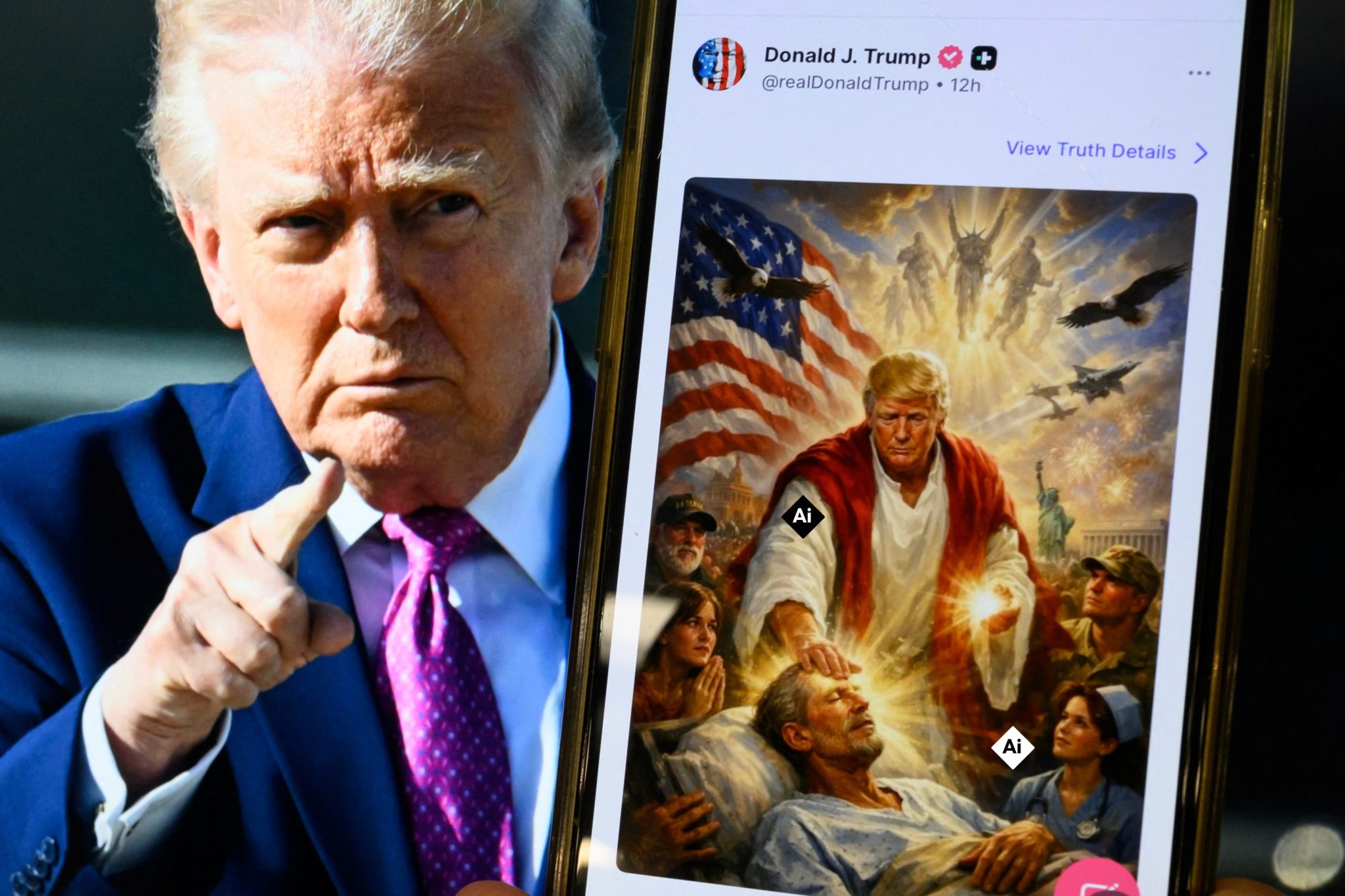
Social media has of course played a huge role in how Trump, and those in his administration, have interacted with the Vatican. Trump posted an AI-generated picture of himself in white robes, one hand on a sick man’s forehead, surrounded by flags, fighter jets, bald eagles, and the Lincoln Memorial. He later said it was supposed to show him as a doctor. Faggioli pointed to a similar incident last year before Pope Leo XIV was chosen. “There’s a history of Donald Trump posting pictures in moments when he was interacting with the Vatican. Just before the Conclave last year, he posted himself sitting in the papal chair. That was not a joke. He was saying: I am the pope of American Catholics. Donald Trump is very smart. This is not accidental.”
Growing anti-Trump sentiment among American bishops
U.S. bishops are rallying around Leo in ways they never did around Francis. “Many bishops, even conservatives who were indifferent toward Trumpism, have realized how dangerous Trump is for the church,” Faggioli says. “Many of them have seen their parishes where immigrant Catholics go empty or half-empty. They’ve realized that this administration is bad for the church.”
White says this is particularly troubling for a nation that long expressed the importance of the right to religion. “This country and even this administration has long touted that the first freedom is religious freedom. I think you could characterize the President’s attempts to undermine the Pope’s ability to speak and preach freely as a real threat to religious freedom.”
More people like the Pope than the President
A March NBC poll found 42% of U.S. voters viewed Pope Leo favorably, with only 8% viewing him negatively. Trump: 41% positive, 53% negative. A YouGov poll found 48% of Americans sided with Leo on Iran, versus 28% with Trump and Vance. Among independents: 50% Leo, 15% Trump.
“The President’s actions toward the Pope are certainly unprecedented,” White ended. “Yet even though it’s unprecedented, it is not entirely unsurprising, given the President’s volatile and often erratic style of operating.”