
NEWS ANALYSIS
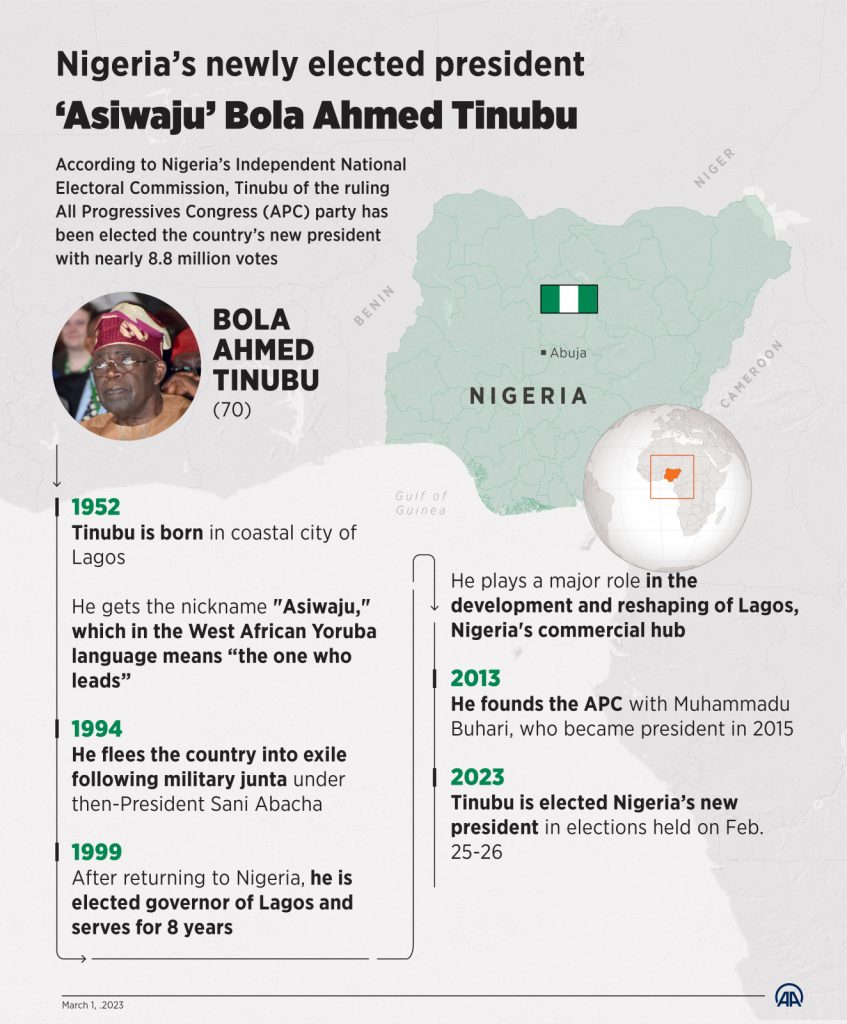
In the early hours of Wednesday, the candidate of the governing party of Nigeria, Bola Tinubu, was announced as the winner of the presidential election held over the weekend, despite many accusations of intimidation, pockets of violence and direct manipulation of the results in parts of the country.
Tinubu, the godfather of Lagos politics, abided by the provisions of the state election law which says a candidate can win by getting more votes than his rival, if he gets 25% of the votes in at least two-thirds of the 36 states and the federal capital Abuja.
Tinubu, of the All Progressives Congress (APC), polled 8.79 million votes, ahead of the main opposition candidate Atiku Abubakar, of the Peoples Democratic Party (PDP), who got 6.98 million voters, and 6.1 million votes for Peter’s Labor Party Obi.
Tinubu will take over the leadership of a country plagued by insurgency in the northeast, assassinations and kidnappings, a cocktail of tanking economy, inflation, unemployment and perennial corruption.
“Actually, no one is an angel of change,” said Lawal Jamiu. “But among the three leaders, it is his own candidacy that looks more promising.”
But the opposition called for the election to be canceled hours before the announcement, vowing to contest the results. He also said that fresh polls should be conducted under new election leaders.
“The results announced at the national collation center have been heavily doctored and manipulated and do not reflect the wishes of Nigerians expressed in the polls,” the party said in a joint statement.
Tinubu asked Nigerians to vote for him based on his track record as governor of Lagos State from 1999 to 2007, when he tried to rapidly modernize the economy of Lagos. But there are concerns about his health, he appears weak, often, in public, with slurred speech and giving unclear responses to questions.
His rivals, especially Obi, have gained the support of many young people who are disillusioned with the corrupt political practices of the past, perpetrated by the APC and the PDP, the two main parties that have been in power for a long time. the end of the military government in 1999. They said they presented a flicker of hope in a country steeped in years of economic and security crisis.
International analysts and observers, including the country’s civil society coalition, also said the election fell short of expectations and was “marred by very poor organization, severe logistical and operational failures, a significant lack of election transparency, significant disruption of the vote . and some violent incidents”.
The Independent National Electoral Commission (INEC) had made a commitment to publish the results of each polling unit on its website, but most of the units were unable to do so immediately due to technical problems.
The results had to be collected manually as in previous elections, which the observer mission also said “undermined the confidence of citizens at a crucial time in the process”.
The spokesperson of the Nigerian electoral body, Rotimi Oyekanmi, blamed the call for the resignation of the electoral body chairman. He defended the process as “free, fair and credible”, rejecting calls for a replay. Oyekanmi said in a statement that any concerns should be addressed in court.
Leena Hoffmann, associate fellow at Chatham House, said the electoral body’s failure to deliver results digitally as promised and its inability to sensitize the public before the election will reduce the credibility of the results.
Many young people are disappointed with the election results. He said it was not a reflection of the people’s choice.
“We have never had young people participating in politics like before. People wait until the night to count their votes, after spending the whole day in queues. Not letting the vote count give way to worry,” said Chijioke Arinze, 28. “It’s not like the winner .And this tells how the people feel about the election results.
He is worried that the result will affect the participation of young people in future elections, “Before now, young people have lost hope in the electoral process. But when the Electoral Act is passed, our hope is new. And we feel that our voice will start .But with what we see, the electoral process is no longer credible in Nigeria.
Arinze is not alone.
Gbenga Sadik, 26, grew up in a politically conscious family in Lagos, and has always been interested in politics. But he was an outlier among his peers – generally disinterested in the political process.
However, he said, in the last two years, many of his colleagues now have a strong interest in politics, especially because they have a candidate they can identify with, and “a lot of confidence in the new electoral process that INEC has promised”.
“But what happened was that INEC did not keep its promises and the people’s votes were not counted,” Sadik said. “I fear that they are effectively killing the growing political participation among young people, and replanting the hopelessness that made generations before us consistently vote for bad leaders.”
Theophilus Alawonde, 22, was filled with hope when the electoral body promised to send election results electronically. It’s a beacon that every young person who doesn’t really believe in the electoral process can turn to. “First of all, I think we will have a transparent election when INEC said it will upload the results immediately, and we can go back home and follow the results in real time when they are uploaded. All that adds to our hope, especially me, when I come out to choose.
Alawonde’s hopes, like many others, were dashed when the results were finally collected manually. “To see all those promises disappear is a big blow. And it will be difficult to convince some of us.
Olasupo Abideen, director of the Brain Builders Youth Development Initiative, said: “If there is anything to be taken away from this election, it is the fact that young people are making their voices heard. More and more young people are not only voting, but also staying in their units until midnight to ensure that their votes are counted. This shows a paradigm shift from the past. It is encouraging. Now they know they have the numbers and can decide and determine the outcome of our elections.
Hoffmann added: “What this means is that we will have a young population that will aggressively learn the political processes, structures and networks needed to address their grievances.”