
The Chinese and US flags are seen near the TikTok logo in this illustrative image taken on July 16, 2020.
Florence Lo | Reuters
BEIJING – China has said it will “strongly oppose” the forced sale of TikTok, underscoring the government’s involvement with the social media giant as it tries to distance itself from Beijing’s authorities.
The Commerce Ministry said Thursday that the sale or spin-off of TikTok from its Beijing-based parent, ByteDance, is subject to China’s law on technology exports – which requires a license to export certain technologies based on national security concerns. ByteDance also owns Douyin, the Chinese version of TikTok that is popular in the country.
“The Chinese government will make a decision in accordance with the law,” spokesman Shu Jueting said in Chinese, translated by CNBC.
Shu spoke at the ministry’s weekly press conference, a few hours before TikTok CEO Shou Zi Chew testified before a committee of the US House of Representatives.
Lawmakers questioned Chew for more than five hours, and wanted clarity on TikTok’s ability to operate independently of Chinese influence on its parent.
ByteDance did not immediately respond to a request for comment on China’s Commerce Ministry comments.
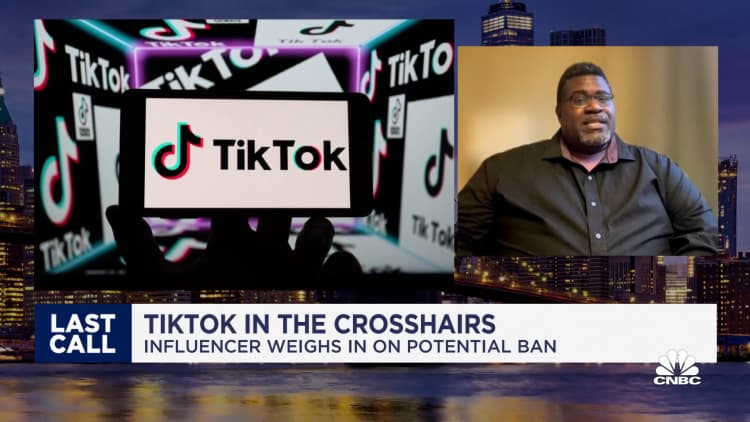
The question did not escape US lawmakers.
“At the end of the day, it is clear from the testimony that Mr. Chew reports to the CEO of ByteDance. ByteDance controls TikTok,” Cameron Kelly, visiting fellow at the Brookings Institution, told CNBC’s “Squawk Box Asia” on Friday. Kelly previously served as general counsel at the US Department of Commerce from 2009 to 2013.
Kelly said evidence that ByteDance has legal control over TikTok has raised doubts among US lawmakers about how the app can demonstrate its independence through restructuring.
TikTok has a “Project Texas” plan to store American users’ data on US soil – in an attempt to counter the company’s claims that mainland Chinese authorities do not have access to them.
Beijing … is now the second Congress and Administration to ‘make my day.’
Daniel Russel
Asian Society Policy Institute
“I don’t think it’s a complete ban or divestment [of TikTok] required. But I think you have to separate that legal control,” Kelly said, noting that could be done through a trust structure.
But the commerce ministry’s statement on the sale or spinoff of TikTok suggests Beijing wants to get involved.
“The Chinese government’s public statement that it will block the sale of TikTok in the US has nothing to do with the protection of China’s algorithms and technology and has a lot to do with giving Washington a taste of its own medicine,” said Daniel Russel, vice president for international security and diplomacy, Asia Society Policy Institute. said in a statement.
“Beijing, have heard [U.S. Commerce] Secretary Raymond lamented that banning TikTok would anger voters under the age of 35, now it’s the second Congress and Administration to ‘make my day,'” Russel said.
The US has increased restrictions on the ability of American businesses and individuals to work with Chinese businesses on technologies critical to high-end semiconductors.
When asked about the commerce ministry’s comments Thursday, TikTok’s CEO said the app is not available in mainland China and is based in Los Angeles. But he said the company is using some of the expertise of Chinese ByteDance employees on “engineering projects.”
Chew also told US lawmakers that China-based employees of ByteDance’s parent company may have access to some US data, but that the new data will stop when the company finalizes its Project Texas plans.
Chinese official comments have previously emphasized that China-based companies must comply with local laws and regulations when operating overseas.
It was not immediately clear how China’s export control law, which took effect in December 2020, might apply to TikTok.
Different types of exports are managed by different government organizations, “each with a separate regulatory system,” the EU Chamber of Commerce in China said in its latest position paper. It calls for more clarity on the roles of different bodies involved in enforcing export control laws.
What’s next for TikTok?
The US and China are increasingly invoking national security as a reason to control technology.
“To be fair, there are indeed national security risks involved [TikTok] – and this is one of the reasons why banning applications from government phones and military phones makes sense,” said Glenn Gerstell, senior adviser at the Center for Strategic and International Studies on CNBC’s “Street Signs Asia” Friday. Gerstell is the general counsel of the National Security Agency since 2015 to 2020.
“As a general public, I don’t see the strategic value in China knowing what the youth dance movement is in Minneapolis. So a general ban does not make sense to me,” he said.
TikTok has more than 150 million users in the US – or about half of the country’s population.
It’s unclear whether the US will eventually force ByteDance to sell TikTok or ban the app’s use in the country. A very popular app has been banned from federal government devices.
“We see a period of 3-6 months ahead for ByteDance and TikTok to be able to sell to US technology players with low spin-offs and very complex to pull off,” said Dan Ives, analyst at Wedbush Securities, in a note.
“If ByteDance fights this forced sale, TikTok will likely be banned in the US by the end of 2023.”
– CNBC’s Lauren Feiner contributed to this report.