
The documentation for Shibarium, the layer-2 technology of Shiba Inu, published by the developers two days ago, shows more details about how it works. Among other things, the document describes how Shibarium Proof-of-Stake and Shibarium Ethereum Bridge are related.
While Shibarium’s Proof of Stake (PoS) chain uses side chains to process transactions, the bridge enables a bidirectional transaction environment between Shibarium and Ethereum. Additionally, the document reveals that the PoS algorithm requires users to token BONE.
Why yes, you are right. ✅$BONE 🍖 it’s gas for #SHIBARIUM. 😉 pic.twitter.com/r0UuVyoITq
— Shib Dream * Shiba Inu News * Shib Army Social 💎 (@theshibdream) March 26, 2023
Furthermore, the platform’s blockchain technology allows users to create programmable tokens and smart contracts that are used in various applications such as initial coin offerings (ICOs) fungible tokens and non-fungible tokens (NFTs). Transaction fees are expected to be less than $0.01.
SHIB Influencer Lucie pointed out other key takeaways from the documentation in several tweets. One important cornerstone Shibarium Staking Manager.
As Lucie writeProof-of-security consensus is ensured by Shibarium performing all proof-of-concept and deployment verification operations on Ethereum smart contracts, leaving computationally intensive tasks to layer-2.
Stakeholders can take on the role of validator, delegate, or observer for fraud reporting. This is where the Stake Manager comes in, which is the main contract for validation-related activities such as managing bets, distributing rewards and verifying signatures.
“Only one role, validator or delegator, can be assigned to a single Ethereum address as a design choice. Using NFT ID as a source of ownership ensures that changes in ownership and signature will not affect the system,” said Lucie.
An important insight from the documentation is also related to the combustion mechanism. When the user makes a transaction, a fee is charged which is divided into two parts: the basic fee (70%) and the priority fee (30%). The latter is paid to the validator, while the base fee is burned.
“After the amount of BONE ($25,000) is collected in the burn contract, the user can start the burning process from Shibarium. After this process starts, the accumulated BONE is sent to Ethereum L1, where the automatic swap for SHIB is performed, and the amount will be burned by calling the function of the contract ,” said Lucie.
Shiba Inu All-In One Wallet For Shibarium
Unification, the developer of Shibarium, also announced an all-in-one wallet for layer-2 technology and Shiba Inu. The wallet will enable two-way asset transfer between the first and second layers, staking/delegating, and will include Shibaswap integration.
The project has also been highlighted in the Shibarium documentation and further publicized by Ringoshi Toitsu, the operator of the pseudonymous Unification Validator.
#Unification has built a revolutionary new ‘Shibarium POS Chain’ exclusively for $SHIBas explained in #Shibarium documentation.
This game-changing innovation offers seamless wallet application, two-way asset transfer between L1 & L2, staking/delegation, & #Shibaswap integration. pic.twitter.com/yUhdHgucJW
—Ringoshi Toitsu (@RingoshiToitsu) March 26, 2023
At press time, Shiba Inu is trading at $0.00001051, continuing a downward trend that has been consistent since early February 2023.
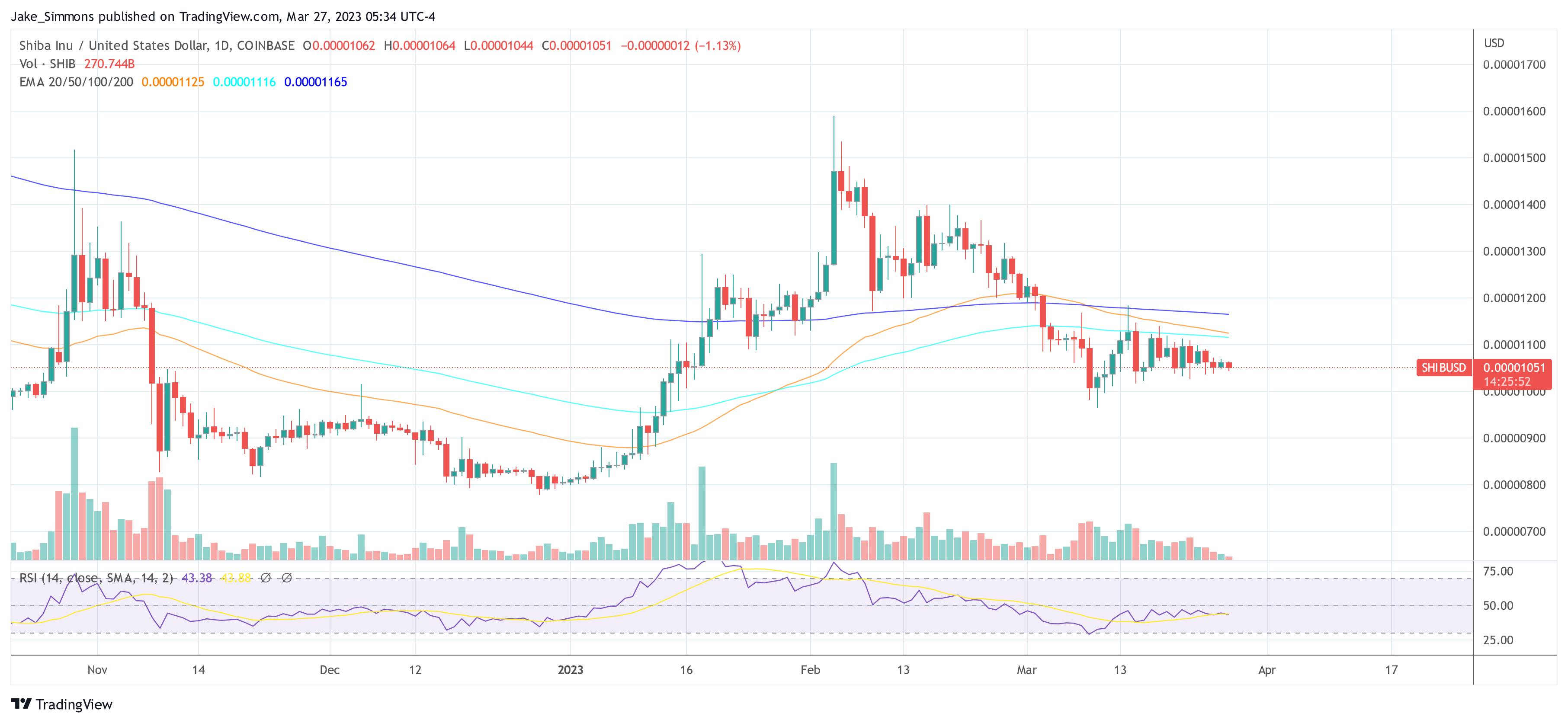
Featured images from Analytics Insight, charts from TradingView.com