
The Big Flip thesis has gained traction in the financial world and reflects the market’s misplaced confidence in the path of inflation and policy rates.
The article below is a free full piecefrom the new edition of Bitcoin Magazine PRO, Bitcoin Magazine’s premium market newsletter. To be the first to receive this insight and other on-chain bitcoin market analysis straight to your inbox, subscribe now.
The Big Flip
In this article, we break down the macro thesis that is gaining traction in the financial world. “Big Flip” was first introduced by a pseudonymous macro trader INArteCarloDossand based on the market’s misplaced belief in the path of inflation and subsequently the path of policy rates.
The link to the tweet is attached.
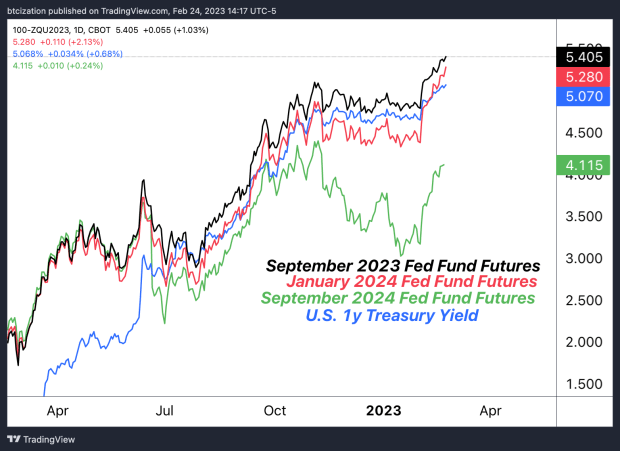
To simplify the thesis, the Big Flip is built on the assumption that the recession that will occur in 2023 is wrong. Although the rate market has priced in the belief that a recession is coming, the timeline of flips and recessions can take much longer. In particular, this change in market expectations can be seen through Fed funds futures and short-end rates on US Treasuries.
In the second half of 2022, as the market consensus turns from expecting stable inflation to disinflation and a final economic contraction in 2023, the rate market begins to price in multiple rate cuts by the Federal Reserve, which is a tailwind for equities due to this expectation of a lower discount rate .
In “No Policy Pivot In Sight: “Further Levels” On The Horizon,” we wrote:
“In our view, until there is a meaningful deceleration in the 1-month and 3-month annualized readings for the measures in the sticky bucket, the Fed’s policy will remain quite restrictive – and may even tighten further.”
“While it is not in the interest of passive market participants to dramatically alter portfolio asset allocations based on the Fed Chair’s tone or expression, we believe that ‘higher for longer’ is the tone the Fed will continue to communicate with the market.”
“In this regard, it is possible that those trying to aggressively execute a policy pivot may be caught offside, at least temporarily.
“We believe that a further upward adjustment of rate expectations is possible in 2023, as inflation continues to persist. This scenario will result in continued rate ratcheting, sending risk asset prices lower to reflect higher discount rates.
Since the release of the article on January 31, Fed futures for January 2024 have increased by 82 basis points (+0.82%), removing the three full interest rate cuts that the market expected in 2023, with a recent Fed spokesperson stating the stance “higher for more long”.
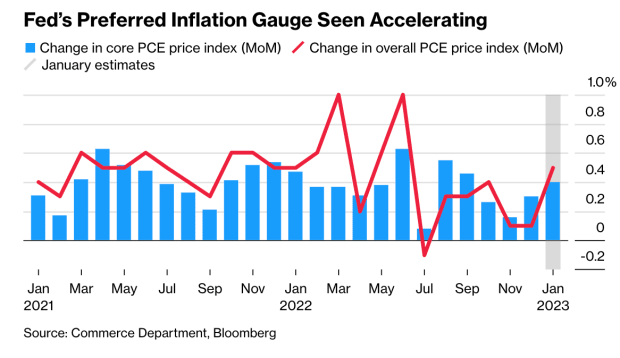
As we draft this article, the Big Flip thesis continues to play out. On February 24, the core PCE price index was higher than expected.
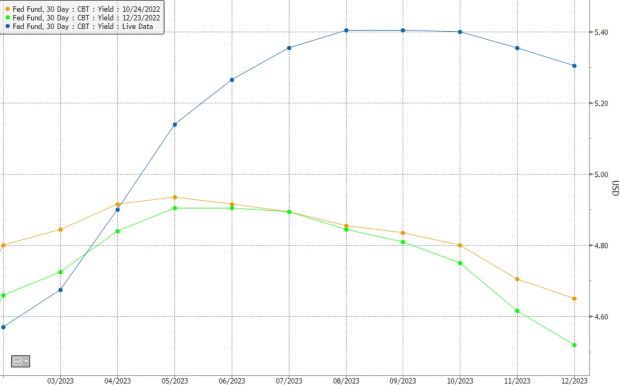
Shown below is the expected path for the Fed funds rate during October, December and now.
Although CPI readings are disinflationary on a year-on-year basis for the second half of 2022, the nature of this inflationary market regime is something that market participants have never experienced before. This may lead to the belief of “transitory” pressures, when in fact, inflation appears to be due to structural deficiencies in the labor market, not to mention the financial situation that has weakened significantly since October. The deterioration of financial conditions increases the propensity of consumers to continue spending, adding to the inflationary pressures that the Fed is trying to squash.
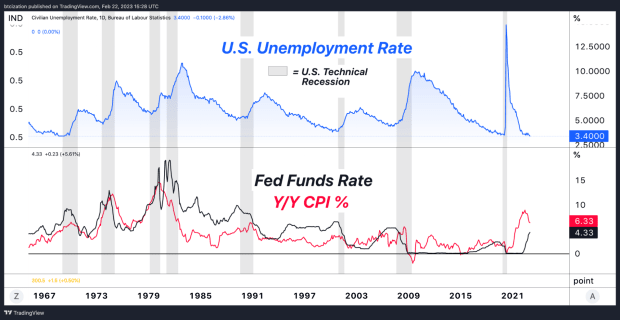
With the official unemployment rate in the United States below 53 years, structural inflation in the workplace will remain until there is sufficient slack in the labor market, which will require the Fed to continue to tighten its belt in an effort to suppress inflation that appears to be increasing.
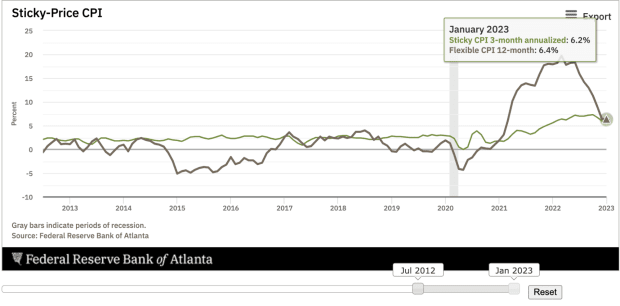
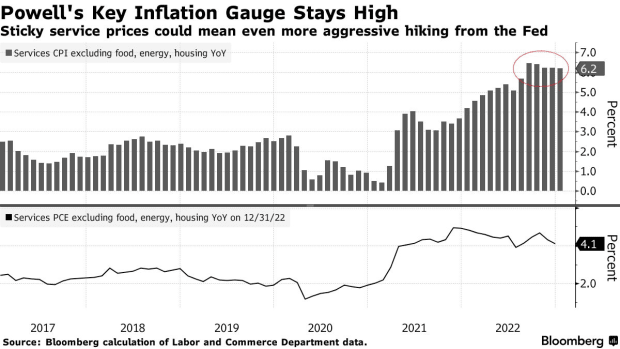
While the flexible component of the consumer price index has declined aggressively since its peak in 2022, the sticky inflation component – with a special focus on wages in the service sector – continues to remain high, prompting the Fed to continue its mission to suck air out of the figurative chambers of the US economy.
Sticky CPI measures inflation in goods and services where prices tend to change more slowly. This means that if prices rise, they are less likely to be and less sensitive to the pressures that come from tighter monetary policy. With Sticky CPI still reading 6.2% on a three-month annualized basis, there is ample evidence that a “longer” policy stance is needed for the Fed. This looks exactly what it’s worth.
Published on February 18th, Bloomberg reaffirmed the stance of disinflation returning to reacceleration in the article “Fed’s Preferred Inflation Gauge Appears to be Running Hot.”
“It’s surprising that the year-on-year decline in inflation has stopped, due to base effects and a good supply environment. That means it won’t take much for a new inflation peak to emerge. – Bloomberg Economics
This comes at a time when consumers still have about $1.3 trillion in excess savings for fuel consumption.
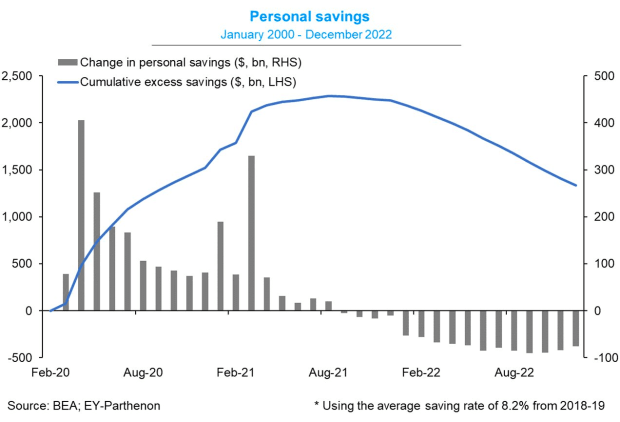
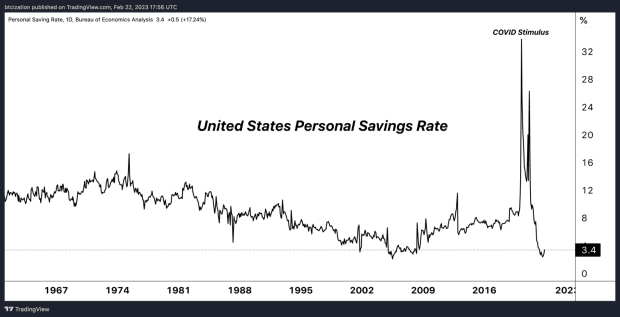
While savings rates are very low and aggregate savings for households is declining, the evidence suggests that there are plenty of buffers to keep the economy warm in nominal terms for the time being, resulting in inflationary pressures while monetary policy lags in effect. filtering through the economy.
It is also important to remember that there are parts of the economy that are less rate sensitive. While the financial world – Wall Street, Venture Capital firms, Tech companies, etc. – depends on zero interest rate policy, there is another part of the US economy that is not sensitive to rates: that depends on social benefits.
Those who depend on federal outlays play a large part in driving the nominal economic heat, as the cost-of-living adjustment (COLA) has been fully implemented in January, sending a nominal 8.3% increase in purchasing power to recipients.
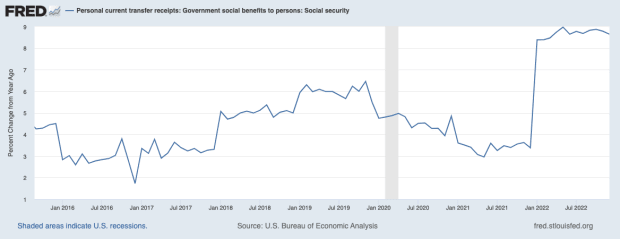
Social security recipients do not actually have much increased purchasing power. The psychology of nominal increases in outlays is strong, especially for generations not used to inflationary pressures. The extra money in social security checks will continue to fuel nominal economic momentum.
PCE Core Comes In Hot
In core PCE data from February 24, the month-on-month reading was the biggest change in the index since March 2022, breaking the disinflationary trend observed in the second half of the year that was a temporary tailwind for risk assets and bonds.
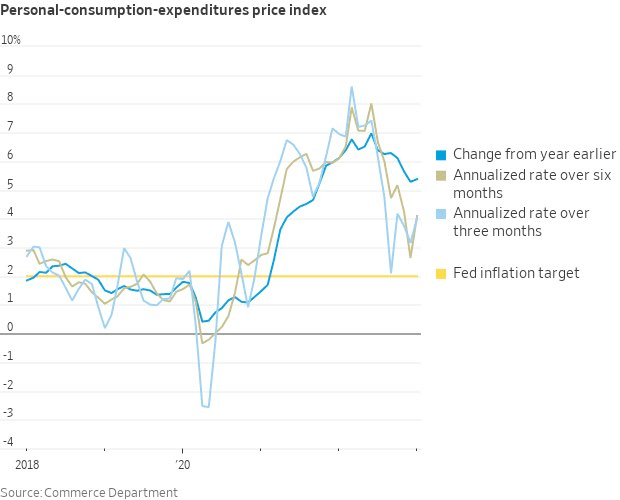
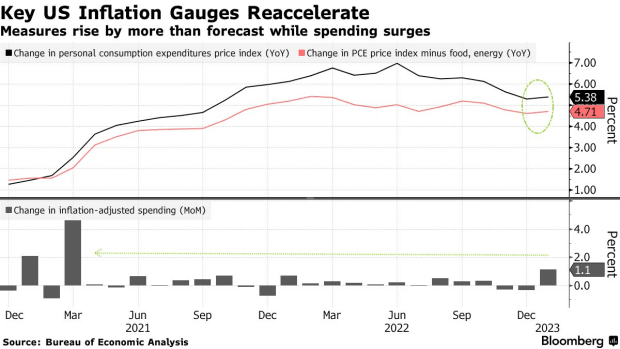
The hot core PCE print is particularly important for the Fed, as the core PCE is particularly lacking in data variability compared to the CPI, as it excludes energy and food prices. While one may question the viability of measuring inflation without energy or food, an important point to note is that the volatile nature of commodities from these categories can distort trends with higher levels of volatility. The real concern for Jerome Powell and the Fed is the wage-price spiral, where higher prices beget higher prices, entering the psychology of businesses and workers in a vicious feedback loop.
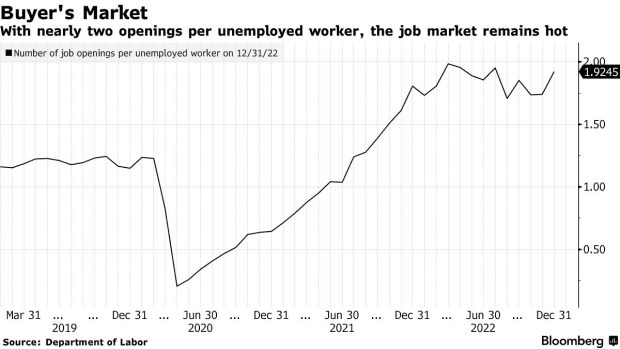
“That’s the concern for Powell and his colleagues, sitting some 600 miles away in Washington, trying to decide how high to raise interest rates to reduce inflation. What Farley is describing is almost uncomfortably close to what is known in economic terms as a price-wage spiral – exactly what the Fed is calling for, at any cost. —- “Jerome Powell’s Worst Fears Come True in Southern Job Market”
The Fed’s next meeting is on March 21st and 22nd, where the market sees a 73.0% chance of a 25 bps rate hike at the time of writing, with the remaining 27% leaning towards a 50 bps hike in the policy rate.
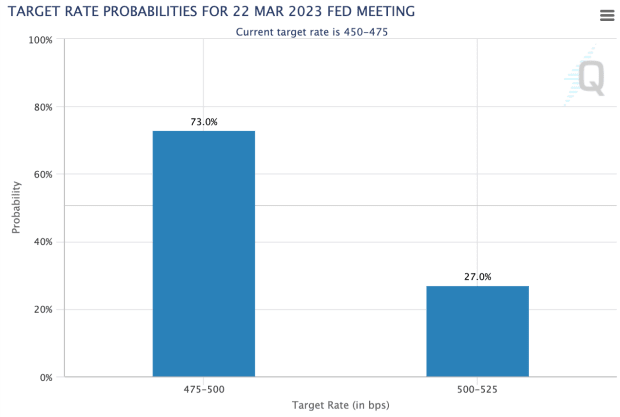
The rising momentum for higher terminal rates should give market participants some pause, as equity market valuations increasingly appear to be decoupled from discounts in the rate market.
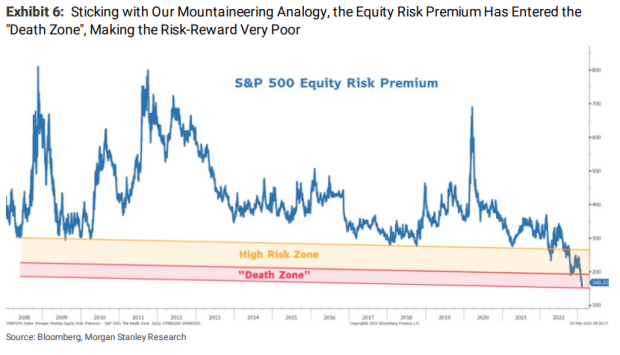
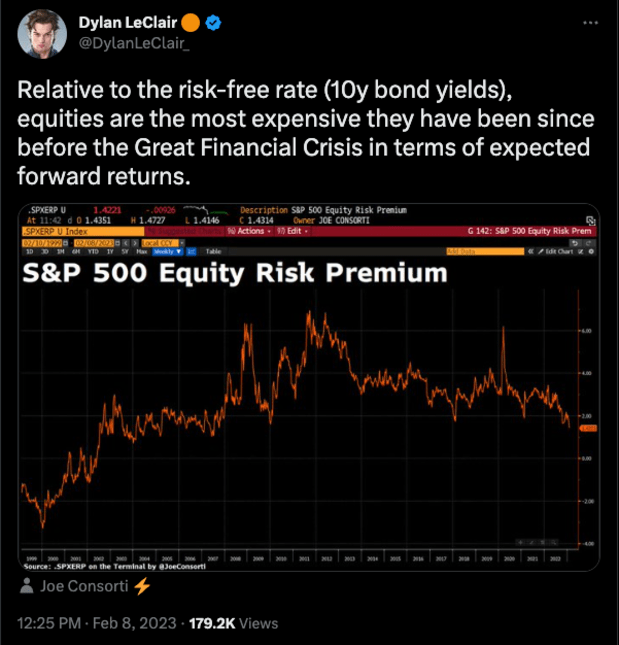
Morgan Stanley’s chief strategist recently expressed this concern to Bloomberg, citing the equity risk premium, a measure of the differential expected return provided in the risk-free bond market (in nominal terms) relative to the expected return on the equity market.
“This is not a good sign for stocks because this year’s sharp rally has been the most expensive since 2007 by a measure of the equity risk premium, which has entered a level known as the ‘death zone,'” strategists said.
“The risk reward for equities is now ‘very poor,’ especially since the Fed will not end monetary tightening, rates remain higher on the curve and earnings expectations are still 10% to 20% too high,” Wilson wrote in a note.
“‘It’s time to return to the base camp before the next guide down in earnings,’ said the strategy – ranked No. 1 in the survey of Institutional Investors last year when it correctly predicted a selloff in stocks.” – Bloomberg, Morgan Stanley Says S&P 500 Could Fall 26% in Month
Final note:
Inflation is firmly entrenched in the U.S. economy and The Fed has decided to raise rates as high as necessary to sufficiently reduce structural inflationary pressures, which will likely require depressing the labor and stock markets in the process.
The hope of a soft landing that many advanced investors at the beginning of the year seems to be dissipating with “higher for more” as the main message sent by the market in the new days and weeks.
Although almost 20% below the peak, shares are now more expensive than at the peak of 2021 and the beginning of 2022, compared to the rates offered in the Treasury market.
The inversion of equities that are priced relative to Treasuries is a prime example of the Big Flip in action.
Enjoy this content? Subscribe now to receive PRO articles directly in your inbox.

Relevant past articles:
- No Policy Pivot: “More High” Rates on the Horizon
- Decoupling Denial: Risk-On Bitcoin Correlates
- A Tale of Tail Risks: The Fiat Prisoner’s Dilemma
- A Rising Tide Lifts All Boats: Bitcoin, A Live Risk Asset With Increased Global Liquidity
- On-Chain Data Shows ‘Potential Downside’ For Bitcoin But Macro Headwinds Remain
- Sunday PRO Market Lock: 2/20/2023