
NEWS ANALYSIS
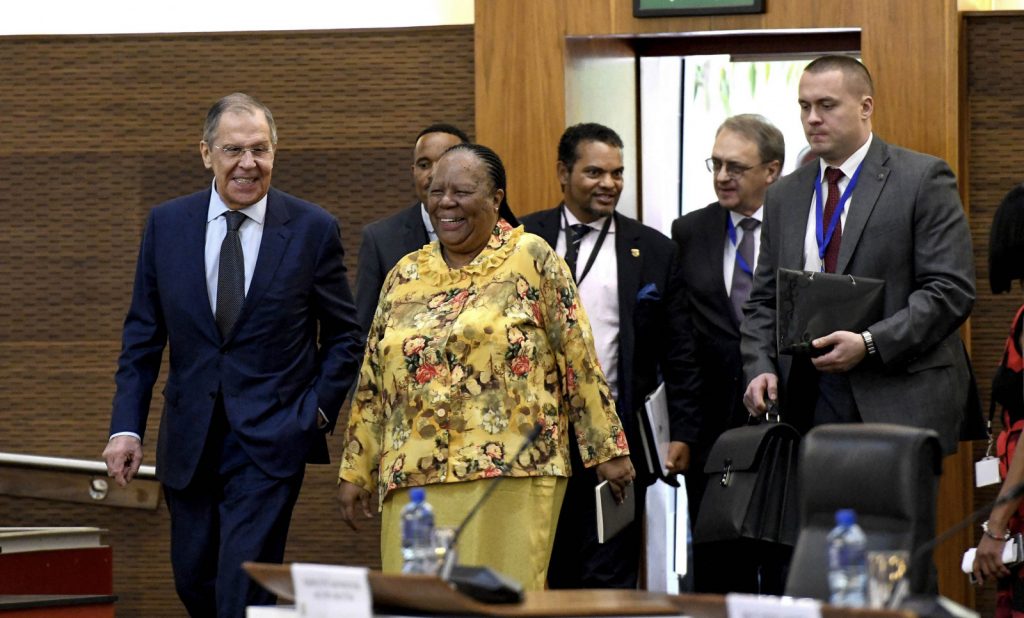
When Russian Foreign Minister Sergei Lavrov visited South Africa, eSwatini, Angola and Eritrea last week, he discussed the historical ties between Russia and the African continent.
The Soviet Union – the superpower that President Vladimir Putin looks set to revive – played an active role in supporting liberation movements in this part of the world.
Therefore, the door here will always be open to representatives of Moscow. Western diplomats who take exception to this, laying claim to some moral high ground, seem to have short memories.
But for all the fun and photo ops – perhaps Naledi Pandor, the foreign minister of South Africa and who initially condemned the Russian invasion of Ukraine, should not be too effusive in his welcome – the hard truth for Russia is that. struggling to find useful African allies.
Eritrea and eSwatini are small, isolated regimes with little diplomatic influence. In the bigger picture, that support makes no sense. Angola is wealthier and politically more important, but it still lacks weight on the international stage.
Say, Botswana, which was originally on the foreign minister’s schedule, was canceled at the last minute without explanation.
South Africa is a great gift. It is the second richest economy on the continent, and the most influential in the diplomatic arena as a member of the G20 group of countries and the Brics alliance (which also includes Brazil, Russia, India and China).
The exercises planned for mid-February between the navies of South Africa, Russia and China are an undoubted propaganda coup for the Russian regime, and will be carried out as a show of support for Moscow’s illegal invasion of Ukraine.
However, South Africa’s relationship with Western countries is stronger.
Economically, there is no comparison. South Africa’s trade with Russia will be over $1 billion in 2021, compared to $21 billion with the United States. Militarily, South Africa’s armed forces regularly conduct large-scale exercises with the US and EU member states (such as Operation Shared Accord in July last year, where 700 South African and American soldiers were trained together “to improve bilateral military interoperability”).
Diplomatically, there is extensive cooperation between Pretoria, Brussels and Washington DC. Just four months ago, President Cyril Ramaphosa was in Washington to meet with his American counterpart. The pair forged a fast relationship just as Joe Biden abandoned a planned program to give Ramaphosa a private tour of the West Wing.
This is in stark contrast to Ramaphosa’s last meeting with Putin in 2019, at the Russia-Africa summit in Sochi, where Putin bullied him into signing a multibillion-dollar deal for a nuclear plant to be built by Russia’s state-owned energy company, Rosatom. .
The proposed deal, first forged in secret by Ramaphosa’s predecessor, Jacob Zuma, has been mired in corruption allegations, and Ramaphosa was absent from Sochi. Appearing slightly irritated, he told South African reporters: “We have met several times and every time the nuclear issue came up. I said we will not start a nuclear power project that we cannot do.
So for all the talk of historical ties, Russia is currently unable to get what it wants from South Africa. That is why, despite public statements of concern, Western diplomats are not worried about where South Africa’s loyalties lie.
“We think working with the Russian navy is not the best look for a country that is trying to say it is neutral,” a US state department official said. “But we also understand politics.”
Without much economic or diplomatic influence, Moscow’s only play was in the military sphere, mainly through the activities of Wagner’s mercenary group.
Wagner is active in the Central African Republic, Mali and Sudan, but his military footprint in Africa is tiny compared to the US, which maintains a network of secret military bases in about half of Africa’s countries.
A 2020 investigation by The Continent found that on any given day there were around 6,000 American troops operating from at least 27 military posts in Africa – and that was the only one that could be verified.
Far from underscoring the strength of Russia’s ties to Africa, Lavrov’s whistle-stop African tour only highlights how fragile his influence on the continent is. Ironically, the emphasis on the Soviet Union’s relationship with Africa – which was deeper and more important – only served to emphasize this fragility.
This article first appeared on Continenta pan-African weekly newspaper produced in partnership with Mail & Guardians. It is designed to be read and shared on WhatsApp. Download your free copy here