
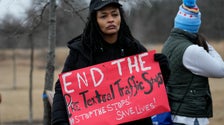
Three racial justice leaders have joined together to call on members of local, state and federal governments to address a common problem: small traffic stops that can escalate and cause civilian harm or even death.
Two months after Tire Nichols died after being arrested by a Memphis police officer in a traffic stop, city council members passed new police reform legislation that would change how city police conduct traffic stops and ban unmarked vehicles from participating in pull overs.
Nicholas Turner, director and president of the Vera Institute of Justice, told HuffPost that police departments nationwide could change the way they deal with traffic “that has nothing to do with public safety.”
Turner, along with Rashad Robinson, president of Color of Change, and Patrick Gaspard, president and CEO of the Center for American Progress, published opinion on CNN this week details why this change is needed.
Police make about 20 million traffic stops a year, mostly for problems such as broken taillights, and black drivers are disproportionately pulled over, he said. In addition to saying that individual police departments need to make changes, the authors called on the U.S. Department of Transportation, which provides funding for highway safety programs, to address the issue.
“Transportation Secretary Pete Buttigieg should direct his department to allocate safety grants to areas that limit low-level traffic and rely on other means of traffic enforcement than the police, including civil traffic professionals that can solve the problem of road safety without the intimidation – and possible danger – of badges and guns,” he wrote.
“We have seen the article and the Department is taking this matter very seriously,” a Department of Transportation spokesperson told HuffPost. “We will continue to work to ensure traffic safety programs, including creating grants, maintaining safety and equality.”
Traffic stops are inefficient in dealing with crime and ultimately lead to increased investigations and civilian harassment, Turner said.
This is proven in the case Derrick Kittling, an unarmed black man in Alexandria, Louisiana, was pulled over for having tinted windows in November. An officer deployed a Taser on Kittling and, after a brief struggle, shot him in the head.
Turner said officers don’t often find evidence of the violent crimes they claim to prevent.
A 2018 study in Nashville in non-moving traffic violations found that less than one-tenth of 1% (0.8 out of every 1,000) resulted in the police charging someone with possession of a weapon. Another analysis of the Vera Institute of Justice found similar results with low-level stops in Suffolk County, Massachusetts.
In addition, Washington, DC, police recover guns in 1% of traffic and pedestrian stops combined in 2020. In the previous year, there was a 0.6% recovery rate in all such stops.
“We know that when rates stop, they’re not efficient,” Turner said. “They undermine any effort to produce public safety. This is a poor deployment of resources.