
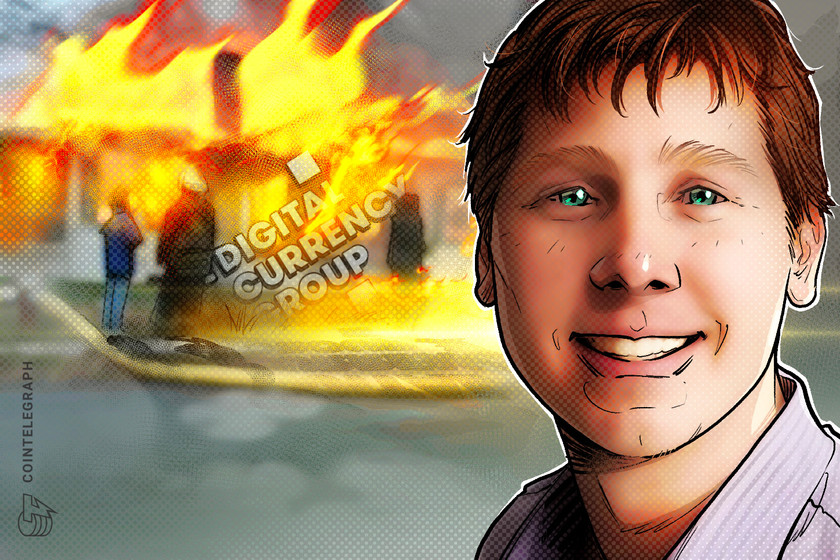
It looks like the bear cycle will claim another high profile crypto company. On January 19, Digital Currency Group’s (DCG) lending subsidiary, Genesis, filed for Chapter 11 bankruptcy. Here we have another industry giant with stories of incest lending, poor risk management and unclear reporting policies.
For market participants, the storm clouds gathering at DCG represent an unthinkable failure in 2021. Founded by CEO Barry Silbert in 2015, DCG has been a mainstay in crypto’s short existence. Genesis’ filing revealed the full extent of its creditors affected by its implosion, which notably includes Gemini, a crypto exchange created by the Winklevoss twins Cameron and Tyler, for which Genesis says it owes $765 million; metaverse project Decentraland ($55 million); and fund manager VanEck ($53 million).
The company lists more than 100,000 creditors in total and says it owes its 50 largest creditors $3.4 billion.
Super sketch that Barry’s credit desk owes Decentraland $55m when DCG and Grayscale $ WHERE investors.
Did they buy from the team and then get their money back? How does Decentraland still have $55m today?
— Adam Cochran (adamscochran.eth) (@adamscochran) January 20, 2023
Some loans inspired new questions, including, for example, whether Genesis held a loan from Decentraland while a separate DCG subsidiary – Grayscale – held 18 million project tokens. (The property was worth $11.74 million as of January 20, down from $105.8 million at its peak in November 2021.)
Genesis was first shaken by the fall of Three Arrows Capital (3AC), which lost more than $500 million in loans from Genesis. FTX’s decline proved too much for lenders, which led to the postponement of withdrawals. Genesis also signaled serious trouble this month when it laid off 30% of its staff.
related: Will Grayscale be the next FTX?
As the bear market progresses, more fundamental systems break down – systems like lending platforms, over-the-counter rails and exchanges. The failure of the system and the relationship between the companies that operate the system is a structural damage to the market, which is certainly important to note. However, it is a mechanical system that can be refactored and rebuilt. Trust is another story. Hard won and easily lost, trust is an elusive but critical force that simply must exist for any industry to thrive. And confidence in that market is at risk.
Contagion exposes hidden connections, shattering public trust
The rapid collapse of 3AC, Voyager, BlockFi, FTX and Celsius shocked the market. But then the connection between this group began to be known, and the shock turned to apoplectic anger. It is clear that while these companies claim to work in finance, few, if any, actually act as finance professionals, and certainly not as industry leaders as many assume – especially in risk management.
6/ Unless Barry and DCG come to their senses and make a fair offer to their creditors, we will immediately file a lawsuit against Barry and DCG.
— Cameron Winklevoss (@cameron) January 20, 2023
Bad policies became standard, with companies borrowing with little or no collateral from one partner to pay another, some even using their own “currency” as collateral. What is more the guarantee is accepted by the creditors. The market frenzy in 2020 and 2021 lays the foundation for bad behavior and bad business practices to thrive at scale. As the true extent of malpractice and poor decisions has become evident, trust in this company has been eroded.
Trust in the ecosystem will be difficult to restore
Asset prices may rise and fall, but most people assume that the underlying fundamentals of construction and market mechanics will remain the same. This has been the core issue in this bear market. As it turns out, manipulation, collusion and insider deals are the norm. And that behavior isn’t relegated to new companies – it seems most industry players are involved at some level or another. Such is the case with DCG. Bad loans, poor risk management and unclear financial statements will hit home.
related: Learn from FTX and stop investing in speculation
Crypto prices will eventually return, and new companies will enter the market. Let’s hope the industry’s collective memory lasts a little longer. A return to deep due diligence and standard skepticism is required. The heavy should be the company to earn trust through their actions. This seems obvious, but obviously we have forgotten.
We are left with an unfortunate reality. Trust must not only be rebuilt in the companies operating in the space, but also in the ecosystem that enables these companies.
Joseph Bradley is head of business development at Heirloom, a software-as-a-service startup. He started in the cryptocurrency industry in 2014 as an independent researcher before working at Gem (which was later acquired by Blockdaemon) and then moving into the hedge fund industry. He received his master’s degree from the University of Southern California with a focus on portfolio construction and alternative asset management.
This article is for general information purposes and is not intended and should not be construed as legal or investment advice. The views, thoughts and opinions expressed here are solely those of the author and do not necessarily reflect or represent the views and opinions of Cointelegraph.