
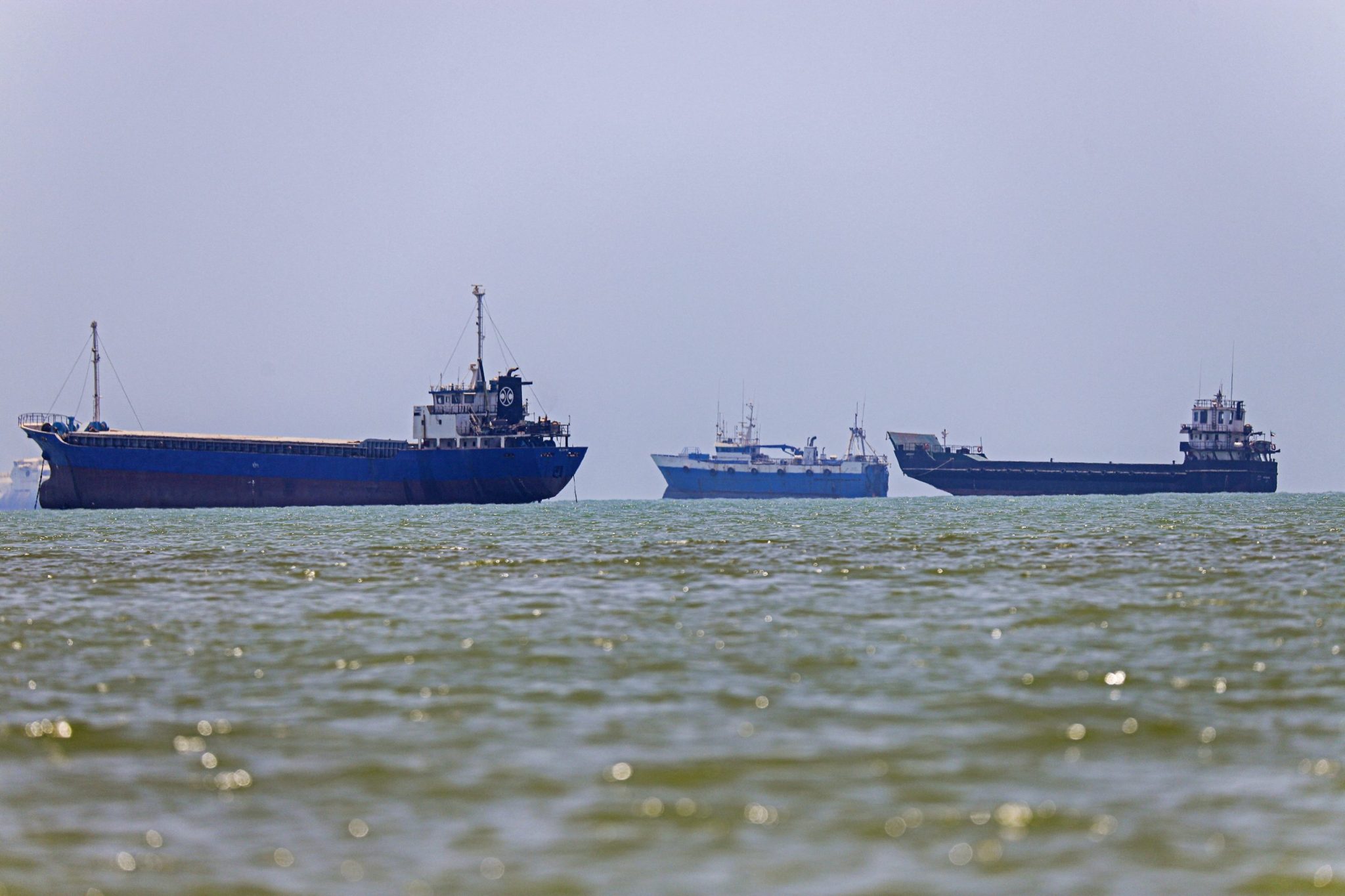
Millions of barrels of oil continued to flow through the Strait of Hormuz this weekend, even after Iran claimed to have closed the waterway again, as Washington and Tehran offer contrasting narratives over the status of the world’s most important shipping chokepoint.
Three laden oil supertankers, with a combined transport capacity of 6 million barrels, emitted signals as they were sailing through the channel on Saturday via a route that hugs Oman’s coast, ship-tracking shows. One of them subsequently resumed sending automated signals early on Sunday after it had reached the Gulf of Oman.
The Gulf Sunrise, hauling about 2 million barrels of Saudi crude to Japan is now crossing the Gulf of Oman, its automated tracking signals show, after vanishing from screens near the apex of the strait on Saturday. The Angola B, loaded with Emirati crude, was last seen rounding the tip of the Musandam peninsula, an Omani exclave that justs into Hormuz, on Saturday. The Monaco Loyalty was yet to reach the apex of the strait when it disappeared, also on Satuday.
An email to the ships’ manager wasn’t immediately returned.
If all three clear the waterway, their movements would support the US military’s assertion that it can successfully defend the southern route near Oman’s coast, despite Iran claiming it can control the waterway. A handful of vessels were also seen entering the Persian Gulf using the same route.
US Central Command said on Saturday that 17 million barrels had passed through Hormuz, despite the reports in Iran’s media that the strait was closed. A liaison between navies and shipping said early Saturday, before Iran said Hormuz was shut, that vessels could transit on the Omani side at any time of day while making their locations visible.
Iran and the US are jostling to control the narrative around Hormuz, with peace talks set to take place on Sunday as top officials including US Vice President JD Vance converge in Switzerland. Ensuring freedom of navigation in the strait is one of the US’s key priorities. Qatar said those talks were starting on Sunday.
The two adversaries are engaging after separate clashes in southern Lebanon between Israeli forces and Iran-backed Hezbollah fighters delayed the start of talks. They’re a few days into a 60-day window for negotiations after reaching a memorandum of understanding that President Donald Trump signed on Wednesday during a visit to Paris, though the deal allows for an extension.
Of the three tankers, one is delivering 2 million barrels of Saudi crude to Japan, the other two are hauling similar amounts of crude from the Untied Arab Emirates and Qatar. All cargoes are based on vessel tracking data compiled by Bloomberg and information from Kpler.
Despite saying Hormuz is shut, ships have also been also emitting signals near Iran’s coastline too.
The Desh Vibhor, Desh Vaibhav and Sanmar Herald were observed in the Gulf of Oman and the Arabian Sea on Sunday, after having been last seen signaling their attempt to cross the Strait of Hormuz late Friday, ship-tracking data compiled by Bloomberg show. They may have transited the strait before Iran announced it was closed again.
The supertankers, each signaling Indian ownership or India-bound cargo, carry between them about 6 million barrels of Iraqi and Kuwaiti oil. They all signaled near Iran’s Qeshm island, suggesting they took the Tehran-approved route.
Shipping Corporation of India, which is listed as the owner and manager of Desh Vibhor and Desh Vaibhav, on database Equasis, didn’t immediately respond to emails seeking comment outside of regular business hours. Neither did Sanmar Shipping Ltd., the operator of Sanmar Herald.
The very large crude carriers’ journeys are part of a growing tally of tankers that also embarked on crossings in either way through the energy chokepoint.
A handful empty tankers were also seen entering Persian Gulf along the Omani coast. One was a very large gas carrier that had traveled from Duqum on the Gulf of Oman.
The other two were crude supertankers that most recently delivered Emirati crude. One of the VLCCs openly signaled its location in one of the anchorages in the Gulf of Oman a few days ago. Some Gulf producers are known to dispatch tankers “dark” through Hormuz so that the cargoes can be transferred onto fresh vessels waiting in those waters without drawing attention to these shipments.
Liquefied natural gas carriers were also observed sailing into the Persian Gulf, with ship-tracking data suggesting they had done so late Friday.
The naval notice that ships could pass along the Omani side with their transponders on came from the Joint Military Information Center early on Saturday morning — before Iran’s reported Hormuz was shut.
“Mariners are advised that they may transit the southern route day or night with their AIS on, radars radiating, running lights on, and normal use of VHF,” the Joint Military Information Center said, referring to the automated identification system from transponders, and very high frequency radio communications.
The JMIC notice contrasted with the American advisory made a few days earlier that vessels should consider sailing along that route without broadcasting their transponder signals. JMIC’s advice also followed an alert by Pakistan late Friday that there was a confirmed mine spotted along the southern route. Pakistan has responsibility for coordinating navigational warnings in the area.