
[ad_1]
Data obtained from NASA’s Juno probe provides new information about lightning processes on Jupiter similar to those on Earth despite dramatic differences between the two planets, according to scientists.
Hidden beneath the brown ammonia clouds that cover Jupiter are clouds that, like on Earth, are made of water. And just like on Earth, lightning is often produced in these clouds – a terrifying sight that has been observed by various spacecraft, including Juno, which has visited the largest planet in our solar system.
Earth is a relatively small rocky world. Jupiter, named after the ancient Roman god of lightning, is a gas giant so big that all the other planets in our solar system could fit inside it – including more than 1,300 Earths.
Drawing on five years of high-resolution data obtained by the Juno radio receiver as the spacecraft orbited Jupiter, researchers discovered that the planet’s lightning initiation process pulsates with a rhythm similar to that observed in clouds on our planet. The pulses observed on Jupiter as lightning flashes start with a time separation of about milliseconds, similar to storms on Earth.

Lightning is the most powerful natural source of electricity on Earth.
“Lightning is an electrical discharge, which starts inside the cloud. Ice and water particles inside the cloud will be charged by collision and form a layer of charged particles of the same polarity,” said planetary scientist Ivana Kolmasova of the Czech Academy of Sciences. ‘ Institute of Atmospheric Physics in Prague, lead author of the study published this week in the journal Nature Communications.
“With this process, a large electric field is created and the discharge can start. This explanation is a bit simplified because scientists are still not sure what is happening inside the cloud.”
Lightning in the solar system
The existence of lightning on Jupiter was confirmed when radio emissions at sound frequencies were recorded in 1979 by NASA’s Voyager 1 spacecraft as it passed through the solar system.
Other gas planets in the solar system – Saturn, Uranus and Neptune – have also been shown to have lightning. There is some evidence for lightning in the clouds of the planet Venus, although it is still a matter of debate.
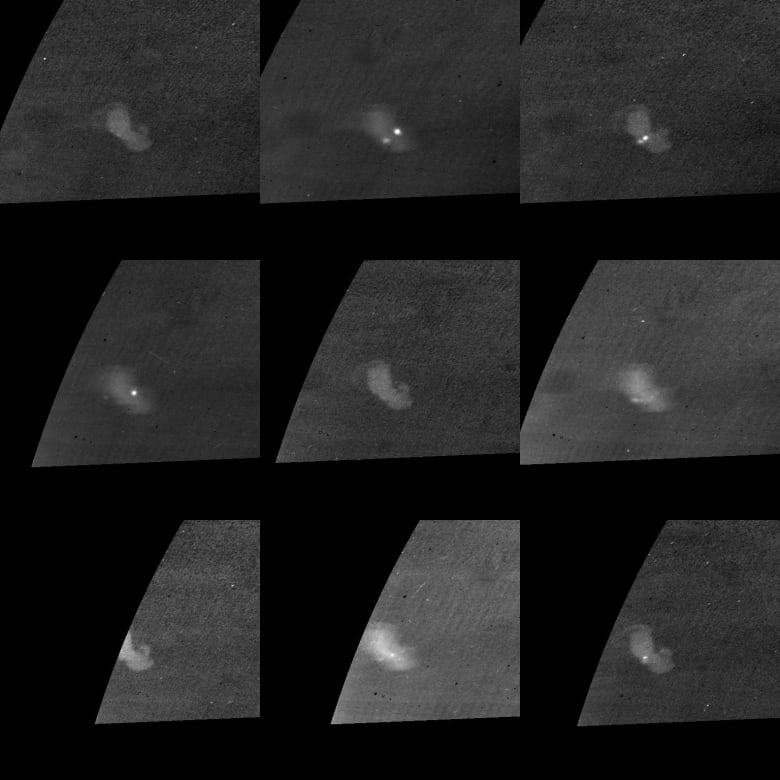
Other studies have revealed other similarities in the lightning process on Jupiter and Earth. For example, the lightning rate on the two planets is the same, although the distribution of lightning on Jupiter is different from that on Earth.
“On Earth, the tropics are the most active regions. The majority of Jovian lightning is in the middle latitudes and also in the polar regions. We have almost no lightning activity near the poles on Earth. This means that the conditions for the formation of Jovian and terrestrial thunderclouds can also very different,” said Kolmasova.
“There have been several attempts to compare the strength of lightning based on optical measurements and it has been concluded that lightning on Jupiter is comparable to the strongest terrestrial lightning.”
Kolmasova noted that further analysis is planned.
Jupiter is composed mainly of hydrogen and helium, with traces of other gases. Stripes and some storms dominate the colorful appearance of Jupiter, the fifth planet from the sun with a diameter of about 143,000 kilometers.
Juno has been orbiting Jupiter since 2016, obtaining information about its atmosphere, interior structure, internal magnetic field and surrounding regions created by internal magnetism.
[ad_2]
Source link