
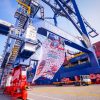
During his historic 2-day working visit to Lagos, the $1.5bn Lekki Deep Port was one of the iconic projects inaugurated by President Muhammad Buhari.
Located approximately 65km east of Lagos, the Lekki Deep Sea Port is spread over 90 hectares of land bordered to the south by the Atlantic Ocean. It is the largest port in Nigeria, and one of the largest in sub-Saharan Africa.
It is a joint venture company owned by a group of investors led by Lekki Port Investment Holdings Inc., the Lagos State Government and the Federal Government. This is a powerful testimony to the power of Public-Private-Partnership (PPP), which has long been championed by the Lagos State government.
A few hours after the official inauguration of the Deep Sea Port, the port received its first commercial container ship.
Announcing the development through its Twitter account, the Nigerian Ports Authority said the ship was owned and operated by a French shipping company, CMA/CGM.
Lekki Deep Sea Port is the first Deep Sea Port in Nigeria, and the first automated port in the country. It is one of the largest in West Africa and is poised to revolutionize the way goods are transported and sold in our country.
It is expected that Lekki Port will not only improve efficiency and connectivity, but will also be a key driver of economic growth in the region.
The port is equipped with tank storage, loading arms, and is connected by a pipeline that runs along the breakwater to carry cargo of finished products such as gasoline and diesel between the tank and the vessel.
It is designed to provide 24/7 operations throughout the year, using the latest technology to facilitate the smooth and efficient import and export of goods, ensuring the smooth flow of cargo, and providing opportunities for new businesses.
It is projected to generate approximately $20b in employee salaries, approximately $201b in Revenue for state and federal agencies from taxes, royalties, and duties and an estimated business revenue impact of $158 billion in the entire value chain.
In terms of employment generation, more than 300,000 jobs will be created from port operations alone, while more indirect jobs can be created in the value chain.
The port’s main breakwater is 1.5km long with a turning radius of 600 metres, sufficient for ships of up to 16,000 standard containers (teu) and an 11km long approach channel.
It has three terminals: container terminal, liquid terminal and dry bulk terminal. The container terminal has an initial draft of 14 meters, with the potential for further dredging up to 16.5 meters. The terminal can handle 2.5 million twenty-foot standard containers per year.
It is the first port in Nigeria with a ship-to-shore crane. It has three container gantry cranes; they belong to the “Super-post-Panamax” group – this means they can reach and unload the rearmost row of containers even if the container ship is wider than the Panama Canal (49 m or 160 ft maximum boat beam).
STS cranes have fixed rails on the quay side. They can lift 65 tons in twin-lift mode, 50 tons in single-lift mode or 85 tons in hook.
The port’s computerized system will allow container identification and clearance from the office, and human interaction will be minimal in physical operations.
There are three liquid berths in the port. The liquid cargo terminal will handle vessels up to 45,000 DWT (deadweight tonnage) and can expand to a capacity of 160,000 DWT.
Liquids (like gasoline or diesel) will be handled in a tank farm near the port. The docking area is equipped with loading arms. It is also connected by pipelines along the breakwater.
The bulk terminal with an available quay length of 300m can accommodate Panamax class vessels (75,000 DWT).
The arrival of the port will help the country to bridge the gap in Nigeria’s maritime infrastructure in the shortest possible time.
The deepening of infrastructure footprints by Mr. Babajide Sanwo-Olu led the administration, both in the environment where the project is located and other axes of the country, is a strong pointer that the government is committed to the development of the port and its underlying social – economic potential.
One thing that is clear in the whole project is the willingness of the Sanwo-0lu administration to go the extra mile to live up to the characteristics of Lagos as an investor-friendly state.
Lagos makes a significant contribution to the Nigerian economy. It contributes 30% to Nigeria’s GDP. This is remarkable considering that Lagos has only 10% of Nigeria’s population. The majority of Nigerian manufacturing is based in Lagos as well as many service industries such as finance. All these factors combine to push the industry to locate in Lagos
At The efforts of the Lagos State government in birthing a new port will be more appreciated when it is realized that only one new sea port was developed in Nigeria in the last forty years.
It should be emphasized that the construction of the Lekki Deep Sea Port started in July 2020 during the pandemic, and will be completed in October 2022.
The new port, therefore, represents another milestone in the country’s economic development efforts. It is a reflection of the endless possibilities that abound when the relevant levels of government work together in harmony.
Interestingly, Sanwo-Olu entered the history books as the first governor to have both the railway line and the Deep Sea Port completed and commissioned.
From the beginning, Sanwo-Olu demonstrated an unalloyed commitment to the speedy achievement of the project. This is based on an understanding of socioeconomic potential.
In October 2019, Sanwo-Olu signed a $629 million financing facility with the China Development Bank (CDB). The first tranche of this loan was disbursed by the Bank in April 2021.
This paves the way for the official award of the Concession in December 2019, with a delivery period of 30 months.
Construction continues through the pandemic, and will be completed in October 2022.
The completion and commissioning of the most important port provides clear authentication for three things. The first is that Nigerians ‘can do passion’. The second is the power of visionary leadership, while the third is the positive impact of effective collaboration between the federal and state governments.
Hopefully, with proper management, the new port will yield the anticipated economic dividends for all promoters. With the port and other concrete development projects around the Lekki corridor, of course, ‘Greater Lagos Rising’.
Ogunbiyi is the Deputy Director, Public Affairs, Ministry of Information & Strategy, Alausa, Ikeja.