
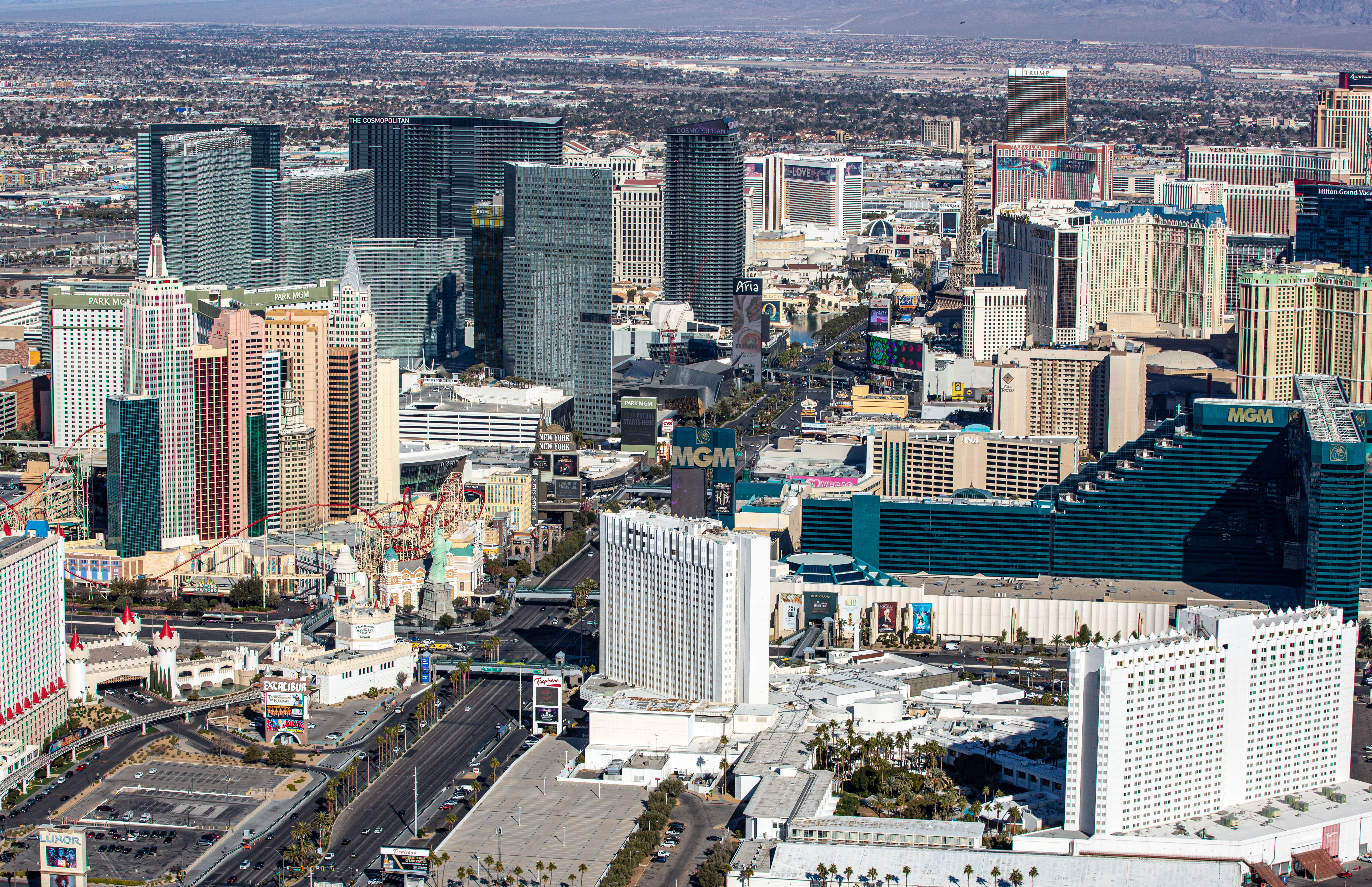
A federal lawsuit in Nevada seeks class-action damages for countless hotel customers who booked rooms in Las Vegas since 2019, according to which most hotels-casinos on the Las Vegas Strip have used third-party vendors to fix prices illegally.
The complaint filed Wednesday in US District Court in Las Vegas alleges that casino giants MGM Resorts International and Caesars Entertainment, along with Treasure Island and Wynn Resorts, shared information with companies that used pricing algorithms to “optimize market prices.”
It accused the resorts and Rainmaker Group Unlimited, a revenue management company owned by Cendyn Group, of “fixing algorithm-driven prices … at the expense of consumers and violating antitrust laws.”
The Associated Press emailed Rainmaker seeking comment. Michael Bennett, a representative of Boca Raton, Florida-based Cendyn, declined to comment.
The lawsuit was filed on behalf of plaintiffs Richard Gibson and Heriberto Valiente by attorneys from the law firm Hagens Berman Sobol Shapiro in Seattle and Berkeley, California.
Seeks class status and unspecified monetary damages for “tens of thousands if not hundreds of thousands” of people based on alleged antitrust violations of the federal Sherman Act.
MGM Resorts, which operates properties including Bellagio, New York-New York, MGM Grand and Mandalay Bay, responded Thursday with a statement calling the lawsuit “without merit.”
“The claims against MGM Resorts are factually inaccurate, and we intend to defend ourselves vigorously,” he said.
Wynn Resorts declined to comment. The Associated Press left a message seeking comment from representatives of Treasure Island and Caesars Entertainment.
Caesars Entertainment operates Las Vegas Strip properties including Caesars Palace, Harrah’s, Horseshoe, Paris Las Vegas and Flamingo.
In a statement, plaintiffs’ attorney Steve Berman requested and recreated the tagline of the ubiquitous advertising campaign that began in early 2003.
“What happens in Vegas won’t stay in Vegas,” Berman said. “We’re going to expose the under-the-table deals that these Vegas hotels are doing.”
Alan Feldman, a longtime MGM Resorts executive who is a fellow at the International Gaming Institute at the University of Nevada, Las Vegas, said hotels, airlines and car rental companies monitor costs and prices in what he calls the “travel ecosystem.”
“Sure, they’re watching each other,” Feldman said. “Then they can decide if they want to go above it, below it, or just ignore it.”
“But I can’t imagine these companies talking to each other,” he said, “and certainly not worth it.”
The lawsuit echoes concerns about algorithmic pricing identified in a 2017 speech by Maureen Ohlhausen, the former acting chair of the Federal Trade Commission.
Ohlhausen defined a computer algorithm as a set of rules or instructions that can model thousands of “complex and nuanced behaviors” in a fraction of a second “and react almost instantaneously to changes.”
He said the company provided price data to “public, outside agents” who used the information to program algorithms “to inflate prices across the industry.”
“We even have an ancient term,” Ohlhausen says, “hub-and-spoke conspiracy.”
“In effect, the company itself does not directly share the price strategy,” he said, “but the information is still in the public hands, and the information shared is then used to increase the price in the market.”
The court filing said two former Rainmaker employees told lawyers the company’s products were used by 90% or “just about every” property on the resort-lined Las Vegas Strip. The lawsuit does not identify the former employees.
The Las Vegas Review-Journal reported that the average daily room rate for Strip resorts reached a record high in 2022, above $200 a night in October during the busy convention month.
For the year through November, the average rate is $170.45, the highest in history, and does not include additional resort fees or account for free rooms available to high-rollers, the newspaper said.
Learn how to navigate and strengthen trust in your business with The Trust Factor, a weekly newsletter that examines what leaders need to succeed. Log in here.