
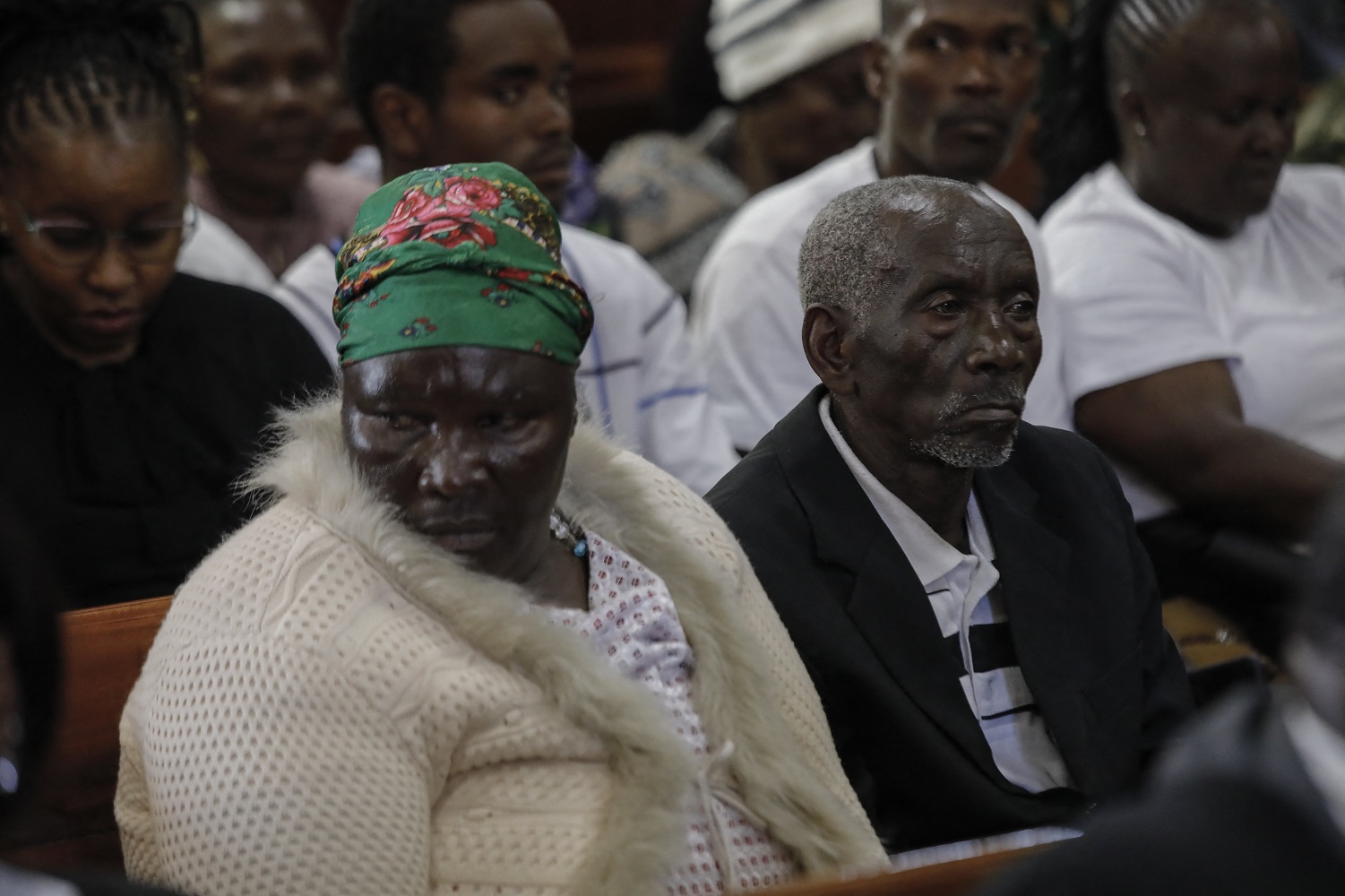
Three Kenyan police officers were on Friday given sentences ranging from 24 years in prison to the death penalty for killing a rights lawyer and two others.
The bodies of lawyer Willie Kimani – who has criticized police abuses – as well as his client Josephat Mwenda and driver Joseph Muiruri were found wrapped in sacks and dumped in a river outside Nairobi in June 2016.
The torture and killing of the three sparked angry protests in Kenya, where many fear the police.
In July last year, High Court judge Jessie Lessit found three officers, including a woman, as well as a police informant guilty of murder. The fourth policeman was released.
Lessit on Friday sentenced former policeman Fredrick Leliman to death while his colleagues were sentenced to 24 and 30 years in prison.
The informant was given a term of 20 years.
“This is the worst kind of murder and execution,” Lessit told the courtroom.
He singled out Leliman for “openly abusing his position” and directing the assassination “in a sophisticated master plan”.
Also read: More arrests for the killing of Kenyan LGBTQ activists
Cliff Ombeta, the lawyer for the three officers, told AFP that they would all appeal against the sentence.
“This ruling cannot stand the test of any appeals court judge,” he said.
– The long search for justice –
Kimani has defended a motor taxi driver who accused Leliman of shooting him for no reason at a traffic stop in 2015.
When the authorities found the body, Kimani’s wrists were tied with a rope, three fingers were cut off and his eyes appeared to be gouged out.
Families and rights groups of the victims expressed their condemnation for protesting the uncontrolled police brutality.
“We are happy and Kimani can finally rest in peace. Along the way, we have lost hope that we will get justice,” Kimani’s wife, Hannah, held back tears.
“This is a good start to building a culture of police accountability. Tolerance for rogue police officers is over,” Amnesty International Kenya director Irungu Houghton told 20 rights groups advocating for police reform.
Also read: LGBTQ rights activist killed in Kenya
The International Justice Mission (IJM), a global legal aid group that Kimani works with, said it expected a higher sentence after 185 court hearings, but was “happy that justice has been done”.
Extrajudicial killings are rampant in Kenya, and justice is rare with few examples of police arrests.
Missing Voices, a campaign group focused on extrajudicial killings in the country, said the sentence showed the justice system “can be trusted to deliver justice to victims of police criminality”.
– Kimani’s death: Police accused of running a hit squad –
Police have been accused of running hit squads targeting people – including activists and lawyers – who are investigating allegations of rights abuses by officers.
In October, Kenya’s new President William Ruto disbanded a feared 20-year-old police unit accused of extrajudicial killings and vowed to overhaul the security sector.
Prosecutors also announced in October they would charge police with crimes against humanity for their crackdown on post-election protests in 2017, a landmark decision praised by UN rights chief Volker Turk.
The allegations include rape, murder and torture and include the case of a six-month-old girl whose death became a symbol of police brutality during the bloody election.
Also read: Women face abuse during Kenyan campaign – rights group
The Kenyan Parliament established the International Police Oversight Authority (IPOA) in 2011 to provide civilian oversight of the powerful institution that is also considered one of the most corrupt in the country.
Only a few officers have been convicted as a result of the IPOA investigation, although the watchdog has reviewed more than 6,000 cases of alleged police misconduct, according to data covering the period from its inception to June 2020.
Activists have largely defended IPOA’s record, saying police often obstruct inquiries by refusing to cooperate.
Although the death penalty is still in place, Kenya has not carried out any executions since 1987.