
[ad_1]

Listen to this article
Estimated 5 minutes
The audio version of this article is generated by AI-based technology. Mispronunciations can occur. We are working with our partners to continually review and improve the results.
A federal judge on Monday dismissed U.S. President Donald Trump’s defamation lawsuit against the Wall Street Journal — involving publication of a birthday card to Jeffrey Epstein signed by Trump — a setback for the president in his legal campaign against media companies he accuses of treating him unfairly.
The case was one of several that Trump has filed during his presidency against major media outlets over reporting that he has characterized as unfair or false. That has led to concern among Democrats and press freedom advocates that he is seeking to use defamation cases to quell critical coverage.
Trump’s lawsuit said the Rupert Murdoch-owned newspaper tarnished his reputation with an article describing a birthday card to deceased sex offender Epstein bearing Trump’s signature. Trump and his lawyers said the card is fake, even after it was released by lawmakers investigating Epstein’s case.

Trump filed the lawsuit in July 2025 as his administration faced criticism from its conservative base and congressional Democrats over its handling of the case against Epstein, a financier who died in a Manhattan jail cell in 2019 after being arrested on child sex trafficking charges.
Miami-based U.S. District Court Judge Darrin P. Gayles, an appointee of former U.S. president Barack Obama, said that Trump had not come close to meeting the “actual malice” standard that public figures must clear in defamation.
That means they must prove not only that a public statement about them was false but also that the media outlet or person who made the statement knew or should have known that it was false.
“This complaint comes nowhere close to this standard,” Gayles wrote. “Quite the opposite.”
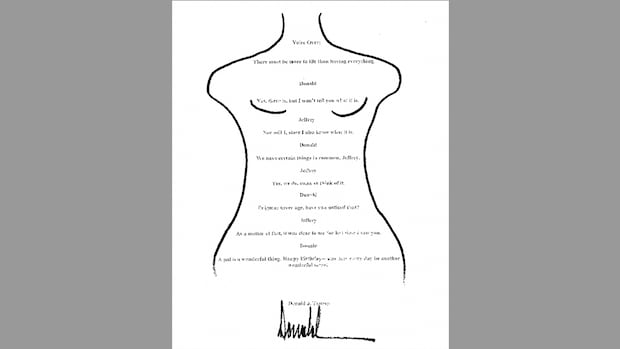
After it was released to the public by a congressional committee, U.S. President Donald Trump continued to deny allegations he wrote a suggestive personal note to Epstein for the convicted sex offender’s 50th birthday.
Trump vows to refile
Gayles said Trump could file an amended version of the lawsuit by April 27.
Trump said in a post on his Truth Social platform that he would refile the lawsuit by that date.
A spokesperson for Dow Jones, the Wall Street Journal’s parent company, said in a statement, “We are pleased with the judge’s decision to dismiss this complaint. We stand behind the reliability, rigour and accuracy of The Wall Street Journal’s reporting.”
Gayles wrote that the Journal’s reporters reached out to Trump for comment beforehand, and printed his denial. That allowed readers to decide for themselves what to conclude, cutting against Trump’s assertion that the newspaper acted with actual malice, the judge said.
The ruling did not address whether the article was true.
The Epstein case generated conspiracy theories that the government covered up the financier’s ties to the rich and powerful and obscured details about his death, which was ruled a suicide.
Trump amplified such conspiracy theories about Epstein during the 2024 presidential campaign and vowed to open the government’s investigative files if he won. He reneged on that promise but has called the ensuing scandal a Democratic hoax.
Trump and Epstein were once friends, but Trump says he severed ties before Epstein pleaded guilty to prostitution charges in 2008. Trump has consistently denied knowing about Epstein’s crimes.

U.S. first lady Melania Trump stunned observers with a surprise public statement denying any relationship with deceased convicted sex offender Jeffrey Epstein or his accomplice Ghislaine Maxwell.
His lawsuit against the Wall Street Journal came in response to an article asserting that Trump’s signature was on a 2003 birthday card for Epstein that included a drawing of a naked woman and a reference to shared secrets in an imaginary dialogue between Trump and Epstein.
Trump’s lawsuit repeatedly asserts the card is fake and takes the Journal to task for not publishing it as proof, but a copy was later released by Democrats in Congress who obtained it from Epstein’s estate.
Chilling effect on speech
In seeking to dismiss the case, the Wall Street Journal said the lawsuit was meritless and threatened to chill the speech of those who would dare to publish content the president does not like.
Trump has also sued the BBC, citing misleading editing of a speech, the New York Times over articles and a book about him, and an Iowa pollster and a newspaper over a poll that showed him trailing then-U.S. vice-president Kamala Harris in the 2024 presidential campaign.
The New York Times suit was thrown out in court, while the Iowa case is ongoing. The BBC previously apologized to Trump over the editing incident, acknowledging an error in judgment, but said the president has no legal basis to sue.
ABC settled with Trump after he sued over an anchor’s inaccurate comments about a civil case accusing him of sexual abuse. CBS struck a similar deal after Trump sued over its edits to an interview with Harris.
[ad_2]
Source link