
The 16th edition of the International Defense Exhibition and Conference and the seventh edition of the Naval Defense and Maritime Security Exhibition will be held in Abu Dhabi, United Arab Emirates, on February 21, 2023.
Mohammed Zarandah Anadolu Agency Getty Images
Few things reflect the health of the arms industry like a large defense exhibition.
Over the past week, Abu Dhabi’s biennial international defense exhibition, known as IDEX, featured a bustling sector. Decorated military personnel, government officials and arms company executives mingled against a backdrop of giant missiles and drone displays, while young men in terminator-like “smart armor” performed battle simulations while fake explosions lit up a giant LED screen.
With enough land for a small city and attracting around 130,000 visitors from 65 countries, this year’s IDEX was the largest and most attended in years.
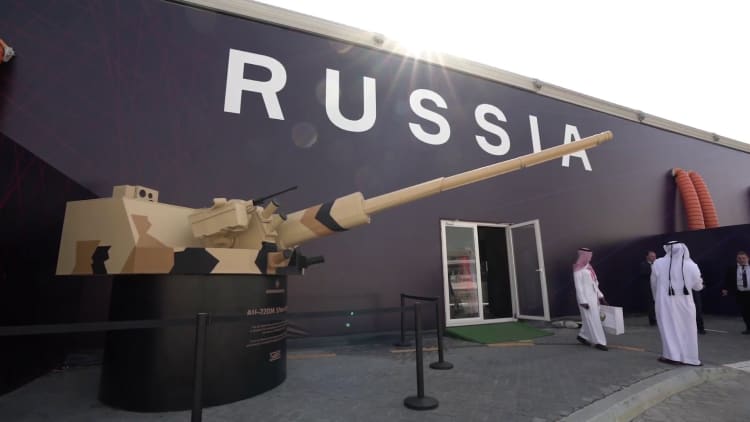
It’s not a secret why. Russia’s full-scale invasion of Ukraine a year ago jolted much of the industrial world out of its comfortable status quo, in which the Western-led security order prevented a major military invasion that the Western powers did not want. Since the violent turning point in late February 2022, governments in NATO and outside have pledged to spend more on defense than ever before.
“From our perspective, Putin is the best arms seller,” one American defense contractor at IDEX told CNBC, speaking on condition of anonymity because he was not authorized to comment to the press.
“If Putin doesn’t choose war, then nobody will buy all these things.”
Indeed, many countries have increased their defense spending to unprecedented levels.
“With the Russian invasion of Ukraine, many European countries have now committed to meeting or exceeding NATO targets – in some cases, years before they originally planned to do so,” the aerospace and defense report by McKinsey & Co. from December read. The crisis prompted “a review of the long-held assumption that large-scale conflict on the continent is impossible in the 21st century.”
Historic changes in military spending
Look at Germany: Just days after the invasion Russia will spend an additional 100 billion euros ($106 billion) on defense, a big change for a country that has been skimping on military investment since the end of World War II.
Poland now aims to increase its defense budget to 3% of gross domestic product in 2023. And French President Emmanuel Macron in early January announced his government’s plan to increase military spending by more than 30% in the coming years and prepare the armed forces. for high intensity conflict. In addition, US military spending in Ukraine alone was almost $50 billion last year.
Big shopping isn’t just in the West. Russia in November announced a defense budget of about $84 billion for 2023 – more than 40% more than the figure planned for that year, announced in 2021.
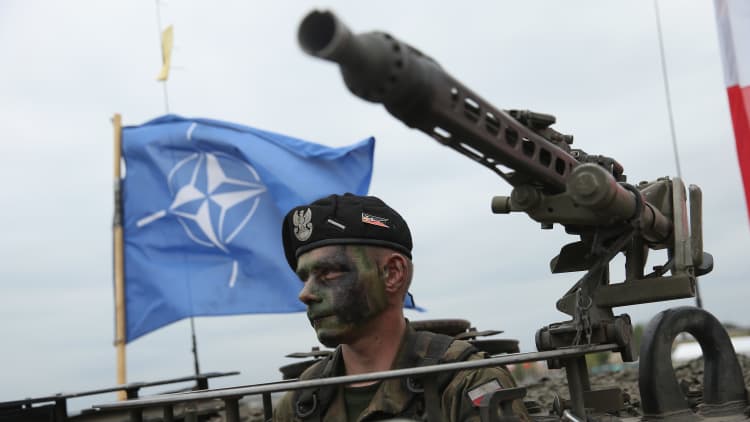
And NATO ally Japan aims to double its defense spending to 2% of GDP by 2027, as regional threats from North Korea and China rise. China and Saudi Arabia are also setting records for their own government defense spending by 2022, which despite inflation shows no signs of slowing.
“Business is very good, unfortunately,” said an employee of a French drone factory exhibiting at IDEX.
American arms companies see record orders
The US arms industry is thrilled. Sales of US military equipment to foreign countries rose 49% to $205.6 billion in the last fiscal year, the State Department said in January.
America’s largest defense contractors, Lockheed Martin and Raytheon, received record orders. Lockheed’s net sales for the fourth quarter reached $19 billion, about 3% above internal plans and up from $17.7 billion in 2021.
Ukraine had supplied US-made Javelins before Russia attacked. Pictured here is a group of Ukrainian soldiers taking delivery of Javelins as Russia deploys troops along the Ukrainian border.
Sergei Supinsky AFP Getty Images
Raytheon’s order backlog exceeded $150 billion last year and fourth-quarter sales for missiles and defense units rose 6.2% to $4.1 billion. But the company said it has been hampered by supply chain issues and labor shortages, and would have seen higher sales figures without them.
Stockpiles of ‘Thin’ weapons in Europe
For Europe, however, there is a real sense of urgency – after years of investment in the sector, dependence on the US and now months of sending arms and ammunition to Ukraine, European countries must curb their own stockpiles. which is completely exhausted.
“The military stock is the most [European NATO] member states have … less in a high proportion, because we have provided a lot of capacity for Ukraine,” Josep Borrell, the EU’s high representative for foreign affairs and security policy, said in September.
“It’s becoming more important. There are more discussions, more requests,” said a manager at a British drone company, requesting anonymity due to professional restrictions. When asked if demand for the company’s unmanned aerial vehicles is increasing, he replied, “Astronomically.”
The French multinational defense company Thales is one of the private sector working to meet the needs of France’s military and its allies which are in short supply.
“Of course the Ukrainian conflict forced us to increase capacity,” Christophe Salomon, executive vice president of Land and Air Systems at Thales, told CNBC. The division focuses on radar, missiles, rockets, vehicles and other ground systems.
“You have to increase your industrial footprint. You have to own your stock. And we are talking about products where the lead time is about two years,” he said, explaining the challenge of lean production when the supply chain for a single weapon. the system involves hundreds of different suppliers.
A Ukrainian soldier fires with a French 155 mm/52 caliber Caesar pistol at a Russian position on the front line in Ukraine’s eastern Donbas region on June 15, 2022.
Aris Messinis AFP Getty Images
The company needs government help to speed up the production process, Salomon said. The French government has taken steps in this direction, including simplifying military contracts and administrative procedures, seeking import substitution for more French-made products, promoting private-public partnerships and providing funds of several billion euros to replenish ammunition stocks.
The French Caesar’s self-propelled guns, which were very effective in the war for the Ukrainian military, usually took two years to make; The government aims to cut that time in half.
Thales in May delivered its sophisticated GM200 radar system to Ukraine, which normally takes two years to build. Due to increased investment in the supply chain last year and the purchase of complex radar subsystems, Thales said, it was able to assemble the GM200 Ukraine in four months.
“We’re accelerating because our team works 24 hours a day,” Salomon said. “We take responsibility for investing, we invest and we buy every subsystem before we know who will buy it.”
Leopard 2 A6 heavy battle tank.
Sean Gallup Getty Images News | Getty Images
Many in the Western defense sector complain that Europe’s largest economy, Germany, is still dragging its feet. Developing a military footprint remains controversial and divisive in German politics, and Berlin has made it clear that it wants to help Ukraine but avoid provoking Russia.
One German private sector participant at IDEX described his frustration at the pace of his government, but admitted that “because of history, it’s a bit of a problem.” He requested anonymity to speak freely.
Germany’s major policy changes last year — notably allowing its weapons to be used in foreign combat zones for the first time since World War II — made a major difference, participants said. “But,” he stressed, “we have to change the process and go faster now.”