
[ad_1]
Flooding from Hurricane Melissa killed at least 40 people in Haiti while the storm still churned across Cuba on Wednesday after leaving Jamaica with widespread damage and power outages, officials said.
Steven Aristil, with Haiti’s Civil Protection Agency, told The Associated Press that 20 of those deaths were reported in the southern coastal town of Petit-Goave, where another 10 remain missing.
Earlier Wednesday, the mayor of Petit-Goave told the AP that at least 25 people were killed in that community.
“I am overwhelmed by the situation,” Jean Bertrand Subreme said as he pleaded with the government to help rescue victims.
The number of dead and missing in Haiti often fluctuate in the early days following major natural disasters.
Aristil said officials expect the death toll to keep rising as heavy rains persist.
In eastern Cuba, hundreds of thousands of people were evacuated and a hurricane warning was in effect for the provinces of Granma, Santiago de Cuba, Guantanamo, Holguin and Las Tunas as Hurricane Melissa made landfall as a Category 3 storm early Wednesday.
Only one official from Haiti’s Civil Protection Agency was in the area, with residents struggling to evacuate amid heavy floodwaters unleashed by Hurricane Melissa in recent days.
Melissa crossed Cuba as a Category 3 hurricane, but has since been downgraded to Category 2. It was expected to generate a storm surge of up to 3.6 metres in the region and drop up to 51 centimetres of rain in parts of eastern Cuba.
Melissa was expected later Wednesday to move through the southeastern or central Bahamas, where a hurricane warning is in effect. It was expected to make its way near or to the west of Bermuda late Thursday. Haiti and the Turks and Caicos also braced for its effects.

Officials reported collapsed houses, blocked mountain roads and roofs blown off in Cuba on Wednesday, with the most destruction concentrated in the southwest and northwest. Authorities said about 735,000 people remained in shelters in eastern Cuba.
“That was hell. All night long, it was terrible,” said Reinaldo Charon in Santiago de Cuba. The 52-year-old was one of the few people venturing out Wednesday, covered by a plastic sheet in the intermittent rain.
Melissa tore off roofs and uprooted trees in the province, but the full extent of damage wasn’t immediately known.
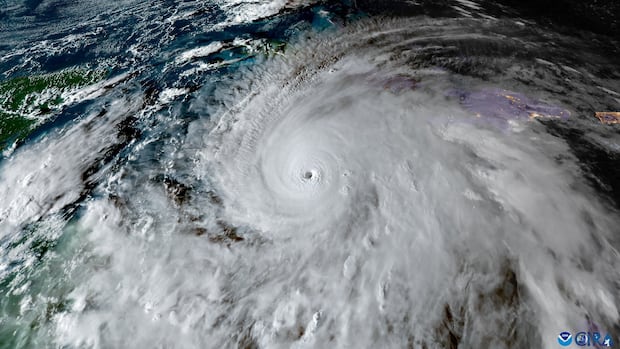
Hurricane Melissa’s Category 5 winds tore into western Jamaica Tuesday morning, marking one of the most powerful Atlantic landfalls ever recorded. CBC’s Johanna Wagstaffe looks at how Melissa may be part of a new hurricane era: storms fuelled by record-warm seas and slowed by a shifting jet stream.
‘It’s not going to be an easy road’
Parts of Granma province, especially the municipal capital, Jiguaní, were underwater, said Gov. Yanetsy Terry Gutiérrez. More than 40 centimetres of rain was reported in Jiguaní’s settlement of Charco Redondo.
The hurricane could worsen Cuba’s severe economic crisis, which already has led to prolonged power blackouts, fuel shortages and food shortages.

“There will be a lot of work to do. We know there will be a lot of damage,” President Miguel Díaz-Canel said in a televised address, in which he assured that “no one is left behind and no resources are spared to protect the lives of the population.”
In Jamaica, more than 25,000 people were packed into shelters Wednesday, hours after Melissa made landfall as a catastrophic Category 5 storm with top winds of 295 km/h — one of the strongest Atlantic hurricanes on record.
People kept streaming into the shelters throughout the day after the storm ripped off the roofs of their homes and left them temporarily homeless.
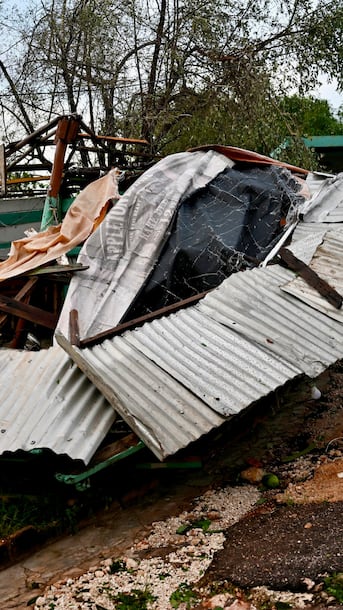
Hurricane Melissa hammered parts of Jamaica before slamming into Cuba, leading to widespread damage, power outages and, in some areas, dangerous flooding.
“It’s not going to be an easy road, Jamaica,” said Desmond McKenzie, deputy chair of Jamaica’s Disaster Risk Management Council.
Dana Morris Dixon, Jamaica’s education minister, said that 77 per cent of the island was without power Wednesday but the water systems weren’t greatly affected.
Prime Minister Andrew Holness plans to fly over the most affected areas, where crews were still trying to access areas and determine the extent of the damage, Dixon said.
Federal officials said they hadn’t yet received any reports of deaths after Melissa made landfall, but that they couldn’t presume that would remain the case, given how soon it was in the recovery effort.

A landslide blocked the main roads of Santa Cruz in Jamaica’s St. Elizabeth parish, where the streets were reduced to mud pits. Residents swept water from homes as they tried to salvage belongings. Winds ripped off part of the roof at a local high school, a designated public shelter.
“I never see anything like this before in all my years living here,” resident Jennifer Small said.
The government earlier said it hopes to reopen all of Jamaica’s airports as early as Thursday to ensure the quick distribution of emergency relief supplies.
The storm already was blamed for seven deaths in the Caribbean: three preparation-related deaths in Jamaica; three earlier deaths in Haiti; and one in the Dominican Republic, where another person remains missing.
The United States is sending rescue and response teams to assist in recovery efforts in the Caribbean, Secretary of State Marco Rubio announced on X on Wednesday. He said that government officials were co-ordinating with leadership in Jamaica, Haiti, the Dominican Republic and the Bahamas.
The current U.S. administration in June reinstated an economic embargo on Cuba and bans tourism to the the country.
[ad_2]
Source link