
Kidane Zekarias Habtemariam, a notorious people smuggler, showed his strength two years ago when he escaped from the Ethiopian court where he was tried.
Before being sentenced in absentia to life in prison for human trafficking and extortion, Eritreans asked if they could go to the bathroom, according to some accounts. There, with the help of two friends who had flown in from Sudan, he changed his prison clothes into civilian clothes and simply walked out of the building.
The law caught up with Kidane last week when he was arrested in Sudan and deported to the United Arab Emirates, where prosecutors are considering charges related to money laundering.
Kidane is accused of having financial ties to Gulf countries. In a 2021 communication to the International Criminal Court, based on the testimony of the victims, a group of human rights organizations said that Kidane had a bank account in Dubai “where migrants and refugees and their families pay for travel and ransom”.
“Human smuggling and trafficking are heinous crimes and now we have closed one of the most important trafficking routes to Europe,” said Brigadier Saeed al-Suwaidi of the federal anti-narcotics unit at the UAE interior ministry. It sends “a strong message to human traffickers: we’re working together and coming for you, one by one”, he said in a press conference after the capture.
Kidane is accused by the authorities in the Netherlands of leading a criminal syndicate that employs violence and intimidation, including torture and rape, to traffic and exploit refugees from the Horn of Africa. “He is a vicious man,” said Meron Estefanos, an Eritrean activist who testified against him in the Netherlands.
“They are brutal, they are not human, they are animals,” said a 20-year-old Eritrean woman who said she was detained by Kidane in Libya between 2017 and 2018. “They burned me, not just my hair, my body too. They did things to me, I don’t want to remember.

The Emirati court will also consider Kidane’s extradition request to Ethiopia as well as the Netherlands, which placed him on the most wanted list in 2021 for alleged crimes against Eritrean migrants and refugees in Libya.
According to the Dutch police, Kidane is the head of a notorious camp in Libya where “thousands of migrants” face “beatings, kidnappings, rape and illegal deprivation of liberty”. They arrived there after a difficult journey through Sudan, Chad or Niger with the hope of completing the journey and starting a new life in Europe.
“Many cannot survive the trip to Europe, and even if . . . he extorts money from them by making them pay for the next member of the family who is on the way,” the Dutch police said in a statement.
Interpol, which has been chasing Kidane since 2019, estimates that Kidane trafficked thousands of victims over a nine-year period. “His arrest will neutralize a major people-smuggling route into Europe and protect thousands who would otherwise be at risk of exploitation,” Interpol said.
Kidane’s arrest involved cooperation between Interpol and police in the UAE, Sudan, Ethiopia and the Netherlands. This was the information that Interpol sent to the UAE that allowed Kidane to be traced to Sudan. Emirati officers then flew to Khartoum on January 1 after alerting the Sudanese authorities, who arrested Kidane. About 10 suspects were also arrested in the UAE on suspicion of related money laundering activities.
Demelash Gebremichael, commissioner general of Ethiopia’s Federal Police, said that “a massive effort resulted in the arrest of an international criminal sentenced to life in prison in Ethiopia. It was a notable success.”
Kidane is adept at using fake identification papers to evade detection when crossing African borders, according to Stephen Kavanagh, executive director of Interpol’s police service.
“This is just the beginning – when this network becomes vulnerable, we have to push harder,” he said, pledging to target a wider ecosystem of collaborators in human trafficking networks.
Also this week, a man suspected to be Tewelde Goitom, Kidane’s friend better known as Welid, appeared at a pre-trial hearing in the Netherlands claiming to be the victim of mistaken identity. Tewelde was sentenced to 18 years in prison in Ethiopia in 2021 and then extradited to the Netherlands. The accused denied being Tewelde and a Dutch forensic laboratory tried to confirm his identity.
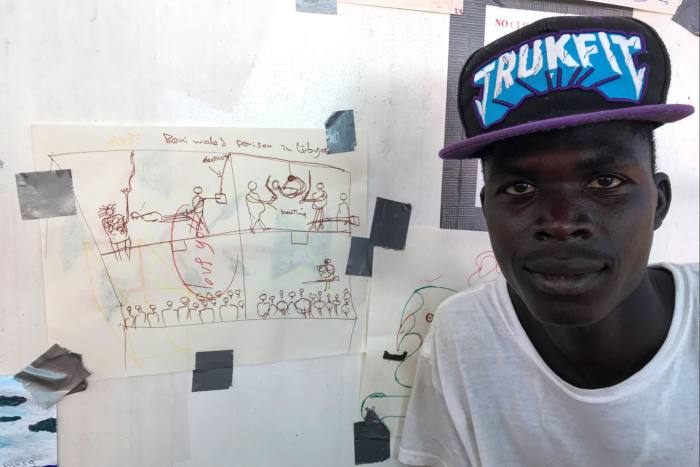
A rescued migrant called Adam poses next to a picture of a torture scene at the Bani Walid compound in Libya © Annie Chaon/AFP/Getty Images
The two men, Kidane and Tewelde, are accused by Meron and human rights groups of operating from an agricultural complex in Bani Walid, a town in western Libya described as a “ghost town” by migrants because so many people have disappeared there.
“The barn on the farm contains up to 1,200 people and is guarded by 70 armed men. Migrants and refugees report being tortured and starving on the farm. Some report people suffocating and falling from speeding trucks,” the human rights organization told the ICC.
Bani Walid emerged as a smuggling hub in 2018 as the expansion of Islamist armed groups in eastern Libya forced smugglers to move there.
The UN panel of experts called Bani Walid a “main transit point for migrants and refugees from East and sub-Saharan Africa originating from or traveling through Sudan, Chad or Niger”, and described the “systematic” detention and abuse of migrants in the region. informal facilities.
Marwa Mohamed, head of advocacy and outreach at the rights group Lawyers for Justice in Libya, welcomed Kidane’s arrest, but warned that much work remained to be done.
“Although the arrest of Kidane as a ‘big fish’ in the world of trafficking is significant, this alone will not dismantle the trafficking network or impact the trafficking route through Libya. Kidane is not operating alone,” he said.
“We see trafficking and smuggling continue even though Kidane fled and hid outside of Libya. They are part of a larger migrant and refugee system in Libya that is still being used today.