
Below is an excerpt from the latest issue of Bitcoin Magazine PRO, Bitcoin Magazine’s premium market newsletter. To be the first to receive this insight and other on-chain bitcoin market analysis straight to your inbox, subscribe now.

Bitcoin Ordinals and Inscriptions
A new and somewhat controversial use of Bitcoin is the innovative application of the Taproot soft fork that was integrated into the protocol in 2021. Ordinal Theory is a method of serializing each unit of bitcoin and labeling this particular satoshi “ordinal”. The creator of this numbering scheme, Casey Rodarmor, explains on his blog, “Satoshis are numbered in the order they are mined, and are transferred from the transaction input to the transaction output in the first order.”
By serializing these individual satoshis and using the Taproot upgrade, Bitcoin users can also include arbitrary data directly in the blockchain. While this is already possible with text using the OP_RETURN function, this new “inscription” can be anything from a jpeg, a short sound clip and even a simple game.
There is a lot of debate in the development community about the implications of storing all this data directly in Bitcoin and what it means for users who want to run a full archive node. While this discussion is important, we want to understand how the current inscription affects the Bitcoin fee market and how it will look in the future.
Efficient Use of Block Space
By their nature, inscriptions are larger files and therefore take up more limited space in each Bitcoin block. Users who create an inscription must pay the necessary fees to send a transaction, but the inscription is included in the witness data that was given a small fee discount due to the SegWit soft fork in 2017.
Ordinals officially opened on January 21, 2023. Less than three weeks later, the inscription has taken up 50% of the Bitcoin block space according to Pierre Rochard, vice president of research at Riot Platforms.
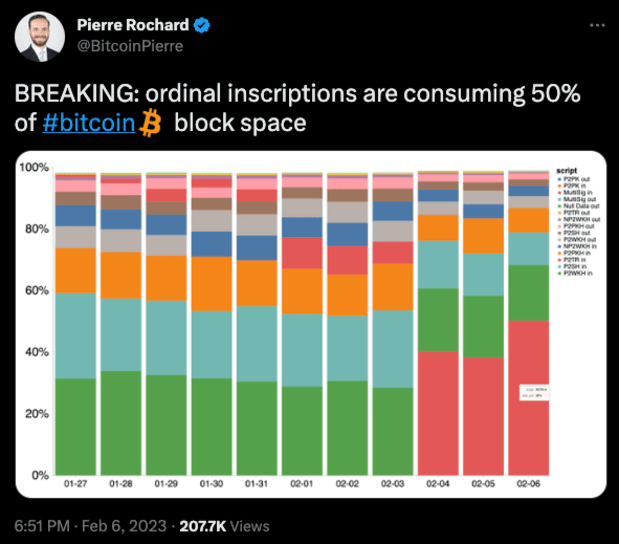
The Bitcoin fee market is a constantly changing landscape. Fees increase when demand for on-chain transactions is high and users want those transactions to be included in the next block. On the contrary, the fee rate decreases when the demand is low and the user does not need the transaction to be confirmed in a timely manner.
Whether these inscriptions should be considered an “acceptable” use of Bitcoin, the market will decide the appropriate fee price for those who want to include this arbitrary data into each block. If transaction fees increase enough, it is likely that less important or smaller bitcoin transactions will be priced out of the market and move to Layer 2 protocols, such as Lightning. This additional layer has always been a game-theoretic hypothesis of Bitcoin’s cost structure, even predicted by Hal Finney in 2010.
History Block Weight
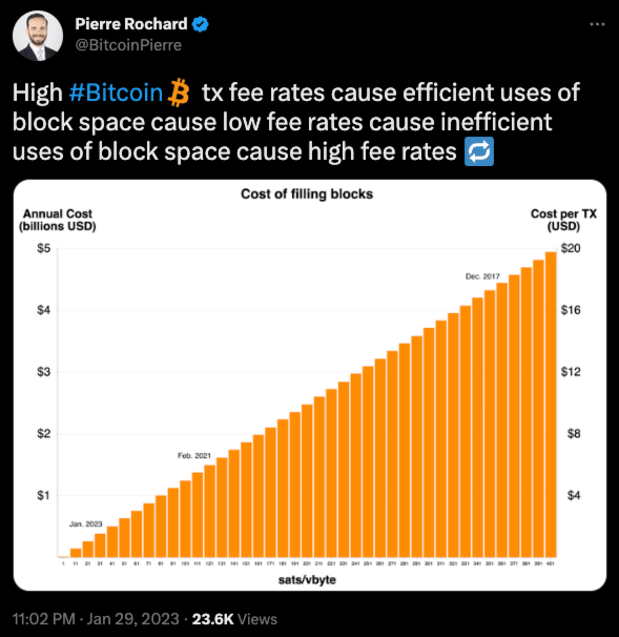
This is not the first time that a significant number of transactions have filled the mempool. As noted, the Bitcoin fee market is dynamic and the cycle of high fees creating the effects of the blockchain, creating low costs, making it inefficient to use the blockchain, creating high costs will repeat ad infinitum.
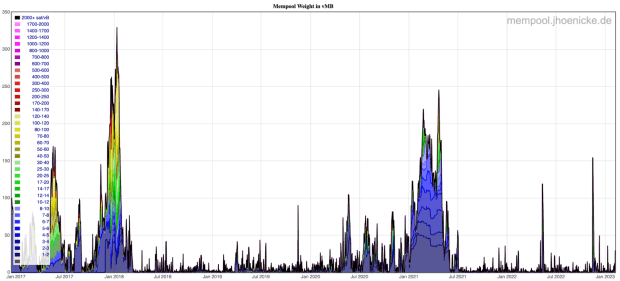
Shown below are mempool data and fee prices going back to early 2017. Blockspace tends to be at a premium during bull runs because many people send bitcoins back and forth from exchanges or cold storage or spend at relatively high exchange rates.

Expanding on the past three months, it is clear that there is a significant number of transactions happening in the second half of November as bitcoin flies off the exchange with users protecting themselves from other potential contagion events.
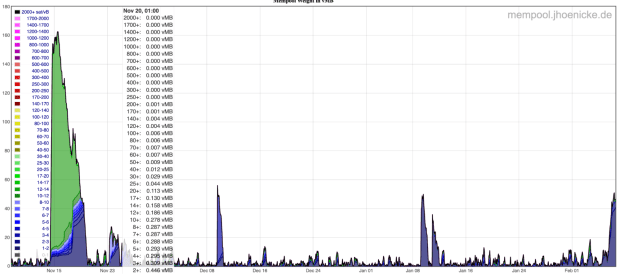
Beyond extreme cases, transaction fees have been low for a long time and raise questions about Bitcoin’s long-term security budget as block subsidies decrease and fees must become a larger percentage of bitcoin miners’ revenue. Again, the hypothesis of Bitcoin supporters is that the demand for blockchain will increase over time as bitcoin gains adoption and scale, causing more use to move to other layers built on top of the protocol.
In the past few weeks, the average block size has seen a huge spike.
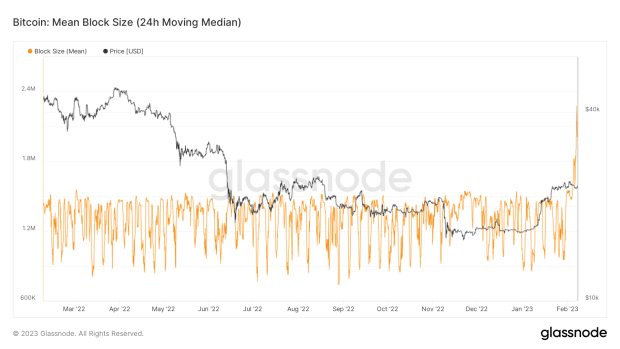
Despite the large increase in the size of this block, the fee market competition is not yet hot. Of course those who want to send monetary transactions will increase their fees to make the transaction faster or those who want to make inscriptions without waiting will do the same. Either way, if the cost increases, it will be profitable for the miners who will collect additional revenue in the block reward in the form of higher transaction fees.
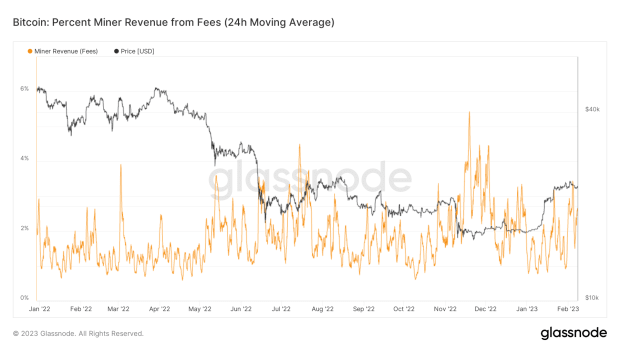
Transaction fees are still an insignificant percentage of mining block rewards, falling somewhere between 1% and 3%. Will fees rise as more people try to use bitcoin to send money and print inscriptions?
Enjoy this content? Subscribe now to receive PRO articles directly in your inbox.

Relevant past articles:
- The State of the Mining Industry: Survival Of The Fittest
- The Crypto Contagion Intensifies: Who Else Is Swimming in Feathers?
- No Binancial Advice
- This Time Is No Different: Miners Are the Biggest Risk Facing the Bitcoin Market in the 2018 Cycle Repeat
- BM Pro Market Dashboard Released!