
Examining more than 100 bitcoin mining companies, it is clear that this industry is poised to increase energy consumption more than any other.
This is an editorial opinion by Ritabrata Santra, an engineer focused on energy technology.
I bought my first bitcoin in 2016. I am a sophomore in college and in my second year living in the US. As I was adapting to my new way of life, I came across an article about Bitcoin.
I have saved money from a job on campus. As someone who saw the devaluation of money done by my parents, the value proposition of Bitcoin was immediately clear to me and I made the second biggest mistake of my life: I bought bitcoins from Coinbase (for $1,500) instead of mining. and cold store (HODL’ing) it! If you’re wondering what my biggest mistake was: Two months later, I got an internship in Germany, so I sold my bitcoins to buy a ticket to Berlin, and six months later, one bitcoin was worth around $16,000!
The Energy Trilemma and Bitcoin
One of the many things that stood out in my new way of life in the US was reliable access to electricity. Growing up in India, I witnessed how lack of energy affects health, knowledge and opportunities.
Today, developed economies use up to 12 times the average of some developing countries. There are more than 900 million people without access to electricity, but we emit enough gas every year to power all of sub-Saharan Africa. In other words, we burn enough gas (releasing carbon dioxide, or CO2) to provide energy to millions of people without creating economic value, because we do not have the technology needed to profitably transport energy to where it is needed most.
I believe that the energy trilemma, the need to balance energy reliability, affordability and sustainability, is one of the great challenges of our lives – we must eliminate energy poverty and meet the additional energy needs of developing economies, while actively decarbonizing to achieve it. carbon neutrality.
Bitcoin mining serves as a medium to take the wasted economic potential of excess energy sources, accelerates otherwise expensive but innovative renewable development, and therefore sits in the middle of solving the energy trilemma.
Trend One: When Harry Met (Stranded) Sally
Innovative monetization of stranded or excess energy resources will create positive economic opportunities and drive the growth of bitcoin mining.
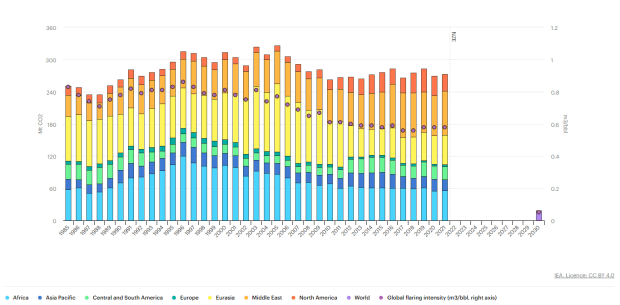
Every energy producer, regardless of the carbon intensity of the energy produced, has to deal with excess energy that cannot be monetized. As hydrocarbon production increases, reservoir pressure drops and producers unwittingly produce gas that is often expensive to transport and so they have no choice but to flare/flare it. In fact, according to a recent article, the amount of gas flared globally is equal to Europe’s total natural gas imports from Russia before sanctions were imposed through the invasion of Ukraine.
According to the IEA, we need to curb gas flaring by more than 90% to reach our net zero target by 2030, as shown in the figure below. In addition, renewable generators often have to limit their energy production to match the demand from the grid, and without batteries, this often means wasting energy.
Many energy producers who do not have ability in bitcoin mining cooperate with bitcoin miners to earn money as efficiently as wasted energy or stranded without transmission infrastructure. Oil giant ExxonMobil has started a pilot project with Crusoe Energy to mine bitcoins. Additionally, renewables giant Nextera and bitcoin miner Marathon opened a joint facility in King Mountain, Texas.
Perhaps the only thing better than a joint venture is a vertically integrated mining company.
To minimize some of these uncertainties with energy prices and availability, we observe bitcoin mining companies that have a source of energy production, that is, produce and use their own energy by eliminating intermediaries. Examples of companies that have natural gas (such as 360 mining and Canary Mining), for water power (Bitfarms), for solar energy (Viable Mining) assets and many others.
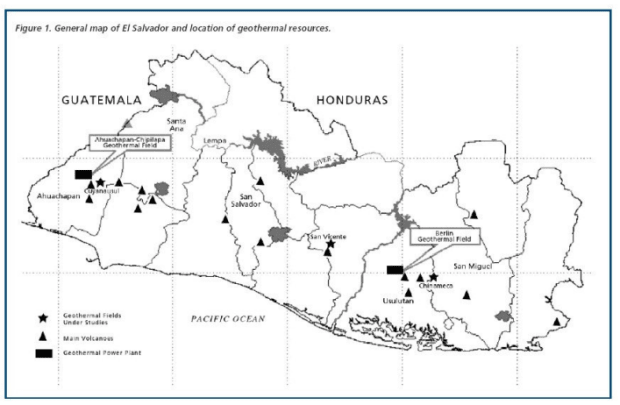
While there have been previous incidents of bitcoin accelerating expensive corporate renewable energy (such as OTEC) development in the US, we are more likely to see the same happening in countries with favorable bitcoin mining policies. For example, El Salvador, which currently produces more than 50% of its electricity from renewable energy, has great geothermal energy potential as shown in the figure below. Now, there is a big push from the government of El Salvador to develop this geothermal resource for sustainable bitcoin mining.
Trend Two: World Eating Software (Mining).
The specialized optimization software category can be an attractive investment for investors who are hesitant about capital-intensive digital infrastructure companies.
Bitcoin mining is a very efficient capital allocation mechanism and is close to the invisible hand of the free market. In the past year, several bitcoin mining companies such as Core Scientific, Celsius, Compute North and Lab Butterfly have declared bankruptcy, while others like Argo Blockchain and Iris Energy are on the brink. The price of energy and being able to use it efficiently in the energy demand from the grid has a great impact on the operational profit margin of bitcoin mining companies; This problem creates a need for energy optimization and efficient use.
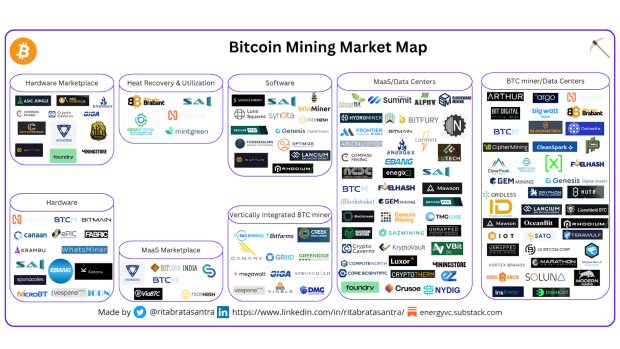
I have created a separate category on the market map for companies that solve this optimization problem for bitcoin miners. Additionally, some mining as a service (MaaS) companies like Lancium offer bundled software solutions to manage computing/mining operations as well as optimize energy usage.
But building the infrastructure for bitcoin mining is a major investment and includes risks due to the volatility of the bitcoin price and the required energy costs. To de-risk that investment (to a certain extent) with multiple offerings, many MaaS companies are building data centers for low-latency computing. With the astronomical rise of cloud computing, demand for latency-agnostic computing has grown exponentially over the past decade and is expected to grow by 10% annually through 2030.
MaaS companies are well-positioned to build data centers because this matches their existing capabilities to build efficient computing infrastructure solutions, thereby increasing the total market they can address.
Trend Three: The Swiss Army Knife Of Decarbonization
Like a Swiss Army knife, bitcoin mining incentivizes energy-saving decarbonization in many ways. Repurposing coal rejects and continuously burns it, uses natural resources to preserve key wildlife habitats, takes methane from landfills and uses that energy to mine bitcoins creating positive economic value for society. In fact, there are more than 120,000 orphan wells in the U.S. alone that emit methane equivalent to producing seven million to 20 million metric tons of CO2 annually and endangering the lives of surrounding communities.
Assuming an average cost of $100,000 to plug those wells and only 10% of those wells are suitable for reuse using bitcoin mining, that’s a $1.2 billion market!

Bitcoin mining uses electrical energy and is therefore clean as a source of electricity. However, as we integrate more intermittent renewables into the grid, the need to balance the grid increases, which can be handled by flexible loads like bitcoin mining and data centers in specific locations.
The electrical energy used in bitcoin mining is converted into heat. Just as energy producers try to monetize excess energy with bitcoin mining, bitcoin miners can monetize wasted heat by taking it and repurposing it. Here is a great example about how bitcoin mining can drive waste heat recovery.
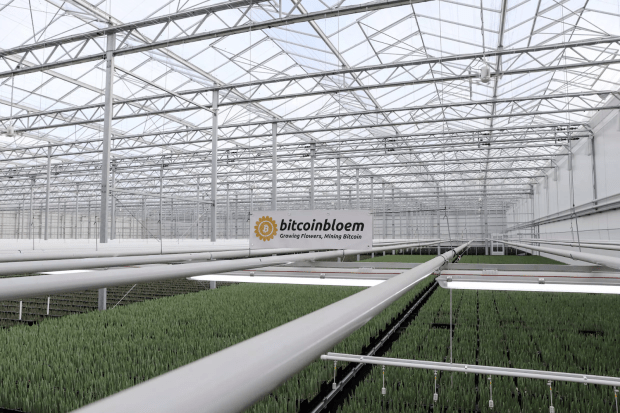
While mapping the market, I have seen companies that use the heat from bitcoins for agricultural purposes such as greenhouses for growing tulips, distilling whiskey or for heating homes. In addition to a resilient revenue model, energy efficient users and wasted heat will be the winners.
Conclusion
Due to its decentralized nature and low barriers to entry, creative destruction is built into bitcoin mining by design. Bitcoin miners who are constantly innovating to improve operational and energy efficiency will thrive in this industry.
This is a guest post by Ritabrata Santra. Opinions expressed are entirely their own and do not necessarily reflect those of BTC Inc or Bitcoin Magazine.