
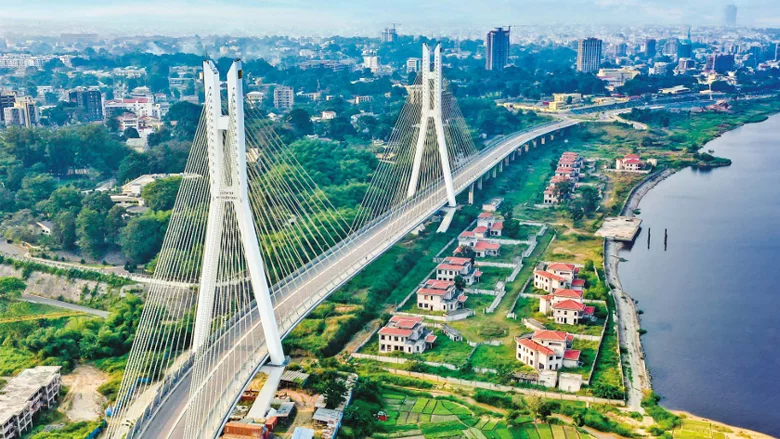
© Parfait Iloki | Department of Land Management, Infrastructure and Road Maintenance, Republic of Congo.
STORY HIGHLIGHTS
- The Republic of Congo’s oil-driven growth model has reached its limits, says a new World Bank report, titled The Republic of Congo’s Road to Prosperity: Building Foundations for Economic Diversification.
- Sustainable development requires efforts to diversify national assets, focus on stronger institutions, human and physical capital development, and more balanced exploitation of natural resources.
- The report sets out how Congo can achieve its economic diversification goals and recommends policy reforms and investments in a number of priority areas.
BRAZZAVILLE, March 15, 2023 – The World Bank released a new edition of its Country Economic Memorandum report for the Republic of Congo. The report, titled The Republic of Congo’s Road to Prosperity: Building a Foundation for Economic Diversification.
Here are some highlights from the report:
1. The oil sector dominates the Congolese economy
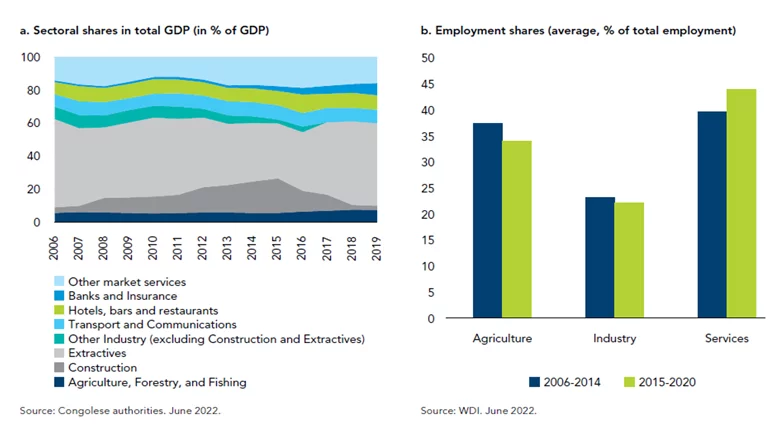
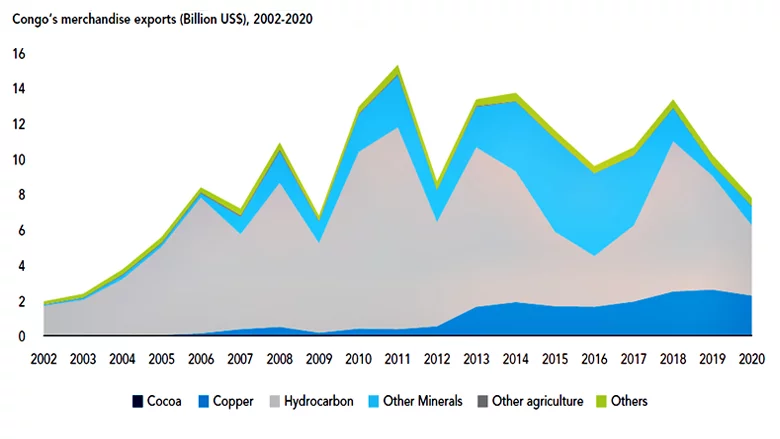
Over the past 15 years, the structure of Congo’s economy has remained unchanged. The hydrocarbon sector has dominated the economy, accounting for approximately 42% of GDP, 80% of total exports, and 60% of domestic income. The services sector is the second largest economy, accounting for 33% of GDP, while agriculture, forestry, and fisheries represent 6%. The manufacturing sector, which is mostly small-scale, accounts for an average of 6.5% of GDP.
Despite the outsize role of oil in the economy and the country
the industrial sector tries which, employs only a small percentage of the workforce, at 20%. In fact, around 75% of the Congolese workforce (including mostly young people) work in the informal sector, either as self-employed or in low-productivity jobs.
Congo’s current oil-dependent economic model will not be able to generate sustainable growth and productive jobs in the future, given the country’s projected oil reserves and the global transition to a low-carbon economy. The new report contributes to the Government’s diversification agenda by identifying key policies and reforms to build a more diversified development foundation that will support long-term growth, increase productivity and improve lives for Congolese people.
The hydrocarbon sector plays a dominant role in the economy but provides fewer job opportunities
2. Less and less labor productivity
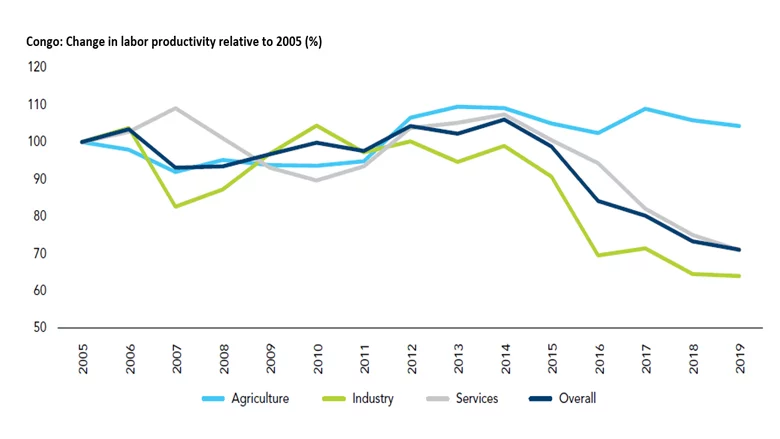
Congo faces low and declining labor productivity compared to peer countries, limiting economic growth. A decrease in labor productivity leads to a decrease in per capita income and an increase in poverty. Using the international poverty line of $2.15 a day, the poverty rate in Congo will rise to 52% in 2021, from 33% in 2014.
Increasing labor productivity is key to prosperity because productivity growth is the main driver of sustainable income growth and poverty reduction. The report analyzes company-level labor productivity, for the first time in the Republic of Congo, with a focus on the non-oil sector. It found that the average worker in Congo had to work 2.6 times longer to produce the same output as workers in peer countries. In 2019, overall Congolese labor productivity, measured as value added per worker, was only $4,500), compared to an average of $6,200 among regional peer countries.
In order to increase productivity, Congo must prioritize policies to reduce the distortions that lead to the misallocation of resources between firms, i.e. by allowing factors of production to flow to the most productive firms. The policy should focus on the service sector, which appears to be most affected.
Changes in labor productivity relative to 2005 (%)
3. Increase productivity through competition
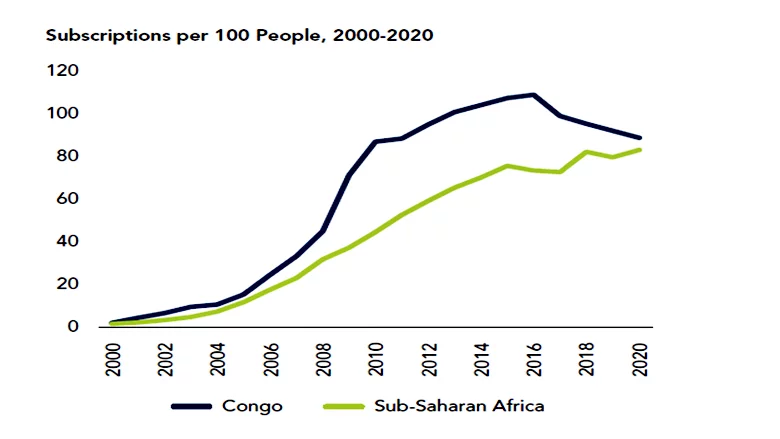
Competition is an important driving force for long-term productivity improvements and private sector development. In Congo, the government plays a large role in the economy through state-owned enterprises (SOEs) in the energy, transportation, banking, and health sectors. In some other sectors, the initial success with market liberalization has fizzled in the last decade and, the telecommunications sector, for example, has been reduced to two market players. The lack of competition is reflected in the decline in mobile usage (see chart below).
The report recommends actions to increase private sector entry and ensure a level playing field for private and public operators and to modernize competition regulations and create an independent national competition authority.
It also recommends pro-competitive regulation in selected sectors such as electricity and telecommunications, as both are important for the efficient functioning of other industries and important for the digital economy, which Congo recognizes as a priority for economic diversification and growth. The lack of reliable electricity service is hurting the company’s productivity. However, despite past reform efforts, the power sector remains constrained by limited coordination and oversight, hampering private investment. In addition, the information and communication technology (ICT) sector, despite recent investments in fiber optics, suffers from inadequate infrastructure and high prices for internet services, which hampers the productivity of Congolese companies.
Mobile telephony penetration has lost ground after a decade of rapid growth
4. Trade competitiveness
International trade can help accelerate growth and improve living standards. Congo’s trade is currently very limited to various products (mainly oil and minerals) and export markets (mainly East Asia). The gas and agricultural sectors provide immediate opportunities for Congo to diversify its export basket. Congo has the fifth largest natural gas reserves in Sub-Saharan Africa, which remain unexploited. In addition, the arable land for agriculture in the Congo remains underutilized and, as a result, the Congo is an importer of food products.
To support the diversification of exports, Congo must reduce tariffs, improve regulatory transparency and speed up the implementation of the African Continental Free Trade Area (AfCFTA). It should also increase efforts for greater integration in the global value chain. This requires increasing the country’s attractiveness as a foreign investment destination, increasing access to credit, avoiding rigid labor market regulation, increasing access to inputs, customs reform, and investment in ports and roads, ICT connectivity. These policies will be key to harnessing the positive impact of the AfCFTA.
Congo’s exports are heavily concentrated in oil and minerals
5. Logistics and ecotourism
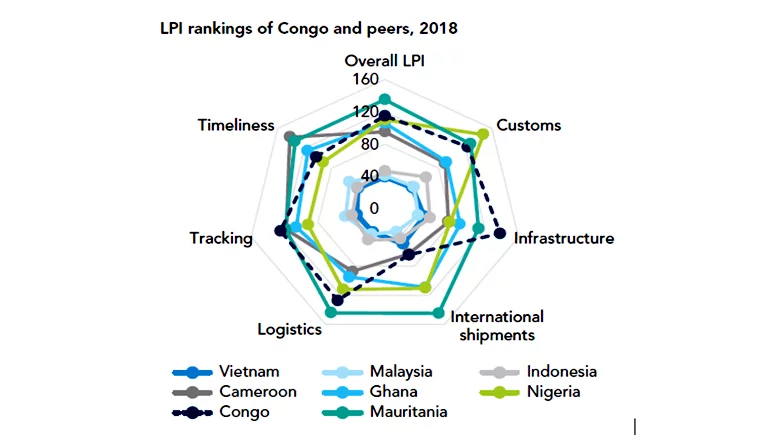
The report examines two main trade-related components that have the potential to make a real contribution to export growth and economic diversification in the Congo: logistics or trade facilitation, and ecotourism. Improved logistics process efficiency can reduce trade costs, including major imports and increase merchandise exports. Ecotourism, a sector with unrealized potential in the Congo, can make an important contribution to job creation, rural development, and service exports.
Logistics efficiency can be improved by examining public-private partnership contracts and using integrated information technology for maritime trade. The development of ecotourism can be supported by increasing regulation and allocating funds to protect natural assets, strengthening regulatory and enforcement agencies, and developing transportation and marketing infrastructure.
Congo’s logistics performance has improved but lags behind its peers
Distributed by African Media Agency (AMA) on behalf of of World Bank
The post For Republic of Congo, Economic Diversification Offers Path to Prosperity appeared first on African Media Agency.