
[ad_1]
Rescuers pulled survivors from the rubble of an earthquake on Sunday, six days after one of the worst natural disasters to hit parts of Syria and Turkey, as the death toll surpassed 28,000 and looked set to rise again.
Facing questions about his handling of Turkey’s biggest earthquake since 1939, President Recep Tayyip Erdogan promised to start rebuilding within weeks, saying hundreds of thousands of buildings were damaged.
In Syria, the disaster has been most severe in the rebel-held northwest, leaving many homeless for the second time after being displaced by a decade-old civil war, although the region has received little aid compared to government-held areas.
The European Union envoy for Syria urged Damascus not to politicize the issue of humanitarian aid, rejecting accusations that the bloc has failed to provide enough aid to Syrians after a 7.8-magnitude earthquake and large aftershocks.
“It’s unfair to be accused of not giving help, when the truth is that we have been doing this continuously for more than a decade and we are doing more even during the earthquake crisis,” Dan Stoenescu told Reuters.
Rescued after 149 hours
In Turkey’s southeastern Hatay province, a Romanian rescue team carried a 35-year-old man named Mustafa down from the rubble of a building, broadcaster CNN Turk said, about 149 hours after the earthquake.
“He is in good health, they say,” said one of the rescuers. “He said, ‘Get me out of here quickly, I’m claustrophobic.'”
The team were placed in a waiting ambulance before hugging each other.

On Saturday, Gizem, a rescue worker from the southeastern province of Sanliurfa said he had seen looting in the city of Antakya. “We can’t intervene, because most robbers carry knives.”
Police and soldiers are working to maintain order and help with traffic, rescue and food distribution.
Turkey says around 80,000 people are in hospitals, with more than a million in temporary shelters.
Survivors fear disease
With basic infrastructure destroyed, survivors fear disease.
“If people don’t die under the rubble, they will die from injuries. Otherwise, they will die from infection,” Gizem said. “There are no toilets here. This is a big problem.”
UN aid chief Martin Griffiths described the quake as the region’s worst in 100 years, predicting the death toll would at least double.
He praised Turkey’s response, saying his experience is that disaster victims are always disappointed by early relief efforts.
The quake comes as Erdogan faces national elections scheduled for June. Even before the disaster, his popularity was on the decline due to rising inflation and the depreciating Turkish currency.
The election has been seen as Erdogan’s toughest challenge in his two decades in power. He called for solidarity and condemned “negative” politicians.
The deadliest natural disaster is number 7
Some earthquake-affected people and opposition politicians have accused the government of slow and inadequate relief efforts, and critics have questioned why the army, which played a key role after the 1999 earthquake, was not brought in sooner.
Erdogan has acknowledged problems, such as challenges in delivering aid despite broken transport links, but says the situation is under control.
Prosecutors investigating the legitimacy of the building collapse have ordered the arrest or detention of up to 95 people, Anadolu news agency said.
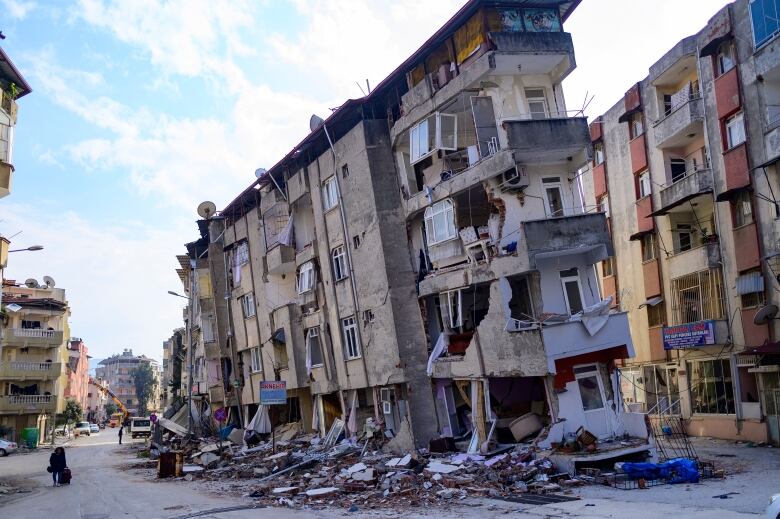
The earthquake was the seventh worst natural disaster in the world this century, the death toll of about 31,000 due to the 2003 earthquake in Iran.
It has killed 24,617 in Turkey, and more than 3,500 in Syria, where the toll has not been updated since Friday.
In the Syrian government-held city of Aleppo, the head of the World Health Organization, Tedros Adhanom Ghebreyesus, described the disaster as heartening as he monitored the distribution of aid and promised more.
Western countries have largely avoided President Bashar al-Assad during the war that began in 2011.
[ad_2]
Source link