
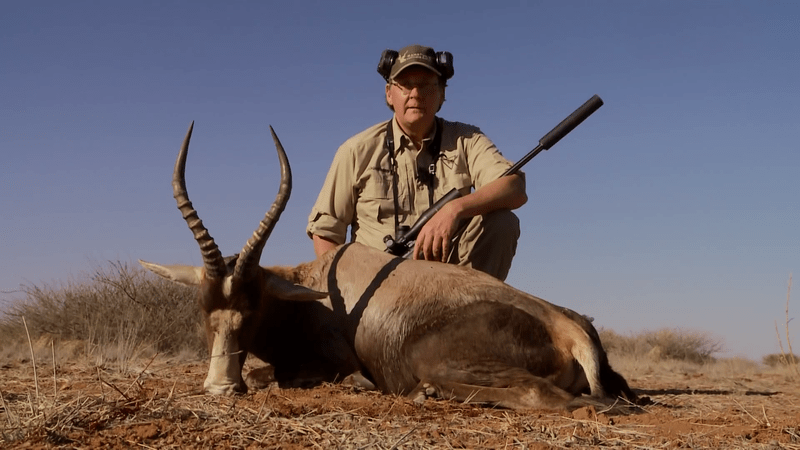
British MPs on Friday passed a government-backed bill designed to stop trophy hunters who kill endangered species overseas bringing body parts back to the UK.
British MPs on Friday passed a government-backed bill designed to stop trophy hunters who kill endangered species overseas bringing body parts back to the UK.
But grassroots conservation groups in several Southern African countries have targeted the Hunting Trophy (Import Ban) Bill, saying it is “another way to recolonize Africa” that will destroy rural livelihoods and threaten wildlife.
On Friday, the bill received its third reading in the House of Commons. It will now go to the House of Lords.
The bill, a private member’s bill introduced by MP Henry Smith, seeks to ban the importation of hunting trophies from around 6 000 conservation species, including elephants, lions and giraffes. Supporters said it would be the “toughest legislation” ever passed by governments around the world and would “send shockwaves through the trophy hunting industry”.
sustainable hunting
On Wednesday, the high commissions of Namibia, South Africa, Zambia and Botswana issued a joint statement supporting sustainable hunting in Africa.
“What supports the British ban on the import of hunting trophies that must be appreciated is that hunting in Africa, if practiced sustainably, feeds families, provides for school children, funds anti-poaching units and, finally, ensures the long-term survival of habitats and species. which we care deeply about,” read a joint statement.
Amy Dickman, a professor at Oxford University, told The Guardian: “It is very disappointing that MPs have given in to emotional but misinformed animal rights campaigning. This bill will kill more animals than it will save. Hope for a rational and evidence-based debate now in the House of Lords.
Gakemotho Satau, university graduate and resident of Ngamiland hunting community and coordinator of the Trust for Okavango and Cultural Development Initiatives, said it has been observed that international hunting is the largest economic activity in the hunting community of Botswana, reports Emmanuel Koro.
“International hunting supports various socio-economic needs of hunting communities. Therefore, if international hunting is banned, communities will lose income streams, jobs, and wildlife hunting and retaliation against wildlife will increase, while the poverty gap will also increase.
Rebecca Banika, leader of the Pandamatenga hunting community, said international hunting has increased socio-economic development and conservation in the community.
“We are also given game meat from the animals we hunt,” he said. “The fund is used to sponsor school children who did not pass the high school exam so that they can graduate and become employees, and then take care of themselves and their families.
“We are also using the proceeds of the hunt to support local farmers by buying farming equipment such as the community tractors we recently bought. For the 2023 hunting season which starts next month, we have been paid 6.5 million pula [more than $430 000] in advance. British MPs should not ban the import of trophy hunting into the UK, but be our supporters.
Banika, who has promised to continue to speak for the interests of the Pandamatenga hunting community rich in wildlife, said “international hunting is not a hobby but an economic activity of great importance to our community”, which is used as a wildlife management tool” to control the population in the carrying capacity of the ecosystem strange.
a cruel legacy
In a statement, head of policy at the Bebas Lahir Foundation, a non-profit animal advocacy organization, Mark Jones said: “Trophy hunting is a relic of the cruel colonial era that causes animal suffering and destruction that has threatened wild animal populations, providing few benefits to local communities that live together wildlife, so we very much welcome the progress made in the House of Commons today.
“While this bill will not ban trophy hunting – the UK government is in no position to ban hunting in other countries – it will prevent British citizens who pay to kill animals in other countries for fun taking trophies home, and hopefully making them. think again. It also sends a clear signal that, with wildlife in crisis, it allows the rich to kill wild animals because they have no place in the modern world.
‘Making animals meaningless’
Dries van Coller, from the Professional Hunters Association of South Africa, said that the UK has traditionally not been one of South Africa’s biggest hunting markets, “in principle – and here is the concern – if the ban goes ahead, it will. It basically robs Africans of their right to livelihood, the right to find sustenance and the right to manage wildlife as we see fit.
This smacks of colonialism, he believes. “We are once again given, in a colonialist way, what Africa should do and how Africa should manage itself by outside parties, who have no stake in the game… We are not told how to manage wild animals. and pheasants and foxes, why do you have to tell us how we manage our animals here?”
The long-term effect, “and we’ve seen it all over Africa”, is that if wildlife doesn’t pay, it’s worthless. “We are the lifeblood of the rural economy, and without hunting and without wild animals, there is no reason for a rural economy.”
The UK is not a big market, but a “symbolic market”, says Stephen Palos, chief executive of the Confederation of South African Hunting Associations. “Everything that the UK does, the European Union wants to copy, it will not be left behind. The knock-on effect will be huge … These people are in the rich west, they do not know what they will do with this nonsense, not only for animals, but also for those who rely on it.This is a socio-economic and conservation tragedy.
‘Driven by greed’
Michele Pickover, executive director of the EMS Foundation, which aims to protect the rights and welfare of wild animals and vulnerable people, told Mail & Guardians the best and most powerful of Africa’s indigenous wild animals are being killed by trophy hunters from the North, including lions, leopards, elephants and primates.
“Trophy hunting is a colonial practice, which reinforces the culture of guns, violence, expropriation and humiliation. This not only threatens wild species but also affects the well-being of individuals and their family groups and the commodification of wildlife. We must build a future based on harmony and compassion. This is only several reasons why British parliamentarians should support this bill.
Matthew Schurch, a wildlife specialist for the Humane Society International/Africa, said the effect the bill would have “reinforces our view that trophy hunting is an industry that is actually driven in South Africa, mainly greedily, for want of a better word. . does not support conservation, does not bring anywhere in the revenue to this country that is another way of tourism, it is like ecotourism, and it is actually a destructive industry for the country.
The bill, “is very much in line with our core message that trophy hunting is an activity that will be tolerated, unacceptable to the public … .
Looking at it as “all in all”, the money from trophy hunting “just doesn’t flow to the local community”, he said. “They are not well supported and there is better and more animal welfare and well-which kind of friendly choice and avenue out there for them. Ecotourism really generates more money, more employees.
‘Recolonization of Africa’
In a letter to Andrew Mitchell, minister of state for development and Africa, earlier this month, dozens of community conservation leaders in the Kavango Zambezi Transfrontier Conservation Area (KAZA TFCA) from Namibia, Botswana, Angola and Zambia, wrote that “the British government must understand that this bill will have a negative impact on wildlife conservation and the livelihoods of our communities.”
“As a community living in the KAZA TFCA landscape, we recognize the importance of wildlife and other natural resources and the role they play in maintaining biodiversity in our shared environment,” the letter said.
If passed into law, the law would “undermine the incentive for rural farming communities to maintain and sustainably manage wildlife; increase human-wildlife conflict with these species, which are expensive to live with farmers (predators, elephants, hippos , etc.) and reduced compensation, so that farmers are not willing to have animals on their land.
There will be “unsustainable local increases” in some species such as elephants which have a devastating effect on vegetation and habitats, thereby affecting wider biodiversity, including some endangered species. “With reduced revenue from trophy hunting, trophy hunting will increase because there will be less funds to pay salaries to community game guards for anti-poaching patrols to prevent poachers. People’s nutritional status will be affected because there will be less meat from hunted animals to distribute to the community.
“The loss of income from trophy hunting will drastically increase unemployment
society that causes poverty, with the potential of society members to be
hunter. It is very sad that we feel this is another way to colonize Africa again, with all the consequences that our ancestors did.