
While many bitcoin investors look to the asset as a safe haven, bitcoin has traditionally been the riskiest of all risk allocations.
Below is an excerpt from the latest issue of Bitcoin Magazine PRO, Bitcoin Magazine’s premium market newsletter. To be the first to receive this insight and other on-chain bitcoin market analysis straight to your inbox, subscribe now.
Short Term Pricing Versus Long Term Thesis
How bitcoin, the asset, will behave in the future versus the way the market is currently trading has proven to be very different from the long-term thesis. In this section, we take a deeper look at these risk correlations, and compare returns and correlations across bitcoin and other asset classes.
Consistently, tracking and analyzing these correlations can provide a better understanding if and when bitcoin has a real decoupling period from the current trend. We don’t believe that at the moment, but expect decoupling to be even greater over the next five years.
Macro Drives Correlation
For starters, we look at the correlation of one-day returns for bitcoin and many other assets. Ultimately we want to know how bitcoin is moving relative to other major asset classes. There are many narratives about what bitcoin is and what it can do, but it differs from how the market trades.
Correlation ranges from negative one to one and shows how strong the relationship is between two variables, or asset returns in our case. Typically, a strong correlation is above 0.75 and a moderate correlation is above 0.5. A higher correlation indicates that the asset is moving in the same direction as a negative or inverse correlation. A correlation of 0 indicates a neutral position or no real relationship. Looking at a longer time window gives a better indication of the strength of the relationship because it removes short-term and volatile changes.
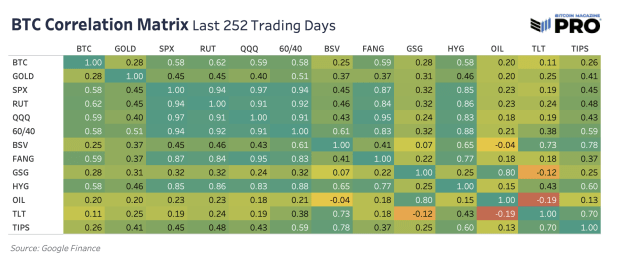
What has been the most watched correlation with bitcoin in the last two years is the correlation with “risky” assets. Comparing bitcoin with traditional asset classes and indices over the past year or 252 trading days, bitcoin is most correlated with many risk benchmarks: S&P 500 Index, Russel 2000 (small-cap stocks), QQQ ETF, HYG High Yield Corporate Bond ETF and FANG Index (high – growth technology). In fact, many of these indices are strongly correlated and show how all assets are related in the current macroeconomic regime.
The table below compares bitcoin to several major asset class benchmarks in high beta, equities, oil and bonds.
Another important note is that bitcoin trades on the market 24/7 while other assets and indices do not. Correlation may be underestimated here as bitcoin has proven to lead the market for greater risk or liquidity in the past as bitcoin can be traded at any time. As the CME bitcoin futures market has grown, using this futures data produces a less volatile view of the change in correlation over time as it trades on the same timeframe as traditional assets.

Looking at the 3-month correlation of CME bitcoin futures versus some of the risk indices mentioned above, they are all tracking.
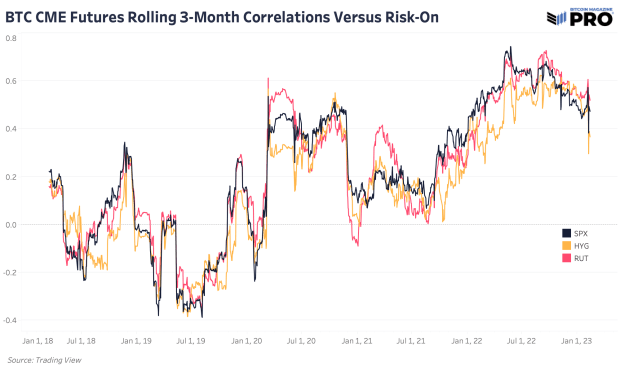
Although bitcoin has had a capitulation and deleveraging in its own industry that rivals many of the historical fundamental events we’ve seen in the past, its relationship to traditional risk hasn’t changed much.
Bitcoin ultimately acts as the most risk-averse allocation and as a liquidity sponge, performing well in any indication of expanding liquidity back into the market. This reverses with little sign of rising equity volatility in the current market regime.
We expect this dynamic to change significantly as understanding and adoption of Bitcoin accelerates. This adoption we see is an asymmetric upside to how bitcoin trades today rather than how it will trade 5-10 years from now. To date, bitcoin’s risk correlation remains the dominant market force in the short term and is key to understanding its potential trajectory over the next few months.
Read the full article here.
Enjoy this content? Subscribe now to receive PRO articles directly in your inbox.

Related articles:
- A Rising Tide Lifts All Boats: Bitcoin, A Live Risk Asset With Increased Global Liquidity
- Bubble Everything: Markets at the Crossroads
- How Big Is The Whole Bubble?
- No Average Recession: Popping the Biggest Financial Bubble in History
- Brewing Emerging Market Debt Crisis
- Evaluating Bitcoin’s Risk-On Propensity
- Debt Crisis & Non-Existing Currency