
Although Bitcoiners often oppose solar power as another ESG attack vector, it could make Bitcoin more resilient and decentralized.
This is an editorial opinion by Robert Hall, content creator and small business owner.
I don’t know where you come on the solar energy debate, but whether you support or oppose investing in more solar is irrelevant. Regardless of how you feel about green energy, installing solar panels on rooftops has been a common choice for homes, schools and business owners for the past 10 to 15 years, and the installation doesn’t seem to be slowing down any time soon.
Did you know nearly 4% of US homes have solar panels installed? This is not a small number and will continue to increase, especially with the Inflation Reduction Act providing subsidies for solar energy.
A study by Princeton University found that added solar capacity could increase from 10 gigawatts (GW) in 2020 to five times as much by 2024 and 100 GW per year by 2030.
As you can see, solar energy is not going anywhere. So, instead of being hostile to solar energy, should Bitcoiners think about changing their position on solar? I think it’s time to reconsider.
Enemy to Solar
In Bitcoin circles, solar is often synonymous with ESG, a set of guidelines used by socially conscious investors to determine how companies affect the environment and communities in which they operate. Sounds harmless right?
But when you get to know them, you realize that behind the nice talk, there is an agenda set by the elite in society to control the energy that other people can use, how much meat they can eat, how many miles they can run. travel and so on. It’s a very twisted way of looking at the world.
This worldview is not surprising because these elites are used to it and use the Cantillon effect to their advantage. Therefore, many Bitcoiners associate solar power and ESG considerations with the fundamental problems of the legacy economy.
But the real question we face as Bitcoiners and as free people in the world is: What can we do to secure our freedom in an environment of increasing surveillance and inflation that steals our wealth and time?
The answer is that we need to get our own energy production.
Personal Energy Sovereignty
One thing that Bitcoin has taught us is that decentralization is very important for the resilience of any system, especially energy and Bitcoin. Centralization of power makes the population easier to control and manipulate.
Look at what Ukraine is doing as a combined attack from Russia trying to break the energy grid. This is only possible because the energy grid is centralized, like other countries in the western world. Centralizing energy production may make energy cheaper to produce, but it is still a major point of failure that adversaries can exploit.
Decentralization of energy production is the only way to make the country resistant to attack and keep the lights on in an emergency. And rooftop solar is the only technology that can do this at scale and relatively quickly.
Solar rooftop unshackles the individual from the central power grid, promotes self-sovereignty and becomes a buyer of energy to an energy seller. So self-sovereignty is where rooftop solar and the value of Bitcoin align perfectly.
Solar Plus Bitcoin Mining is similar to Merdika
According to the US Energy Information Administration, the average American home uses about 886 kilowatt hours (kWh) of energy per month. Solar installation costs vary by location, but on average, you can expect to pay around $18,000 to $25,000. Using a website such as Project Sunroof, you can enter your address and see how much solar would cost for your home. This is what I get when I enter my address:
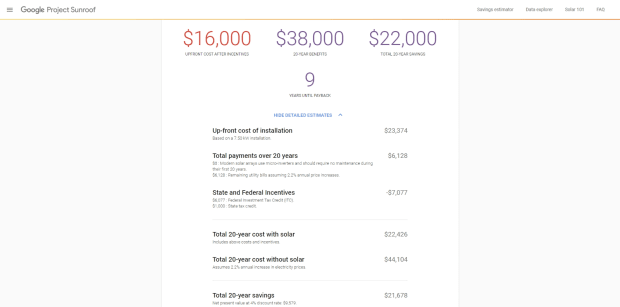
As you can see, the potential savings are quite significant. The money saved with rooftop solar can buy more bitcoins, instead of paying the utility company. Another Bitcoin, you say? Yes, please!
And the savings are not even the best, friends. When you add Bitcoin miners to the mix, now you’re cooking with gas! Rooftop solar is notorious for being unpredictable and oversupplying the grid with power during the day when demand is low. The utility company will often pay you for this oversupply of energy, but they don’t pay very much.
For example, in Arizona, the utility company will pay you up to 9.4 cents per kWh of excess power. The kicker is that this rate has the potential to decrease by 10% per year. This is, of course, to prevent people from putting solar panels on the roof, thus limiting the sovereignty and independence of the grid.
So, instead of selling your excess power to a utility company, you can use your excess energy to mine Bitcoin! Which one sounds like a better deal? Stacks sitting with the sun or getting paid back with dirty, depreciating, fiat currency?
Not only do you monetize the excess energy generated in your home with solar panels, but home mining with them also decentralizes Bitcoin mining even more, thus making the network stronger and longer lasting.
Now, imagine this at scale: Millions of solar-powered homes and Bitcoin miners gone. This is the future I want. I can see solar companies in the future offering Bitcoin mining as a value added product. It’s a no brainer if you ask me.
Rooftop solar is in line with the ethos of Bitcoin and should be embraced by Bitcoiners.
This is a guest post by Robert Hall. Opinions expressed are entirely their own and do not necessarily reflect those of BTC Inc or Bitcoin Magazine.