Below is an excerpt from the latest issue of Bitcoin Magazine PRO, Bitcoin Magazine’s premium market newsletter. To be the first to receive this insight and other on-chain bitcoin market analysis straight to your inbox, subscribe now.
Analyzing Indicators Down On-Chain
In this week’s dashboard release, we’re highlighting some of the key on-chain metrics we like to track. In this article, we want to describe it in more detail. In bitcoin’s short history, many on-chain cyclical indicators are now showing what appears to be a classic bottom in bitcoin’s price. Market extremes – above and below potential – are where these indicators have proven to be most useful.
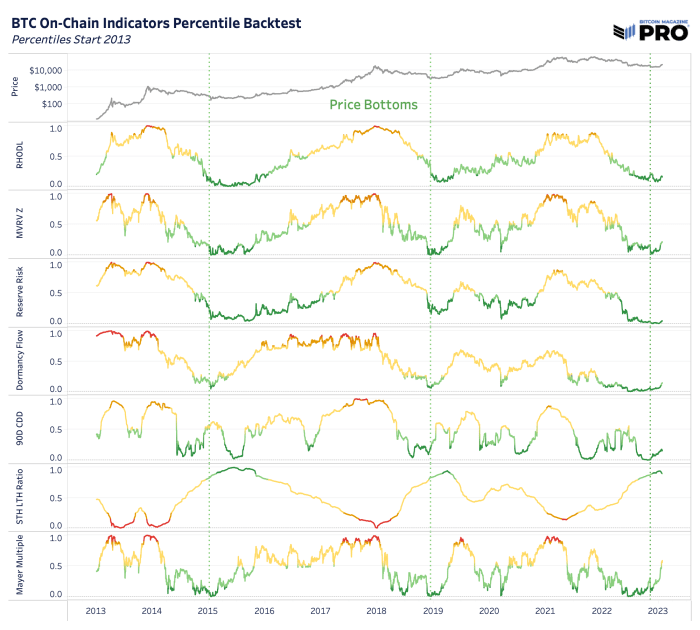
The on-chain indicator is overlaid with previous bitcoin price fundamentals.
However, these indicators should be considered alongside other macroeconomic factors and readers should consider the possibility that this could be another bear market rally – as we are still below the 200-week moving average price of around $24,600. That being said, if the price can hold above $20,000 in the short-term, the bullish metrics suggest an interesting long-term accumulation here.
A major tail risk can be a market-wide selloff in risk assets that are currently priced in a “soft landing” style scenario along with the potential wrong expectations of the Federal Reserve’s policy pivot in the second half of this year. Many indicators and economic data still point to the possibility that we are in a bear market similar to 2000-2002 or 2007-2008 and the worst is yet to happen. This secular bear market is different from this bitcoin cycle compared to others in the past and that makes it more difficult to use historical bitcoin cycles after 2012 as a perfect analog for today.
All that said, from a bitcoin native’s perspective, the story is clear: Capitulation is clear, and HODLers are holding the line.

Due to the transparent nature of bitcoin ownership, we can see the various cohorts of bitcoin holders with great clarity. In this case, we look at the realized price for the average bitcoin holder as well as the same metrics for long-term holders (LTH) and short-term holders (STH).
Realized price, STH realized price and LTH realized price can give us an understanding of where the various market cohorts are in profit or underwater.
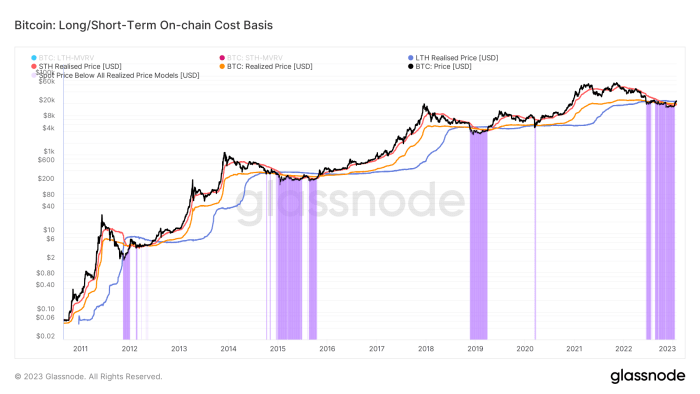
A look at the realized price for short- and long-term holders.
On a monthly basis, realized losses have flipped to realized profits for the first time since last April.
Capitulation and loss loss has been flipped to the realization of profit across the network, which is a very healthy sign of a thorough capitulation.
There is a strong case that given the current elasticity of bitcoin supply – evidenced by the historically small number of short-term holders or the larger number of long-term holders – it will be a challenge to shake up current market participants. . Especially considering the challenges we’ve faced over the past 12 months.
Statistically, long-term bitcoin holders are usually not surprised when faced with bitcoin price volatility. The data shows a healthy amount of accumulation throughout 2022, despite the large risk events in the bitcoin and legacy markets.
While the liquidity dynamics in the legacy market are worth noting, the supply side dynamics for bitcoin appear to be as strong as ever. All it will take for significant price appreciation will be new demand.
Enjoy this content? Subscribe now to receive PRO articles directly in your inbox.