
Bitcoin mining difficulty is currently at its highest values, but miners seem unfazed by the fact that the hashrate just keeps on rising.
Bitcoin Mining Hashrate Continues Uptrend Despite Increasing Difficulty
“Mining hashrate” is an indicator that measures the total amount of computing power currently connected to the Bitcoin network. These values are measured in terahashes per second (TH/s).
As the value of the metric increases, it means that miners are bringing more machines online in the current network. The trend shows that BTC blockchain is currently attracting miners.
On the other hand, the price of the indicator is down indicating that some miners are disconnected from the chain at the moment. This kind of trend may indicate that it is not profitable for miners to mine cryptocurrency at the moment.
Now, here’s a graph showing the trend in the average 7-day Bitcoin mining hashrate over the past year:

The value of the metric seems to have been sharply going up in recent days | Source: Blockchain.com
As shown in the chart above, the average 7-day Bitcoin mining hashrate surged and reached a new high when it returned, but in the last few days of February, the metric was observed to plunge.
This decline was only temporary, but, since the beginning of this month, the indicator again shows a strong uptrend and has reached an all-time high. To understand why these metrics work this way, the data for “mining difficulty” should be looked at.
Difficulty is a concept built into the BTC blockchain that decides how difficult it is for miners to find mines on the chain. The reason this feature exists is because the network aims to keep what is called a constant “block production rate”.
This rate is a measure of how fast miners are mining blocks on the network. Whenever the hashrate changes, this rate naturally fluctuates because the computing power available to the miners is also different.
To counter these fluctuations, the Bitcoin blockchain changes the difficulty up or down (depending on whether miners are faster or slower now) just enough that the block production rate returns to its default value.
The chart below shows how BTC mining difficulty has changed recently.

Looks like the value of the metric has spiked recently | Source: Blockchain.com
As you can see above, Bitcoin mining difficulty reached a new all-time high in the last network adjustment after the hashrate also reached a new high. Due to this increase in difficulty, the hashrate follows the fall.
As miners find it harder to mine (due to increased difficulty), they make less profit. Therefore, some small miners who earn little profit start to see the disconnection when the difficulty increases like this.
However, it is interesting how the drop in hashrate is only temporary. Miners still continue to add more rigs to the network even though it is difficult to keep sitting at that ATH level.
This may be a sign that the bigger players in the mining space are still very confident about Bitcoin’s future and benefit from expanding their mining facilities now.
BTC price
At the time of writing, Bitcoin is trading around $22,400, down 4% over the past week.
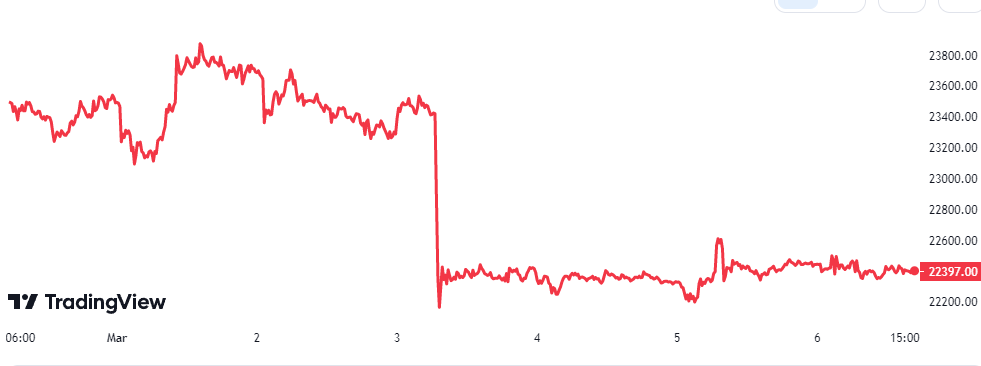
The asset has moved sideways since the plunge | Source: BTCUSD on TradingView
Featured images from Brian Wangenheim on Unsplash.com, charts from TradingView.com, Blockchain.com