
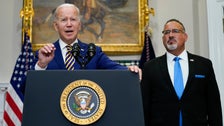
WASHINGTON (AP) – The White House is moving forward with a proposal that would lower student loan payments for millions of Americans now and in the future, offering a new route to paying off federal debt under lower terms.
President Joe Biden announced the repayment plan in August, but it was overshadowed by a sweeping plan to reduce or eliminate student loans for 40 million Americans. Despite the low profile of the payment plan, however, some education experts see it as a more powerful tool to make college affordable, especially for those with lower incomes.
Education Department officials on Tuesday called the new plan a “student loan safety net” that will prevent borrowers from going into debt.
“Student debt has become a dream killer,” said Education Secretary Miguel Cardona. “This is a promise to the American people that, finally, we’re going to fix our broken system and make student loans affordable.”
Biden, a Democrat, is moving forward with a repayment plan even as debt cancellations face an uncertain fate before the Supreme Court. The White House asked the court to uphold the plan and rejected two legal challenges from conservative opponents. The Biden administration submitted its brief last week, with oral arguments scheduled for February 28.
The Education Department officially proposed the new payment plan on Tuesday by publishing it in the Federal Register, kicking off a public comment period that often takes months to navigate.
If passed, the proposal would be a major overhaul of income-driven repayment plans — one of several repayment options offered by the federal government. The resulting plan will have lower monthly payments, an easier path to forgiveness and a promise that unpaid interest will not be added to the loan balance.
The federal government currently offers four types of income-driven plans, but the proposal would mostly eliminate three of those while focusing on one simplified option, reducing the variety of options that confuse borrowers today.
Under the existing plan, monthly payments are capped at 10% of the borrower’s discretionary income, and those earning less than $20,400 a year do not have to pay. The new proposal would cap payments on student loans at 5% of a borrower’s salary, cut the bill in half, and require payments only for those earning more than $30,000 a year.
As long as the borrower makes monthly payments, unpaid interest will not be charged. The changes are meant to prevent borrowers from having unpaid interest added to their loan balances, a practice that can cause debt to snowball even when borrowers make payments.
Importantly, the proposal would also make it easier to clear the debt after several years of payments. Existing plans promise to pay off the remaining debt after 20 or 25 years of payments. The new plan will erase all remaining debt after 10 years for those who take out a loan of $12,000 or less. For every $1,000 borrowed beyond that, a year will be added.
Public graduates of four-year universities would save about $2,000 a year compared to the current plan, the Biden administration said, while 85% of community college borrowers would be debt-free within 10 years.
Supporters see the proposal as an important step toward tuition. Some say it’s too generous to come close to free community college — a campaign promise Biden pushed but failed to deliver.
Enemies on the right blasted the revised plan as an unfair handout with a steep price tag. The Biden administration estimates the repayment plan will cost nearly $138 billion over a decade, and some critics have put it closer to $200 billion.
Even some on the left have questioned the soundness of the idea, saying the generosity effectively turns student loans into funds that don’t need to be repaid. That could cause more students to borrow, they warn, and could spur colleges to raise tuition prices if they know students won’t be on the hook.
Still others are calling for the administration to scrap the income-driven payment plan, calling it a failed policy. Critics cited a federal report from last year that found that poor oversight of the program left thousands of borrowers stuck with loans that should have been forgiven.
Cardona said his agency is working on other proposals that would hold colleges accountable if their students take on too much debt. One of the ideas proposed by Biden is to warn the public about programs that leave graduates overwhelmed with debt.
The Department of Education on Tuesday began a process to deliver on those goals, asking the public how best to identify “low value” programs.
The Associated Press education team received support from the Carnegie Corporation of New York. AP is solely responsible for all content.