
[ad_1]
Well, it’s happening. And not only that — it’s happening in … the cloud.
Tilly Norwood, the AI “actor” so controversial that it unleashed a furor in Hollywood last year, has landed its first role — sort of.
Particle 6, the same AI-powered content studio that created Norwood in the first place, announced Monday that the character will play the lead role in its upcoming drama, Misaligned.
Misaligned is described as a comedy-drama telling a “coming-of-age story infused with existential AI chaos.” It’s set in something called the “Tillyverse,” a surreal digital world “located somewhere up in the Cloud.”
“Art will most definitely be imitating life,” Eline van der Velden, CEO & Founder of Particle 6, said in a news release.
But whether that is art people want is another matter.
“This will feel quite chilling to anyone who acts. Best of luck,” entertainment writer and film critic April Neale posted on X Monday.
“No plans to see this film or cover it … support humans!” independent Hollywood journalist Jeff Sneider added on X.
SAG-AFTRA, the union representing actors and other performers in the U.S., has previously criticized Particle 6 for creating the “synthetic performer.” Dozens of Hollywood actors have also voiced their distaste, and van der Velden has said she received death threats.
Meanwhile, Norwood’s existence has sparked wider discussions about the future of filmmaking, including the appearance of entirely AI-generated movies at film festivals and the use of AI to recreate actors after their deaths.
“This is exactly what AI companies have been promising, and actor’s unions worried about,” Richard Lachman, a digital media professor at Toronto Metropolitan University and author of Digital Wisdom: Searching for Agency in the Age of AI, told CBC News.
“It isn’t unexpected, it’s the next natural step, but it doesn’t necessarily represent an inevitable future,” he added, explaining that he thinks we’ll see two models of AI use in film-making — one that’s AI-heavy, and one that keeps AI limited to special effects, colour-grading and the technical realm.
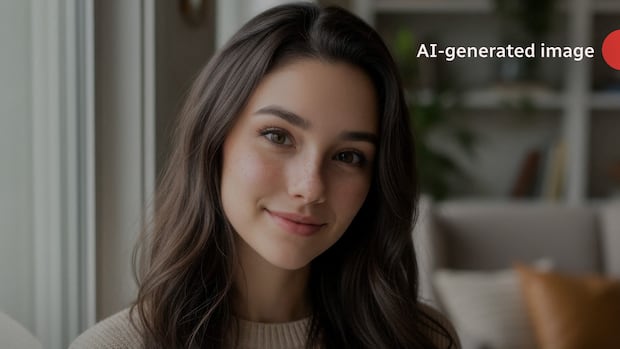
European AI production company Particle6 says their AI-creation Tilly Norwood has generated a lot of interest, but Hollywood actors including Emily Blunt, Melissa Barrera and Whoopi Goldberg as well as the SAG-AFTRA union have come out against the AI character.
‘Poor clanker’
SAG-AFTRA has reminded the industry that Norwood is not a real actor. Meanwhile, celebrity profile writer Taffy Brodesser-Akner of The New York Times Magazine repeatedly reminds herself that “Tilly is just a computer” in a recent interview with the creation.
Particle 6 appears to be leaning into the same existential discomfort with Misaligned.
The movie is set inside a surreal digital world and follows Tilly as an AI being “with no real body, no childhood and no lived experience of her own … only access to everyone else’s,” the company said in its news release.
Then things spiral, Particle 6 said, and Tilly becomes “terrifyingly human.”
“Poor clanker,” tech and entertainment website Polygon wrote sarcastically in the subheadline of an article Monday about how AI’s most infamous “actor” will “star in a ‘coming-of-age’ movie about how rough it is to be AI.”
Clanker is a derogatory term for AI systems and robots.
The movie is currently in early development, with “key collaborators currently being attached,” Particle 6 said in its news release.
The company said it is being designed as a hybrid production combining “traditional” film professionals, such as directors, writers and editors, with AI specialists.
“Reminder that none of this is real,” actor and filmmaker Luke Barnett wrote on X Monday, reminding readers that the company making the movie is the same one that created Norwood.
“Don’t let the headlines scare you, this is all a scam. The industry isn’t ‘hiring Tilly Norwood,'” he said.

Actors union advocates for AI protections
CBC News has reached out to SAG-AFTRA for comment on Norwood’s role in Misaligned but has not heard back yet. In September, the union posted a statement that “‘Tilly Norwood’ is not an actor.”
“It’s a character generated by a computer program that was trained on the work of countless professional performers — without permission or compensation,” the statement reads.
“It has no life experience to draw from, no emotion and, from what we’ve seen, audiences aren’t interested in watching computer-generated content untethered from the human experience.”
As the Los Angeles Times noted, the union has been advocating for stronger AI protections for actors. In June, SAG-AFTRA approved a contract it described as “celebrating human performance,” because of additional terms restricting the use of synthetic performers.
SAG-AFTRA also supports a federal bill, the NO FAKES Act, which would establish individual property rights over a person’s voice and likeness, the union said in a news release.

Generative AI is making its way into publishing, leaving authors and creators with differing views on the technology. The CBC’s Ben Dornan reports. Correction: A previous version of this story said that MacIntyre Purcell Publishing used AI to generate and scramble words in some puzzles in a puzzle book. MacIntyre Purcell Publishing says they do not publish AI-generated material and the information was provided to Nimbus in error.
But Lachman, the digital media professor, says he sees a lot of promise with AI. This is especially true for indie films, he added, where filmmakers may not have the funds or experience to shoot a movie in the traditional way.
Yet there are still some major concerns, he added, like how the industry will develop talent when the spaces where big-name actors tend to learn their craft — spaces like independent and low-budget projects — could most easily be taken over by AI.
And there’s a second concern, Lachman said.
“Having AI actors live forever, never aging, never missing a day of work, never making embarrassing comments at an LA nightclub, will also reduce the opportunities for new actors.”
[ad_2]
Source link