
In a highly controversial move, the US Securities and Exchange Commission (SEC) fined crypto exchange Kraken $30 million yesterday and forced it to shut down its staking product. In an announcement Thursday, regulators announced that Kraken failed to register its crypto-asset-staking-as-a-service program with the SEC.
In a series of tweets, Jesse Powell, co-founder and CEO of Kraken, stated he hopes there will be an exchange that dares the SEC. But, he said, it would be “a brutal, long, expensive fight.” For “risk-adjusted return” reasons, Kraken chose not to fight the case in court.
“A bigger balance sheet will not hurt. They lifted the bottom of the bear market, waiting for us to do 30% layoffs. They have all our finances, a lot of influence. Maybe we look weak. This is more about FTX than us or staking but the timing is not good, Powell said.
Is the SEC Targeting Coinbase?
SEC Chairman Gary Gensler said the action was intended to make it clear to the market that staking-as-a-service providers must register. This has caused uproar in the crypto industry and raised questions about who the SEC will target next.
As the largest US exchange, Coinbase seems to be a potential target, especially since CEO Brian Armstrong was one of the first to report the crackdown yesterday. After the news, COIN shares fell 14%.
However, according to Paul Grewal, Chief Legal Officer (CLO) at Coinbase, it is unlikely that the SEC will target his company. Grewal explained through Twitter that the Kraken products are meant to produce products. “The actual on-chain staking service like ours is completely different,” he said.
“The rewards of our customers are connected to reality. They depend on the rewards paid by the protocol and the commissions we reveal. We do not play games. Our customers have the right to rewards. We cannot just decide not to pay any rewards,” said the CLO of Coinbase .
Furthermore, Grewal explained that rules that make these distinctions clear would provide real clarity for the industry and consumers. On the other hand, CEO Armstrong has expressed his willingness to fight if the SEC attacks Coinbase customers.
We will continue to fight for economic freedom (our mission at Coinbase). Some days being the most trusted brand in crypto means protecting customers from government overreach.
— Brian Armstrong (@brian_armstrong) February 10, 2023
Who’s Next on the SEC’s Crypto List?
Exchanges aren’t the only ones that could be the focus of new regulatory scrutiny. At this point, it is not known whether the evidence of stock-based cryptocurrencies such as Ethereum will also be the focus of the SEC, and whether a securities classification for ETH is planned by the SEC. At least, the press release gives no indication of that.
Meanwhile, rumors say more enforcement actions are coming from the SEC. As Samuel Andrews report, more “exchanges and stablecoin issuers will receive the Wells Notice in the coming days and weeks.” A Wells Notice is a notice issued by a regulator to inform an individual or company of a completed investigation where a breach has been found.
One rumor has arrived. New York Department of Financial Services (NYDFS). investigate stablecoin publisher Paxos. While the scope of the investigation is unclear so far, Pax Dollar (USDP) and Binance USD (BUSD) are among the company’s stablecoins and could be part of the investigation.
On another note, Paxos has did not return rumors that the US Office of the Comptroller of the Currency is asking crypto companies to withdraw their applications for full banking licenses:
To clarify speculation: Paxos has not been asked to withdraw its application for a national trust bank charter from the OCC, nor has it been denied the charter. Paxos continues to work constructively with the OCC.
Another name Andrew learned from an anonymous source was Circle. The second largest stablecoin issuer in the crypto market, USDC, may also face a Wells Notice.
At press time, the Bitcoin price stood at $21,898, trying to bounce back.
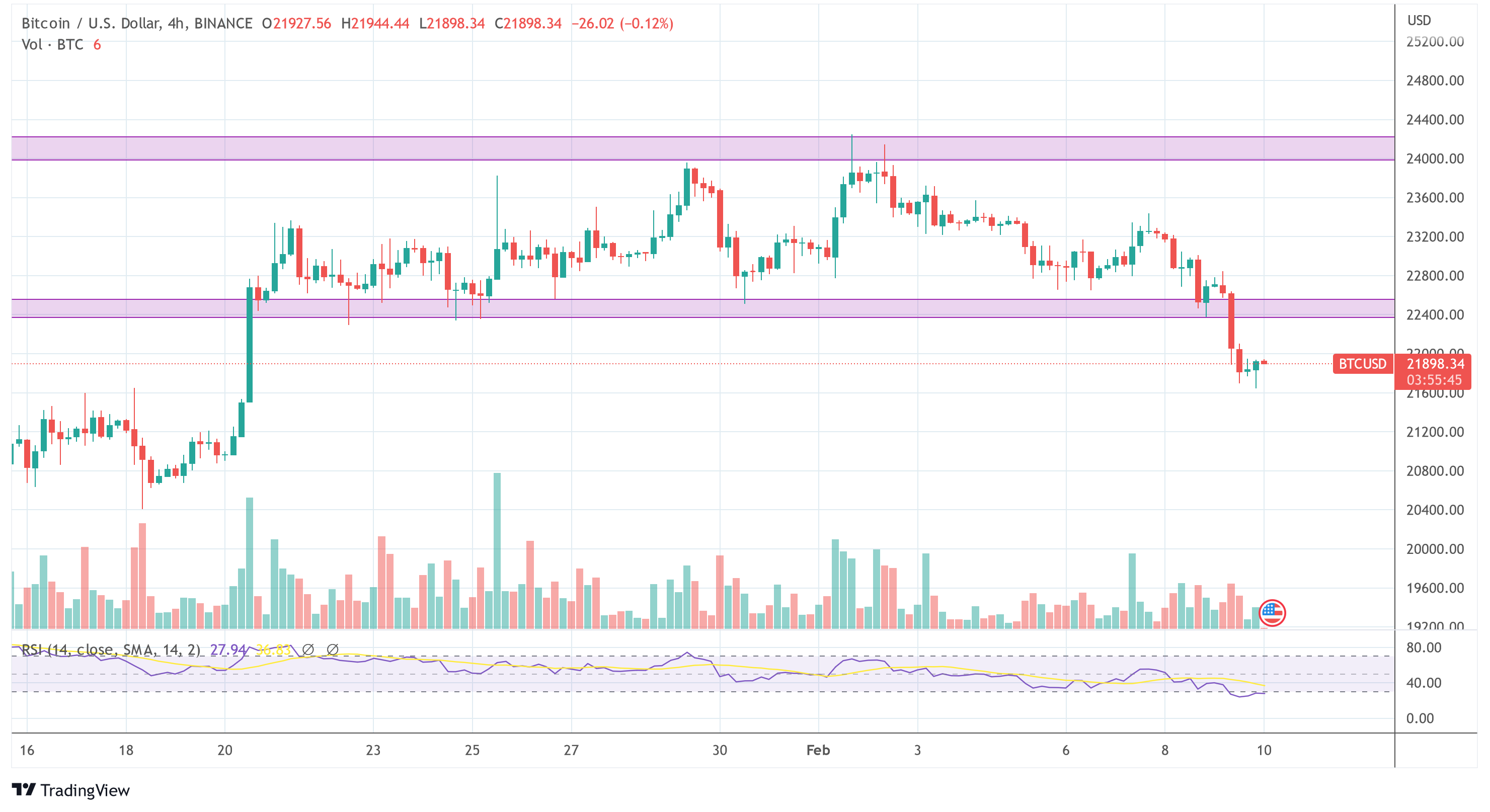
Featured image from NBC News, Chart from TradingView.com