
Bitcoin inscriptions have been out for a few more weeks, so we follow up on the fee market and block usage to observe what changes after 100,000 inscriptions.
Below is an excerpt from the latest issue of Bitcoin Magazine PRO, Bitcoin Magazine’s premium market newsletter. To be the first to receive this insight and other on-chain bitcoin market analysis straight to your inbox, subscribe now.

Addressing Bitcoin Decentralization & Block Space
New users have flocked to Bitcoin to create what are known as inscriptions – often called NFTs (non-fungible tokens) on other blockchains. Image files typically increase demand for Bitcoin block space, leading some network participants to worry about Bitcoin’s future decentralization. If the cost of running a full node increases significantly because users need storage space and bandwidth to download all this data unrelated to monetary transactions, fewer people can run a full archive node, with the centralization of the Bitcoin ledger.
The cumulative amount of storage used by inscriptions continues to rise with almost 3 GB of storage dedicated to inscriptions at the time of writing.
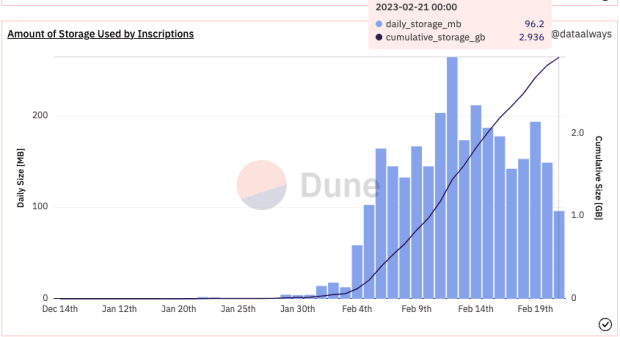
If the block space is continuously used up to 4 MB, it will add about 210.24 GB of data to the chain every year, which is not a major cost barrier to open a full node but can still be considered expensive in space. where technology is not available cheaply. There is the ability to run pruned nodes that do not require the storage of any witness data and only track Bitcoin monetary transaction data. However, to create a pruned node, the user still needs to download it entire from the first data. Here comes the concern of insufficient bandwidth. In areas of the world where there is no access to high-speed internet, the initial block download can take so long that it cannot sync to the chaintip.
If that is the case, the hope for the Bitcoin blockchain is always that it will be full at some point, which is partly why there is a cap on the size of the block. This cap was raised during the SegWit soft fork and includes fee discounts for witness data – like inscriptions – that are not linked to Bitcoin’s financial ledger and unused transaction output sets (UTXO).
Bitcoin has been compared to a decentralized clock because of the way it tracks the sequence of transactions as they happen around the world. The nature of inscriptions in Bitcoin uses this order for inscription numbers when written on the blockchain, aka timechain. When the number of inscriptions approached 100,000, people rushed to get the inscriptions confirmed before or exactly in that number. We see the biggest increase in costs at this time, which is shown above in dark green. With a quick look at the fee rate chart, it is clear that when the 100,000th inscription is made, the most fees are more than 25 sat/vByte.
After this monumental inscription number, the rush to create NFTs in Bitcoin has decreased drastically. While there is still a backlog of transactions in the mempool, the cost required to confirm transactions in the next block has dropped significantly and the total daily cost of creating inscriptions is “just going down.”
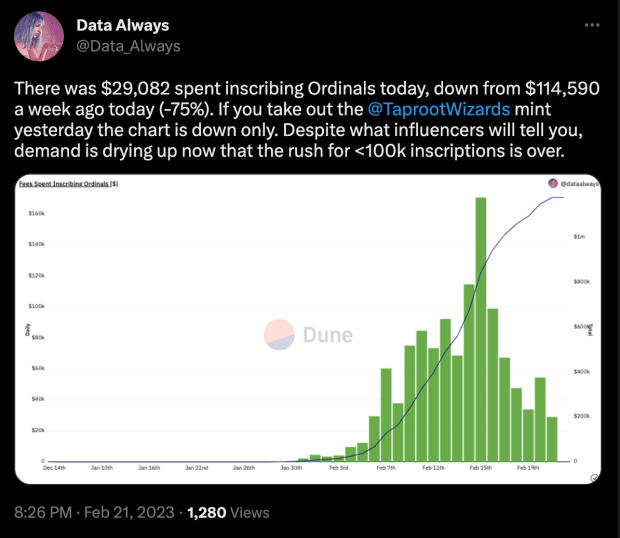
Although the cost is decreasing along with the total amount of money bought in the inscriptions every day, the number of transactions pending in the mempool remains high and constant, with no signs of letting up in the short term.
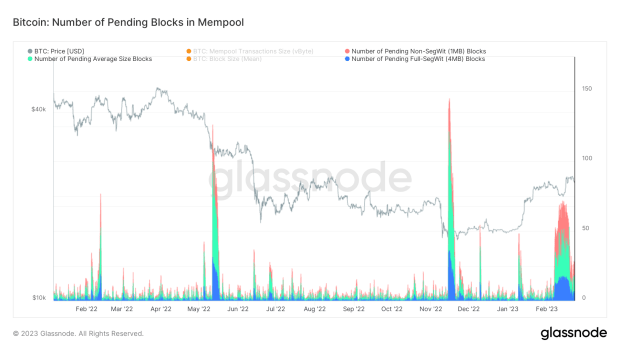
In the past mining era, blocks were mined so fast that there was a difficulty adjustment of almost +11%.
“The expected ratchet up in mining difficulty will remove some of the relief felt by operators in the past few weeks, due to the increase in USD-denominated income. The miner’s income in bitcoin terms will return to the lowest position. – State of the Mining Industry: Common Miners Beat Bitcoin
This fast mining block rate allows multiple inscription transactions at lower cost rates to be mined because blocks are mined faster than new transactions are broadcast to the network.
Now that the initial rush to become an early inscriber is over, one theory is that inscriptions will become buyers of last resort for block space when costs are low and fewer people are transacting on the chain.
We will see if this thesis plays out. It is possible that the lower cost period will be used by those who open the Lightning channel as well, which is one of the arguments against the inscription because it can lead to the financial use case of Bitcoin.
A final note
There are unanswered questions about the bandwidth requirements to download the full node of the archive as well as the cultural question of whether these non-monetary transactions should occur in the base layer of Bitcoin or if they can be moved to Layer 2.
Enjoy this content? Subscribe now to receive PRO articles directly in your inbox.

Relevant past articles:
- Fee Market Competition: Bitcoin Ordinals and Inscriptions
- The State of the Mining Industry: Common Miners Outpace Bitcoin
- Before You Think: An Objective Look at Bitcoin Adoption
- The State of the Mining Industry: Survival Of The Fittest
- Tired Bitcoin Sellers, Accumulators HODL Lines