
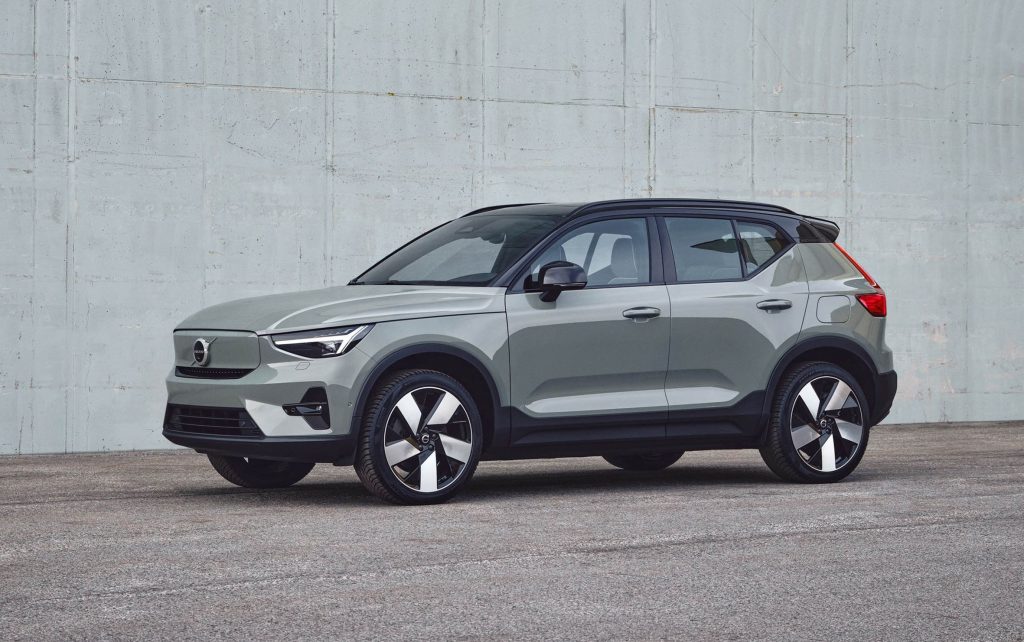
The Volvo XC40 P6 Recharge was released as a “more affordable” version of the twin-engine XC40 P8 that was launched in March last year.
Sacrifices must be made for the model to be cheaper than the P8. The P6 is a single 170kW front-wheel drive motor with a slightly smaller lithium-ion battery at 69kWh, vs 78kWh in the P8.
Despite the difference in battery size, which causes the P6 to be 158kg lighter, it promises to be more efficient with a higher range of 423km on a single charge (WLTP cycle) versus 418km on the P8.
It has a peak output of 170kW and 330Nm of torque and can accelerate from 0-100km/h in 7.4 seconds, which is 2.5 seconds higher than the P8 with 300kW of power and 660Nm of torque.
The models look the same, except the back of the P6 says “Recharge”, and the P8 says “Recharge Twin”.
I spent a few weeks with the P6 from mid-December to January, and during that time, we experienced the worst load-shedding.
Located in Johannesburg, power outages last up to 4.5 hours at a time with shorter intervals between the next scheduled cuts. Having an electric car longer than normal during the sixth stage means that it is not easy to plan.
I previously maintained that, during the fourth stage, I can work around it. Now, I have to pay attention if my power outage is 2.5 hours or 4.5 hours and the time between the next scheduled cuts. If I use a public charger, I have to make sure it’s online and available.
The electric vehicle (EV) has an on-board 11kW charger that can be used at home. It also comes with a home wall box charging station when you buy it. I use a single phase 32A 7.4kW front charger to recharge often. But I found that the car gave me an inaccurate estimate of when the charge would be due. It’s always off by more than an hour, unlike other EVs I’ve used with.
Interestingly, to use Audi’s public charger in the suburbs, I was told that I needed “permission” from the principal. I also had problems with the Porsche charger when I had the BMW on test. But Jaguar and BMW dealers don’t ask you when you show them electric cars of other brands.
EVs all use the same Type 2 charger, so dealers need to be more open-minded about allowing EV drivers to use their chargers. It works both ways for drivers as well.
Charging issues aside, the car seamlessly fitted into my lifestyle for the type of commutes I do. I don’t drive to work every day, I walk in the suburbs, and rarely drive long distances.
For those of you who don’t know, some electric Volvo XC40s don’t have a “start” button. You just put the vehicle into gear and drive off. Having led P8 in Bukak, I am familiar with this, and do not find it out of the ordinary. After you hit the park button and open the door, the car turns off.
It’s powerful enough to go around or accelerate when shooting, and to be fair, I don’t need the power that the P8 has. As a “less powerful” option, it is ideal for those who want to transition to an EV for the amount of driving they do.
When I am below 50% in the battery, I will use some optimiser, but even then, I drive more economically than I do in a gasoline car. Outside of the optimization mode, I didn’t find the AC to be as powerful as I expected for summer in Joburg. Average consumption over three weeks is 22.6Wh / 100km.
The P6 is comfortable inside. It has plenty of room with conveniences like a heated steering wheel and seats, wireless phone charging, multiple USB-C ports and a park assist camera.
It also has a large Android-powered infotainment system with built-in Google services, which requires internet connectivity to work. I also paired my iPhone seamlessly to use Apple CarPlay.
I love using Google Maps natively in the car because it gives you a battery percentage indicator when you get to your destination. This little information is very important for EV drivers who will also find it easier to find a charger near your destination.
But connectivity is poor on South African roads. Frequent load shedding also means mobile towers are not working, thus adding to the problem. When there is no connection feeding through, a large chunk of the driver’s view is empty. You can’t change it to a different display because it only supports one screen.
And that brings me to the next point. Basic Android-based infotainment; it doesn’t take much effort to make it look great. The interface can do with skins, like how Samsung, Oppo and Xiaomi have their own overlays on Android; I feel less in the car.
Overall, I enjoyed driving the Volvo XC40 P6 Recharge. Stage six shedding the load is really a problem, and the outlook is not good but requires more planning before exiting.
The P6 Recharge is billed as the “most affordable” luxury electric car, as it is the company’s “entry-level” EV. All 25 units allocated at launch sold out within 24 hours via the myvolvo.co.za portal.
EVs are still expensive in South Africa, and the R1 075 000 price point appeals to a niche market. No EV stock is sold exclusively online.