
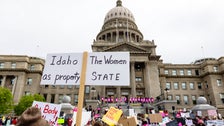
The Idaho Constitution does not implicitly enshrine abortion as a fundamental right, the state Supreme Court ruled Thursday as it rejected several lawsuits brought by Planned Parenthood.
The ruling is a blow to those who oppose the Idaho law that took effect in August, including one that criminalizes all abortions after six weeks of gestation except to save the life of the pregnant woman or for rape or incest.
“This is a dark day for the state of Idaho. But our fight is far from over,” Rebecca Gibron, CEO of Planned Parenthood Great Northwest, Hawaii, Indiana, Kentucky, said in a statement.
Planned Parenthood and family doctors are bringing three lawsuits against the governor and Legislative leaders in an effort to block the new abortion ban. One law allows potential family members of a fetus to sue a health care professional who performs an abortion. Others make it a crime for medical professionals to perform abortions after electrical activity is detected. And a third effectively bans all abortions but allows doctors to defend themselves in court by proving that the abortion was performed to save the patient’s life.
The Idaho Supreme Court heard arguments for all lawsuits in a joint hearing last year. Thursday’s ruling applies to all three cases.
Planned Parenthood claims the law violates constitutional principles such as equal protection and due process, a high court judge said.
But the majority of the judges said in the decision that the Constitution of the country does not provide a fundamental right to abortion.
“Since Idaho attained statehood in 1890, this Court has repeatedly and steadfastly interpreted the Idaho Constitution based on the plain and ordinary meaning of the text,” the justices said.
If they jump to the conclusion that the document implicitly protects abortion rights, the Constitution “will be effectively changed by the votes of a few people sitting on this Court,” the justices maintained.
Idaho Supreme Court Justices Colleen Zahn and John Stegner dissented from the majority opinion. Zahn said, “The Idaho Constitution doesn’t freeze rights like it did in 1890.”
“We must look to the history and traditions of Idaho to determine the intent of the framers but will not be locked into examining the right only under the circumstances that existed in 1890,” Zahn wrote.
In his opinion, Stegner noted the impact of pregnancy on women, saying the majority opinion “takes away the most basic rights of Idaho women.”
“Idaho women have a fundamental right to an abortion because a pregnancy — and whether that pregnancy can be terminated — has a profound effect on a woman’s inalienable liberties, as well as her right to life and safety,” Stegner wrote.
Idaho’s ban has increased pressure on abortion facilities in neighboring Oregon, where abortion rights are protected.
In South Carolina, the state Supreme Court on Thursday struck down a ban on abortions after cardiac activity is detected, ruling the ban violates the state’s constitutional right to privacy.
The South Carolina court said the state has the authority to limit privacy rights that protect women from state interference with their decisions, but any restrictions must allow women sufficient time to determine if they are pregnant and “take reasonable steps to terminate the pregnancy.” .”
The Idaho Supreme Court said the case focused.
“All we have decided today is that the Idaho Constitution, as it stands, does not include a fundamental right to abortion,” Judge Robyn Brody said in the majority opinion.
Brody said Idaho’s new anti-abortion law “is rationally related to the government’s legitimate interest in protecting prenatal fetal life at all stages of development.”
Idaho’s law came after the U.S. Supreme Court last year overturned the Roe v. Wade, which guarantees abortion rights under the US Constitution.
A narrow section of one of Idaho’s abortion bans has been temporarily blocked by a federal judge in a separate case.
Opponents of abortion applauded the Idaho court’s decision.
“Today is a good day for babies born in Idaho,” said Blaine Conzatti, president of the Idaho Family Policy Center, a conservative Christian policy research and education organization.
Planned Parenthood said the court’s decision will especially affect those who have faced the greatest barriers to health care because of a legacy of racism and discrimination, including people of color, low-income people, immigrants and others.