
This is an editorial opinion by Josef Tětek, Trezor brand ambassador for SatoshiLabs.
The African Bitcoin Conference (ABC) was held earlier this month in Accra, Ghana. Some events in your life have such an impact that you find it difficult to return to everyday reality after you’ve gone through them. My visit to this event was one of those experiences.
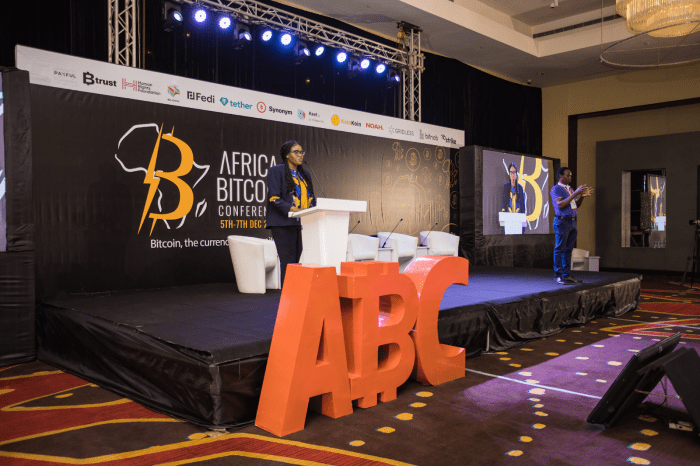
Images throughout are copyrighted ABC photographer Nana Twum.
Pre-Conference Orange Pilling On The Beach
For some time now, I have been a big fan of Alex Gladstein and his perception of Bitcoin as a tool to empower the disenfranchised, the exploited and the oppressed. This spring, I gulped down a new book called “Check Financial Privilege,” and a few weeks later I had the good fortune to visit the organization Oslo Freedom Forum. But even if I know rationally that Bitcoin is a necessity for billions around the world, I never really have experience Adoption of this perspective, and never met the very person for whom Bitcoin can be a life preserver. That changed for me a few weeks ago in Ghana.
Oddly enough, the most eye-opening thing for me about local Bitcoin adoption was not the conference itself, but rather, the interaction with ordinary Ghanaians in the city of Accra, who learned most about Bitcoin for the first time from us, the conference attendees.
Some other Bitcoiners and I, including Hermann Vivier (the organizer behind the South African circular economy project Bitcoin Ekasi) visited the local beach the day before the conference began, and spent the whole afternoon discussing Bitcoin with the residents. What we found is that Bitcoin becomes very real when local residents are shown that they can receive value quickly, without registration, and spend airtime directly through Bitrefill. Whoever we talk to – fishermen, souvenir traders, taxi drivers, artists – we witness the same cognitive process: from indifference and suspicion to joy, within minutes. All that is required is to present a direct use for Bitcoin, and everything is clicked.
Now, this may not seem like much to some readers, but the reality is that in many places, there is no easy way to make digital payments. Western Bitcoiners are used to seeing bitcoin as a long-term store of value – which is, of course, a valuable use case everywhere in the world – but in many countries, bitcoin is also an exceptional medium of exchange. And often, the only thing missing is knowledge of the Bitcoin ecosystem.
Bitcoin: The Pan-African Hope
One theme that resonated throughout the three-day conference is the notion that Bitcoin can serve as a tool for liberation from the post-colonial control system in the form of the IMF, the World Bank, the CFA franc system and similar obstacles.
Gladstein explained in essence the debt slavery that most African countries are in, with the IMF and the World Bank willingly lending billions of dollars to dictators, while the citizens of that country are then forced to pay the debt, even. although the loans are only to fill the personal coffers of the kleptocrat dictators. Gladstein’s talk is based on his latest essay for Bitcoin Magazine, in which he outlines the frustrating details of the IMF/WB exploitation scheme.
Africa is probably the continent most damaged by fiat money. Fourteen countries still have a currency managed by the French government (CFA franc regime), two countries are currently experiencing inflation close to or above 100% (Zimbabwe and Sudan), almost half of African countries face inflation higher than 10%, and cross -border payments are often expensive or impossible. Many speakers pointed out that Bitcoin is the only viable way out, and the only practical chance to unite the continent.
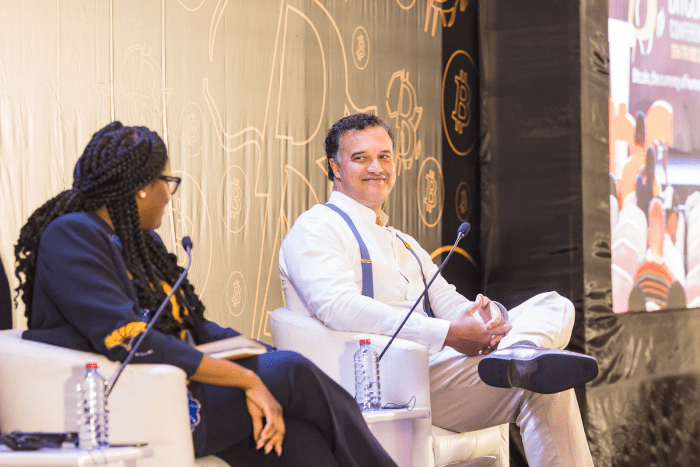
Ray Youssef from Paxful in a fireside chat with Farida Nabourema: Bitcoin has the potential to unite 54 countries in Africa and pave the way to extraordinary prosperity.
The pan-African nature of Bitcoin is often touched on: in many discussions, panel discussions and networks that do not have a stage – it does not matter from which country the speaker is; Bitcoin is generally understood as a pan-African phenomenon.
On the other hand, the lessons learned from the adoption of Bitcoin on the African continent have no value for Bitcoin itself and its potential for hyperbitcoinization – in Africa, Bitcoin is tested to its extreme limits: many countries are open to Bitcoin opponents, infrastructure of all kinds. often unreliable, people are often lured by bitcoin affinity scams; but adoption follows an exponential curve.
Obi Nwosu of Fedi summed up the perspective of many participants in his keynote, when he stated that “Africa wins with Bitcoin. And Bitcoin wins with Africa.
A strong theme throughout the conference was the need for African Bitcoiners to build tools for Africa, as developers from the Western world often have an understandable blind spot for the needs and conditions of Africans.
A prime example is this year’s launch of Machankura, a service that makes Lightning Network payments accessible on feature phones. Machankura is being developed by Kgothatso Ngako, a programmer from South Africa, where feature phones are still widespread (as in other African countries). It’s hard to see Machankura being developed and adopted in Europe or the US, because people in those regions don’t need to use Lightning on their feature phones; but in Africa, it is a game-changer for millions.
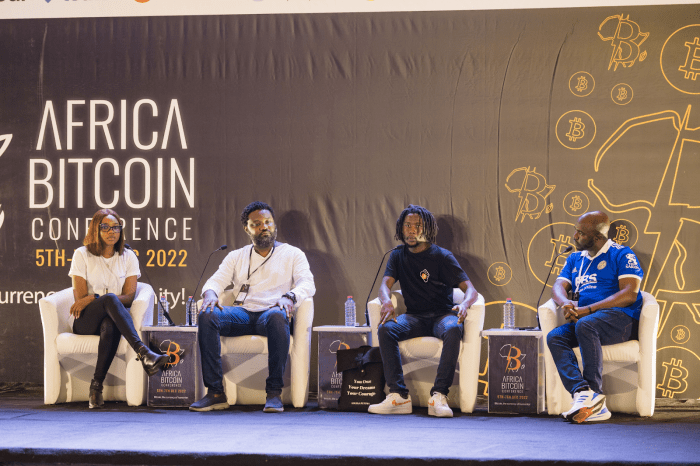
Panel on early Africa. Left to right: Tochi Onyia (Paxful), Ola Atose (KoinKoin), Kgothatso Ngako (Machankura), Osideinde Adewale (Bitnob).
A network of Bitcoin tool makers is growing in Africa. In the last few years, education and grant programs such as Btrust and Qala have emerged, and more developers from the African continent can work on Bitcoin full time, through grants or find employment in the many African Bitcoin startups. .
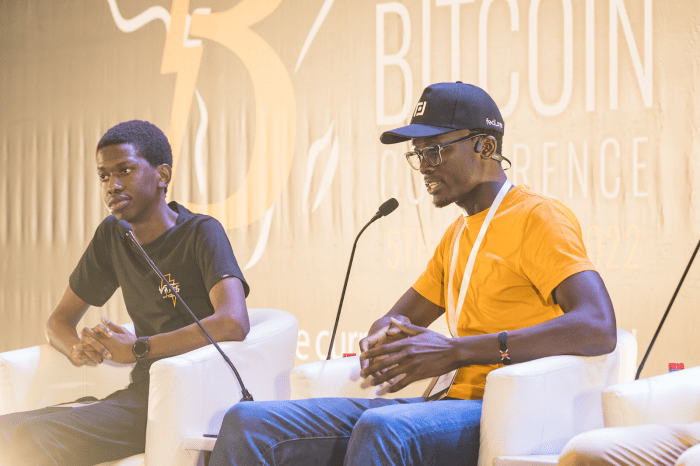
Abubakar Nur Khalil (Btrust, Qala) and Okjodom (Fedimint) discuss what solutions African Bitcoin developers are focused on.
Obstacles On The Road To Africa’s Hyperbitcoinization
The exploding adoption of Bitcoin in Africa has similar problems.
First things first: infrastructure. As one speaker aptly put it: “Every Ghanaian knows – when it rains, the internet goes down.” The good news is that Africans are actively working on the problem; one of the interesting projects presented at the conference is Gridless, a bitcoin mining company that uses stranded energy, such as local hydropower plants that are not connected to the national grid. During the conference, a new $2 million investment into Gridless was announced, helping the project expand beyond Kenya, its home country.
The second obstacle is widespread fraud and exploitative schemes. A prime example is Worldcoin. Some time ago, the global Bitcoin community was very angry with this project, which offered new users through airdropping tokens for retina exchange. After the initial wave of dissent, things quieted down and the general impression was that Worldcoin was abandoned. To my surprise, I found out that the project is very much alive and the eye scanner orb is distributed all over the African continent. Bitcoiners worldwide have a duty to shine a light on such disgusting data-harvesting experiments, and ensure that Africa is well-informed about the difference between Bitcoin and everything else.
Third: corporate conquest. It does not make sense for the African continent to get rid of neo-colonial monetary schemes such as the CFA system, only to be replaced by similar companies. From several discussions, I understand that Binance and other major exchanges are muddying the waters about what it means to actually hold bitcoins, discouraging newcomers from holding their own, and even promoting exchange accounts as the only option. Another alarming area of corporate conquest is the widespread reliance on WhatsApp; as one Twitter commenter said recently stated, WhatsApp is “African e-mail.” This should serve as a reminder that educational efforts should focus not only on Vitcoin and its own custody, but also on the likes of Signal, encrypted email, password managers, VPNs and other similar digital empowerment tools.
All Eyes On Africa
Bitcoin Africa Conference is one of the most exciting events. Everyone I met – entrepreneurs, human rights activists, circular community builders, developers – was full of energy for orange pills on the African continent. But their enthusiasm is not naive and does not stem from any kind of ideology or heterodox economic school; on the contrary, they have a very practical approach. Africa has a similar problem, and Bitcoin can help fix it – if we do it right.
Many speakers throughout the conference reminded us of the essential ingredient of the Bitcoin revolution: people. If ordinary people cannot understand and easily use technology to alleviate their daily problems, Bitcoin will not go very far. Bitcoin does not need to onboard politicians and central banks, but taxi drivers and street food vendors. Thankfully, there are many grassroots communities emerging on the continent, leading the adoption of the orange coin below. To name just a few, there are Bitcoin Ekasi, Bitcoin Mountain, Bitcoin Cowries, Bitcoin VillageExonumia and DigiOats. And many more are emerging.
Personally, I can’t wait for another opportunity to visit a Bitcoin conference on the African continent, the optimism for a better future is simply unmatched. The next upcoming conference appears to be the Nigerian Bitcoin Conference, happening in March. Since Nigeria has one of the most orange-pilled populations in the world, I’m sure it’s also a wild, unforgettable experience.
Note: live streams from days two and three of the African Bitcoin Conference are available at conference YouTube channel.
This is a guest post by Josef Tětek. Opinions expressed are entirely their own and do not necessarily reflect those of BTC Inc or Bitcoin Magazine.