
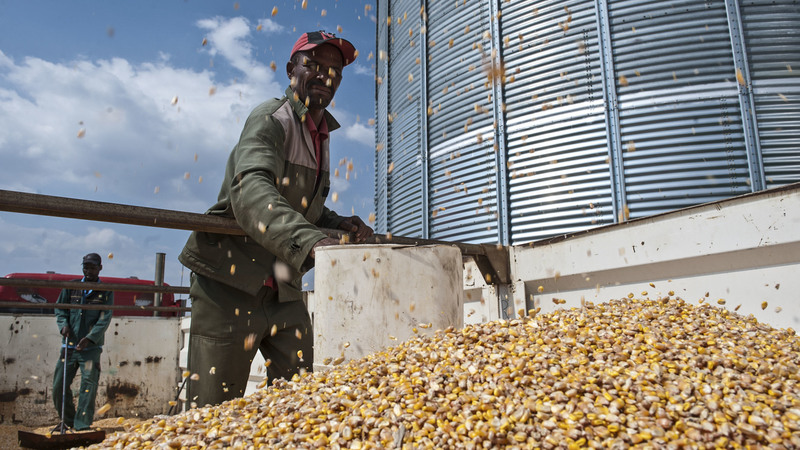
Food insecure African countries must prepare for a challenging future. (Delwyn Verasamy/M&G)
Whichever direction the Russian-Ukrainian war may take over the next few weeks and months, the conflict has an impact on the next harvest season. This will have a ripple effect on global food security, possibly for several years. Food insecure African countries must prepare themselves for a challenging future.
While it is important for African countries to develop strategies to overcome the agricultural decline in response to the Ukraine war, it is also important that these countries remember their commitments to existing obligations, such as 2003 Maputo Declaration on Agriculture and Food Security of the African Union. The declaration contains several important decisions on agriculture and the most important among them is the “commitment to allocate at least 10% of the national budget resources for the implementation of agricultural policy and rural development within five years”. Including the 10% allocation, countries are also promised to raise agricultural productivity by at least 6%.
African governments should give priority to formulating possible solutions and interventions to reduce the consequences of the conflict in Ukraine. Below are potential policy recommendations for policy analysts and international partners to consider when formulating response measures.
In the short term:
- Countries should strengthen initiatives that provide food to vulnerable populations through access to strategic reserves. This approach should be led by multi-stakeholders and not just government.
- Major grain producers should be supported to increase production and distribution.
- To address immediate food shortages, barriers to market access must be removed, including border restrictions on the movement of food.
- The government should provide essential planting kits (such as seeds, fertilizers, equipment and limited fuel) to ensure that farmers do not miss the next planting season.
- Provide relevant data – specific to the needs of farmers – to continue operations with minimal disruption to produce agricultural results for the nation’s food.
- Rising food prices are coupled with seasonal price fluctuations, making it more important to stabilize corn price fluctuations.
- Protecting Africa’s rich biodiversity, forests and other carbon sinks is key to increasing agricultural yields.
In the long run:
Continental and regional approaches – The AU has taken the lead in the rollout and implementation of continental response measures. At the regional level, the Regional Economic Community must develop a strategy to strengthen the market, harmonize key policies and implement measures that will speed up and improve cross-border trade for agriculture and food. International development partners should use the trust they build for better engagement while aiming to strengthen continental and regional approaches.
Trade will remain a priority in the medium to long term in terms of offering African products access to foreign markets as international markets seek new trading partners as they reduce their dependence on Russia. The African Continental Free Trade Area is ideally placed to strengthen regional trade integration initiatives, and unblock important agricultural and food product transport barriers, while providing opportunities for new markets and strengthening supply chains.
Climate resilience in African food systems – Climate change disrupts weather patterns, which in turn hinders the growth and productivity of Africa’s food systems. Estimates state that climate change has the potential to remove 15% of the gross domestic product by 2030, causing an additional 100 million people forced into poverty by the end of the decade. Therefore, climate resilient technologies should be promoted to provide opportunities to increase Africa’s food production and productivity while building resilience and reducing poverty and hunger.
Climate change is expected to become a major threat to global food security. African policy analysts must focus on formulating long-term sustainable solutions aimed at strengthening the resilience and adaptability of crops as we all struggle with the effects of climate change. International development partners can play an important role in providing support to African countries in the process of policy development and implementation, which can lead to more sustainable long-term solutions to strengthen agricultural production capacity.
Research and development (R&D) – Investment in agricultural systems and R&D is important to improve agricultural productivity. The focus should be on crop diversity to produce climate and nutrient-friendly crops, detecting the most suitable areas for optimal harvests, improving food and nutrition security and resilience to shocks. The Ukraine conflict has exposed new vulnerabilities in Africa’s food supply systems that require more R&D to address immediate concerns while also planning for long-term issues.
Promotion of local substitutes – Food manufacturers in Cameroon, the Democratic Republic of Congo, Egypt, Kenya and Nigeria have tried to mix cheaper alternatives to wheat flour into bread, cakes and pasta. Ethiopia has been promoting the use of indigenous grains, such as teff, as suitable substitutes for wheat. Local rice, cassava flour and sorghum are also used as substitutes. International development partners experiencing genetic diversity in agriculture should encourage the promotion of local crop substitution, as domestic crops are less affected by trade disruptions or global inflation, which provides some protection from food price increases caused by external shocks.
Multi-partner inclusion of various stakeholders – It is important to promote the inclusion and adoption of various stakeholders, including the government, the private sector, civil society and philanthropic organizations, to help the most vulnerable in the community and be proactive actors in the pursuit of coordinated solutions. Fractional interventions will not produce optimal results.
Recommendations for African partners:
- While the Ukraine conflict can be prioritized and development aid can be redirected, it is crucial that cuts in development aid to partner countries are avoided.
- Continue to support African countries in formulating and implementing initiatives to reduce the consequences of the war in Ukraine.
- Prioritize and strengthen response initiatives, especially those involving partner countries, for a higher chance of success.
- As shown during the Covid-19 pandemic, Africa needs international development partners to speak up and raise awareness, if there is stockpiling of grain and fertilizer, as seen in the stockpiling of the Covid-19 vaccine.
- It is important to plan and implement policies and strategies that anticipate global shocks in order to readjust focus and target funding when needed.
In short, African countries are formulating response measures aimed at improving the continent’s resilience to food insecurity caused by the war in Ukraine. To strengthen these response measures, international partners must provide assistance and share their expertise to increase the prospects for success and sustainability beyond the war.
Dr Craig Moffat is the head of the governance and influence program at Good Governance Africa.