
Data from Glassnode shows Bitcoin mining has remained in near-perfect balance throughout BTC history, thanks to its difficulty feature.
Bitcoin Miners Have Spent An Almost Equal Number Of Days With Profits As Losses
According to a new report published by on-chain analytics company Glassnode, BTC miners have been making gains recently. To understand whether Bitcoin miners make a profit or a loss, the difference between revenue and expenses is taken.
The company defines “mining revenue” as the sum of the total coins issued by miners (ie, BTC earned through mining block rewards) and the transaction fees received for handling transfers.
As for the costs incurred by the chain’s validators, Glassnode considers that the “mining difficulty” metric contains information about all mining-related metrics, and thus, can be used as a reliable way to calculate costs.
The mining difficulty here refers to Bitcoin’s blockchain feature that controls how hard miners are currently finding to mine on the network. The reason this concept exists is because the BTC network aims to maintain a constant BTC production rate, no matter how much computing power the miners have connected to the network.
When, for example, a miner connects another mining machine to the network, difficulties will arise in the next periodic adjustment, so that the miner cannot use this extra power to produce a greater amount of Bitcoin than usual.
The feature is that the difficulties that exist in the network have far-reaching consequences for the BTC economy. As Glassnode suggests, “the net result is that mining is a hyper-competitive industry, where production costs for BTC consistently approach the break-even price for the average miner over the long term.”
Now, to more easily see what impact the difficulties have had on the network, the firm has charted the number of profitable and unprofitable days that miners have experienced throughout the history of the asset.
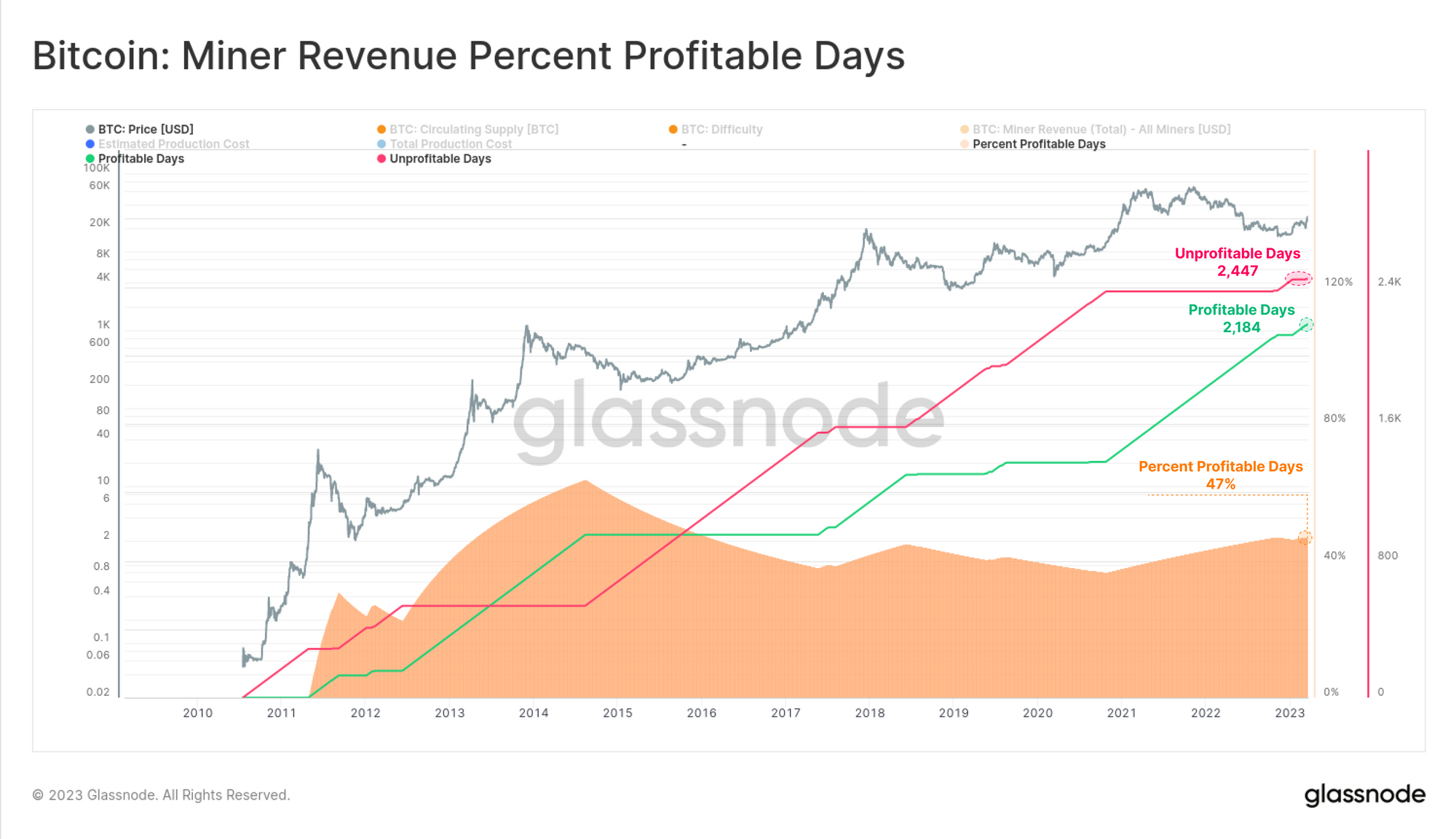
Profitable and unprofitable days for the BTC miners | Source: Glassnode
Here, as mentioned before, the days are divided into profitable and unprofitable using whether the mining revenue is more or less than the production cost (calculated using a difficulty-based model) on a given day.
Interestingly, so far in the entire lifetime of Bitcoin, the average miner has spent 2,184 days in profit, while he has spent 2,447 days in loss. This means that 47% of all days have been profitable, meaning that there is a fairly even split between profitable and unprofitable days.
“According to economic theory, a perfect market is a market in which supply and demand reach equilibrium, and the price of the asset approaches the cost point (production price),” explains Glassnode. “Given how close these numbers are to the 50:50 condition, one could argue that the difficulty adjustment has done an amazing job of targeting the balance.”
BTC price
At the time of writing, Bitcoin is trading around $27,700, up 2% over the past week.
BTC has moved sideways recently | Source: BTCUSD on TradingView
Featured images from Brian Wangenheim on Unsplash.com, charts from TradingView.com, Glassnode.com