
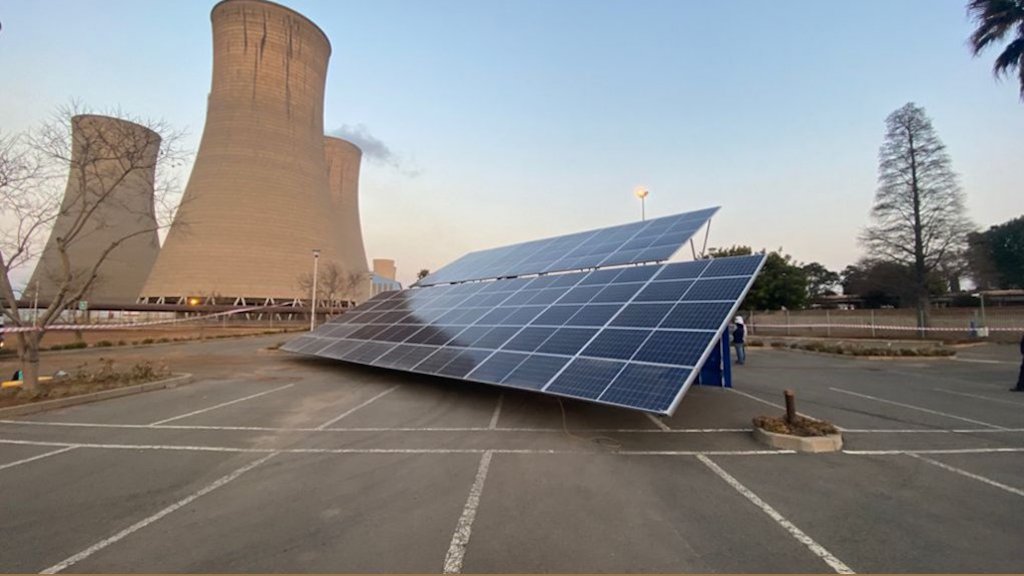
Out with the old, in with the new: Komati is used to demonstrate how old power plants can be reused.
menvestec described Finance Minister Enoch Godongwana’s 2023 budget speech as “walking hard to provide fiscal assistance to Eskom, support households and increase spending” and “credit neutral”. The national energy crisis took center stage in the speech, giving more details on Eskom’s debt repayments and incentives to promote renewable energy and power generation.
But several things have happened since then that could limit the effectiveness of the measures in the budget to solve the energy crisis and the long-term sustainability of the country. These include South Africa being graylisted by the Financial Action Task Force, former Eskom chief executive Andre de Ruyter’s interview with Annika Larsen on eNCA, during which he made several allegations about corruption at Eskom, and S&P downgrading South Africa’s credit outlook from positive to. stable.
Challenges with consistent electricity supply hinder economic growth. Load-shedding contributed significantly to South Africa’s GDP which fell by 1.3% in the fourth quarter of 2022. This, in addition to direct economic losses through manufacturing shutdowns and job losses, contributed to S&P’s decision.
According to the 2023 Budget Review by the treasury, South Africa’s public debt is expected to increase from R4.73 trillion in 2022-23 (71.1% of GDP) to R5.84 trillion in 2025-26 (73.6% of GDP). Debt service costs, the costs associated with repaying loans, are expected to increase from R307.2 billion in 2022-23 (4.6% of GDP) to R397.1 billion in 2025/26 (5% of GDP). Beyond 2025-26, the national debt is expected to decline. However, R397 billion represents almost a third of the national annual budget. This amount can be used for health, education, infrastructure and other things to overcome the energy crisis.
Eskom has struggled with high operational costs, corruption, poor management and neglect of maintenance leading to constant breakdowns, which has resulted in open-shedding that costs the state nearly R1 billion a day in foregone revenue. At the time of the budget speech, Eskom had a debt of R423 billion and had received a bailout of R263.4 billion from the treasury since the 2008-09 financial year. In addition, the government guaranteed about R350 billion of Eskom’s debt, which would be at risk of default if not met.
To prevent default, the treasury is providing debt relief worth R256 billion over the next three years to improve the financial stability of beleaguered utilities and increase the availability of electricity in the country. R78 billion will be distributed to Eskom in 2023-24, R66 billion in 2024-25 and R40 billion in 2025-26, with the government taking on 70 billion of Eskom’s debt portfolio in 2025-26.
There is a risk that Eskom’s bailout will be a sneaky subsidy to coal-fired power plants at a time when the country is active in the development of renewable energy generation.
The bailout has conditions that will ensure support for the unbundling of national utilities and focus on maintaining the existing network infrastructure. But implementing these measures to maintain long-term financial stability and prevent the need for future bailouts raises questions. Currently, 96 of South Africa’s 278 municipalities owe Eskom more than R56 billion between them. Municipal non-payment significantly reduces the financial viability of Eskom, forcing the company to borrow more to make up for lost revenue. Municipalities experience non-payment from customers, which results in non-payment to Eskom.
In order for Eskom to be functional, have operational power in the long term and not need a bailout, the utility must be able to collect revenue from those it serves. A new request from a municipality to challenge Eskom’s implementation of the 18.65% tariff approved by the South African National Energy Regulator puts the utility at significant risk and threatens efforts to save the utility.
Non-payment of municipalities actively contributes to the need for higher rates, because this leads to a smaller pool of people who pay for services, which leads those who are subject to subsidizing those who are not. In addition, there is a significant risk that those who can afford to pay will exclude themselves from the national grid, leading to the necessary rate increases. Municipalities will be further burdened with service costs as more and more customers cannot afford electricity prices, creating a vicious cycle. Long-term thinking is essential to solving the country’s electricity crisis and must include local municipalities or risk failure. Solutions can include the installation of prepaid electricity meters.
The slow pace of reforms to improve the infrastructure and governance of state-owned enterprises and their responsibilities in the national debt were additional factors in S&P’s decision. De Ruyter’s interview supports the view that it is not enough to improve governance in state-owned enterprises.
The Wits Kidul Center for Inequality Studies has raised some concerns about the treasury’s approach to the Eskom bailout in terms of government accounting. The exclusion of payments to Eskom from the main budget balance means that there is no accurate accounting of the country’s debt. Budgetary oversight can also be reduced. Creative accounting can be used for cash payments to other state-owned enterprises, hiding government debts and increasing government responsibilities.
In line with the national disaster relief goals announced during the State of the Nation address, the treasury is proposing two tax incentives for renewable energy generation. The first is the expansion of the existing renewable energy tax incentive, which allows businesses to deduct 100% of the cost of qualifying investments in renewable energy for one out of three years. The expansion allows the business to reduce the cost of all renewable energy projects by 125% in the first year, without generation capacity limitations.
The second incentive allows individual taxpayers to deduct 25% of the cost of solar panels for rooftop solar installations, up to a maximum of R15 000, from their taxes, and is only available for one year. But the treasury does not include inverters, installation costs and batteries, which are the most expensive components of solar electricity systems, from incentives. This, and specifically the focus on solar PV panels, has been criticized by the South African Photovoltaic Industry Association (SAPVIA). The treasury’s reason for the exemption is that it wants to optimize the use of limited government funds to expand generation capacity.
The problem with this approach is that while electricity production can increase, without storage, much of the electricity generated from solar photovoltaics will be wasted. Even with storage, the amount of solar electricity generated can exceed household use. To solve the problem, it is very important that an attractive feed-in tariff is introduced, similar to the solution used by Vietnam to stop the load shedding in the country.
Below is the cost of rooftop solar in South Africa according to Nedbank:
- R55 000 to R60 000 for a grid-connected solar system that generates solar electricity but draws power from the grid when the system does not generate enough electricity. Grid-tied systems do not include batteries, which are often the most expensive part of a solar power solution. The average Freedom Lite Lithium-ion 5kW battery costs almost R37 000.
- R 115 000 to R120 000 for a Hybrid solar system with eight solar panels and two batteries. Hybrid systems generate and store the most electricity and draw power from the grid when needed. Prices vary. As mentioned earlier, including batteries increases the price of a solar system.
- R250 000 for an off-the-grid solar system with nine batteries and 14 solar panels. The off-the-grid system is independent of the national grid and corresponding blackouts.
The treasury bailout of Eskom has the potential to change the country’s energy landscape but implementing it will come with its own challenges and hurdles. Industry bodies and the treasury should work together to develop adequate measures because incentives to promote rooftop solar at the individual level are insufficient due to high system costs. In addition, the municipality is very important to solve the country’s energy crisis and make the treasury efforts productive.
Treasury must do more in these initiatives to support individual taxpayers to improve energy security, while transforming Eskom into a world-class utility. Improving South Africa’s macroeconomic environment depends on how to address the burden and mismanagement of state-owned enterprises more broadly.
Vincent Obisie-Orlu is a researcher in the natural resource governance program at Good Governance Africa.
The views expressed are those of the author and do not necessarily reflect official policy or position Mail & Guardians.