

Rallying around: Porsche 911 Dakar
Variety is the spice of life. I love this saying. For those who love the art of gastro-culinary, this means an all-you-can-eat buffet with mouth-watering morsels enough to satiate even the most ardent foodie. Fashionistas probably think of slinking through the streets of Milan or Rome, buying the latest threads and the most money can buy.
In the automotive context, it conjures up the image of a storage hangar filled with unique cars – a sea of exotic metals as far as the eye can see – some invaluable because of the sentimental value they command.
Every once in a while, we can find a special car – one that makes gasoline veins with the highest octane.
I recently returned from Morocco, where I drove one such car – a Porsche 911 Dakar. Wait, what Porsche 911? Let me explain. You see, back in 1984, the Porsche 911 campaign was specially developed to compete in the Paris-Dakar Rally, where it clinched the overall victory and the birth of the all-wheel-drive system in the 911.
It is essentially a 911 Carrera 3.2 model with a raised ride height, 4 × 4 drivetrain and knobbly off-road tires, perfect for tackling sand and rock-strewn gravel roads.
Code named 953, three of these custom-made 911s lined up in the 1984 Paris-Dakar Rally, with one driven by Belgian racing legend Jacky Ickx, who was instrumental in convincing Porsche to go ahead with this crazy motorsport project. Ickx, together with co-pilot Claude Brasseur, had won the race the previous year in a Mercedes-Benz 280 GE (Geländewagen).
The other two cars were project manager Roland Kussmaul and co-driver Erich Lerner, while the third and race-winning car, the now-famous number 176, was driven by René Metge and Dominique Lemoyne, to critical acclaim.
Here’s a sports car pitted against a purpose-built rally racing car and outright beat it. This paved the way for the Porsche 959, which took part in the 1986 edition of the epic race. Porsche is clearly here, but there’s been a long hiatus and nothing to continue on that excellent trajectory – until now.
Welcome to 992 4 base GTS 911 Dakar, of which only 2 500 units will be built. It pays tribute to the ’84 Paris-Dakar Rally-winning car and it has been a long time coming.
Well, in 2012, Porsche built a 991-based 991 off-road concept, dubbed the Vision Safari, as a case study, but it didn’t seem like anything. Maybe the management thought the derivative was too far to mess with the winning 911 sports car recipe – the holy grail really, if you will – and put the idea on ice.
However, when buyers look beyond buying a sports car for searing performance and dizzying top speed, perhaps there is a case for off-road 911 that can pass more than conventional tarmac.
To prove this, we explore Morocco’s vast expanses of desert and sand, to welcome the latest installment to 911 folding.
This jacked-up 911 is the company’s modern interpretation of the 911 Vision Safari, based on the current 911 4 GTS, but most of the underpinnings share very little with the color-based model. This includes a 50mm higher ride height, which can be raised 30mm more in Off-Road mode, a higher front and rear approach, and a full chrome scuff plate departure angle.
There is adaptive air suspension at each corner, while the tires are Pirelli Scorpion off-road items measuring 245/45/19 at the front and 295/45/20 at the rear and designed specifically for the 911 Dakar.
There’s also a CFRP (carbon fiber reinforced plastic) rear wing that weighs just 3.2kg and pays homage to the ’84 racing car. It has a lithium battery and a carbon fiber bonnet, all to save weight. This brings the curb weight of the 911 Dakar to 1 605 kg, only 10kg more than the 911 4 GTS on which it is based.
In addition, you can choose the Rallye Design Package that echoes the winning rally car, complete with “Rothmans” livery, called “Roughroads” in this case, due to the ban on cigarette advertising. It’s a paint job from Porsche Exclusive Manufaktur, and not a wrap, which makes it even more special.
You can also move the roof-rack option, which allows you to carry some cool facilities off the beaten track, such as foldable shovels, jerrycans or, absolute favorite, put a tent on top of the roof and camp anywhere in the bushveld. Very cool!
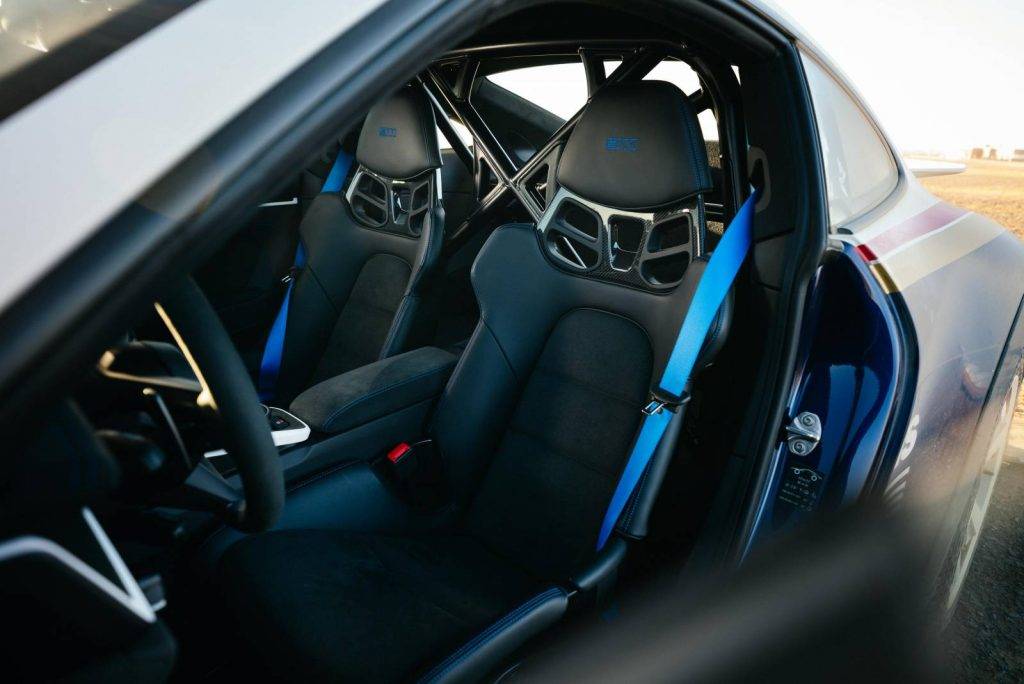
The cabin is familiar to those who are used to the GT3, with the same racing bucket seats, roll cage and the presence of rear seats. It’s a lekker place with an Alcantara-wreathed steering wheel and leather touchpoints, with a serial number plaque on the passenger drop-down console to add that touch of exclusivity you can brag to your friends.
But of course, this being a 911, you’d expect sizzling performance and it delivered here. At the rear is a 3.0-litre, bi-turbo boxer engine capable of producing 353kW and 570Nm linked to an 8-speed PDK gearbox and all-wheel drive.
Even with knobbly off-road boots, the 911 Dakar can accelerate to 100km/h in 3.4 seconds (5.5s on sand), while the top speed is limited to 240km/h, because of the tires.
There are two new driving modes in addition to Wet, Normal and Sport – Rallye and Off-Road. In 911, it still beggars belief, but it exists, and can cure Absolute.
Thanks to a special suspension mechanism that raises the ride height by 30mm more on both rear axles for a total of 191mm, you can go over land in a place more suited to the Cayenne than the 911 at speeds up to 170km/h before the suspension resets to its normal ride height.
Rallye mode also opens Control Open type of rally start, so you can bring out the René Metge in you.
The suspension has been properly activated, and while some ruts on the gravel can disturb the quality of the ride, and the desert vegetation, which is as hard as stone, must be avoided at all costs, as some media colleagues found out at the launch. , the suspension of the 911 Dakar which is quite extraordinary.
We scaled massive dunes that will 4 × 4 fans panting when trying to negotiate them. At one point, I felt that Porsche really didn’t like to do this, but it showed off the model’s capabilities in a way that its lucky owners would never experience.

Even so, the 911 Dakar is a proper sports car and feels great on the open road, thanks to specially designed off-road tires without the typical road noise.
According to the Pirelli representative, what is interesting is that the tire was developed about six months into the 911 Dakar project, which only took 13 months from start to finish, remarkable for the many suspension components provided for this model.
Having experienced the 911 Dakar, I doff my hat to the team that presented this ludicrous idea to the members of the Board. The fact that they are allowed to continue says a lot about the Porsche brand.
At a cool price of R4.2 million, and with a very limited number of models coming to our shores, it will remain rare, which should be celebrated when spotted out in the wild.
I will have mine in Rallye Design “Roughroads” livery, with a roofrack, thanks. One is allowed to dream, of course.
I’m glad Porsche continues with ridiculous projects like this. The fact that orders far exceed 2 500 units to be built is proof of the desirability of this model.
I get it now. Unequivocally so! And the car that won the 953 Paris-Dakar will agree that this latest 911 Dakar is a spiritual successor.