
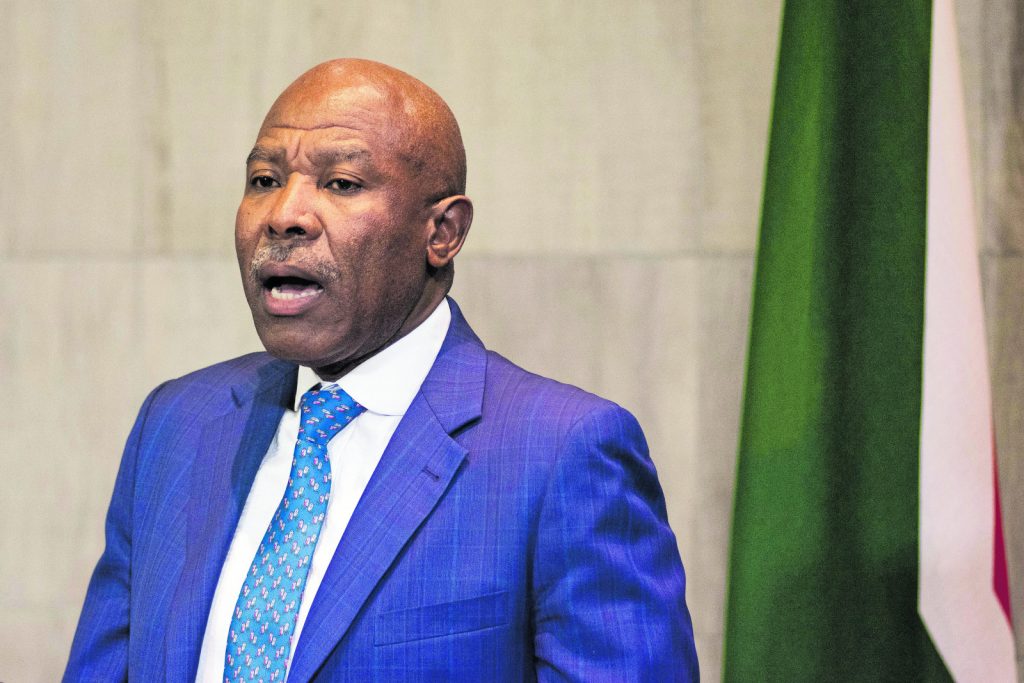
Reserve Bank Governor Left Glory
meIn a lively discussion there, economic historians Adam Tooze and Lesetja Kganyago went head-to-head on the topic of the governor of the South African Reserve Bank has been held quickly in – the mandate of the central bank.
Kganyago once again warned of the dangers of creative central banks, saying they are as dangerous as creative accountants. “They lead to unpleasant results,” he said.
The discussion on the role of central banks, hosted by the University of the Witwatersrand, comes amid a recent push by the ANC to review the Reserve Bank’s mandate and change its ownership structure. It also comes amid calls for central banks to take a bigger role in fighting climate change.
Affirming the “mantra of financial stability and price stability”, Tooze replied, “I am afraid that this will be delegitimizing. In an era that demands radicalism say, ‘Don’t trust a radical central bank,’ forgive me for saying this, almost like a policeman.
“Your task is very difficult, sir. I fully appreciate that, but there are so many problems in the world right now that conservatism is like that… it’s like a cop out.
But Kganyago insists that institutions, designed with specific responsibilities, must stay on their own path. “We are not asking soldiers to deal with inflation. They have the wrong instruments.”
Kganyago earlier noted that the central bank is increasingly being asked to deal with issues that are directly in the domain of government. The Governor of the Reserve Bank is regularly criticized for his view that the solution to South Africa’s massive unemployment crisis lies outside the realm of monetary policy.
Although the Reserve Bank has a responsibility to protect financial stability, it does not have the instruments to deal with climate change, Kganyago said. However, central banks are working to protect the financial system from climate risks.
However, Tooze challenged the view that the responsibility of the central bank in regard to climate change is limited to financial stability concerns. “Is it correct, politically, to say: ‘Oh, we will continue what we are doing. Our institutions remain focused on the limited delivery. We will remain on our path, because – as you said, governor – this is what it was designed to do ,” he said.
“If you take the climate challenge seriously at this level, this is a moment like the 1970s, or the post-apartheid period in South Africa, where the constitution of the society was implemented … policies can remain outside this turmoil.
But Kganyago suggested the Reserve Bank’s priorities could not be pulled in different directions by the country’s many crises.
“This country is facing great poverty. Why recast the role of the central bank to focus on climate change and not on poverty?,” he asked.
“This country is facing unemployment. Why recast the mandate of the central bank to focus on climate change and not on unemployment? … And the reason I say this is not to belittle or minimize the point, it is to try and say, society is designing institutions to handle specific areas and the central bank is no exception.
The governor’s rhetorical question should be taken seriously, rather than an expression of impossibility, Tooze responded. Trade-offs insist on a limited mandate, he said, “tragic in significance”.
“A whole generation of people, especially young people, is struggling to find a place in the labor market. This is a burden of responsibility that economic policy makers have to shoulder,” added Tooze.
“And, of course, no one can enforce just… [a] a kind of narrow loyalty to the institutional mandate in the face of such orders.
Kganyago challenges the notion that the Reserve Bank’s mandate is narrow. “The Constitution of the Republic of South Africa says that we must strive for price stability in the interest of balance and sustainable growth in the republic. He is a student of history, the author of our Constitution and, when he explains it, he knows that balance and sustainable growth cannot be achieved without price stability, ” he said.
“But they also know that price stability is only one contributor to balanced and sustainable growth and you have to bring all the other institutions of society into this thing.”
Kganyago added a final caution – institutions about democracy, he said. A quality institution with a clear mandate is more important.
State capture, he notes, seeks to repurpose state institutions. “So we have to be careful what we wish for.”