
“Everywhere you go in South Africa, the oppression is severe. There is not a day when your anger lacks fuel. At the highest pitch, you are shaken by violence, and you feel that you will rage in the streets or kill.
But you don’t. You are making your own contribution to repression by holding onto your anger. Among your friends, you don’t even talk about the anger you’re carrying. It just feeds the fire. So you smolder but you don’t explode.”
Ernest Cole wrote these words in House of Bondage, an account of life under apartheid in photographs and essays. Only through the current description of “this is how it is” that the generation called “born free” can get closer and closer to the image of life in a system that now seems unimaginable.
But archives have a lot to teach us. There are names and faces that collectively link the evil of apartheid: from the image of Cecil John Rhodes with one foot in Cape Town and one in Cairo, to Hendrik Verwoerd, the architect of apartheid, and Eugene de Kock, the Prime Evil itself, and finally, to PW Botha, the famous Groot Krokodil.
One name I never associated with apartheid was Samuel P Huntington. The former political scientist and academic wrote books such as Clash of Civilizations and Political Order in a Changing Society, books that seem to have established him as an authoritative and enduring voice in political science. His ideas were so influential that PW Botha caught on, when he needed them most.
Take a quick look and there’s a good chance you’ll miss Huntington’s contribution to the effort to resuscitate apartheid in the 1980s. I had, until I started digging through the Harvard University archives. Almost every contemporary front page containing the words “Harvard” and “apartheid” focuses on calls for Harvard to divest from companies that were complicit in apartheid. And it appeared, in 1986, when the university announced that it would cut its ownership of some of these companies, that Harvard had written itself on the right side of history.
However, the contribution, or at least that of one loved one, the director of the Harvard Center for International Affairs and university professor Albert J Weatherhead III, may be greater than any other foreign institution. Botha knew that, when the 1980s arrived and he first became prime minister, he had to “adapt or die”. In this endeavour, Huntington became an unofficial adviser to the Botha government.
In his keynote speech to the Political Science Association of South Africa, in Johannesburg on 17 September 1981, Huntington urged Botha to pursue a twin policy of what he called “repression and ‘reform'”. Reform, says Huntington, is not necessary for ethical reasons or because apartheid is untenable, but because, “It seems that the hierarchical ethnic system dominated by minorities in South Africa will be increasingly difficult to maintain.” Any South African familiar with the sinister nature of Botha’s “Total Strategy” knows that this ill-conceived policy marked the beginning of a bloody decade.
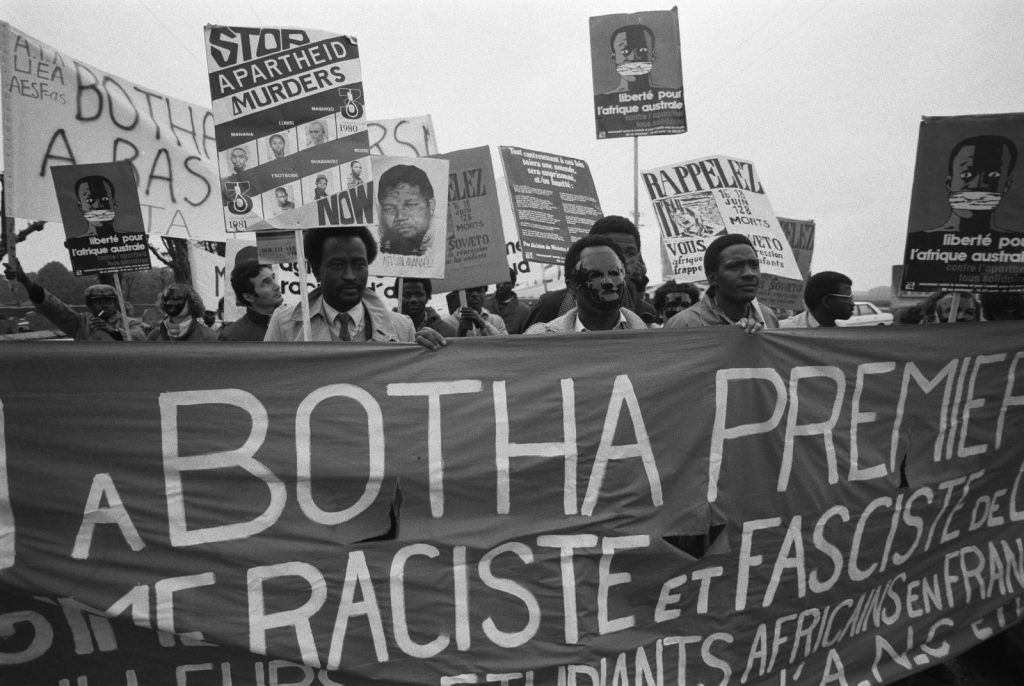
Huntington emphasized in his speech that “Perhaps the hardest lesson to learn for a government sensitive to the need for reform is the importance of introducing reform from a position of strength.” Otherwise, Huntington said, the reform will “weaken the regime” and “provoke a counter-revolutionary reaction”.
One shudder to think how Botha took the meaning of the word “position of power”. The 1980s was a decade of national State of Emergency, tanks and army apparatus deployed in the cities, regular arrests without trial, assassinations and extrajudicial killings that still want to be answered.
Huntington drew on the worst advantages of apartheid to facilitate its perpetuation; system design elements that make it not only one of racial segregation but of ethnic segregation, where one language is given to one land. Huntington sees the way out of apartheid not through multiparty democracy, but through consociationalism, a political structure that is difficult to articulate as he describes it. He described it as an “elite conspiracy to control political competition within and between communal groups”, basically arguing that the “elite” representing each political group, which would be divided along ethnic lines, should control the group’s decisions. It is a structure that, given the division of non-white South Africa into homelands, will not struggle to apply.
Some of the remnants of apartheid are more visible today than the long and stubborn legacy of spatial apartheid, which even small apartheid was removed by Huntington’s proposals. A strange part of this archival work is that there are times when Botha followed Huntington’s proposals to the letter. Huntington said, in the same address, “Continued adherence by the South African government to the homeland policy, for example, could make it easier for the government to introduce some form of political representation for colored and Asian people.” As it happened, in Botha’s “reforms” in 1984, a tricameral parliament was established and colored, Asians and white South Africans were included in parliament, while black South Africans were made to remain in the condemned Bantustan.
There is no doubt that Botha regarded Huntington as one of his most important strategists. A 1987 article by Gay Seidman on Harvard Crimson stated, “Huntington’s reform strategy quite clearly informed the efforts of the South African government… His 1981 paper helped to give the intellectual justification for, and was mentioned extensively in, the proposals for the 1984 constitution, the foundation of the country’s president PW Botha’s so-called reforms.”
There is a question, then, how little of perhaps the most damning contribution of the man so well considered in the academic world is known. We might even say that the powerful hide the history they prefer to the masses – indeed, Harvard prevents anyone from accessing administrative documents it creates for 50 years after they are created.

But there is something more dangerous about it. It shows a certain cold-heartedness; Huntington’s theory is put in a textbook that is easy to send to the mail in an envelope signed “PW Botha”.
He believed, in the end, that if he “created the right mixture of reform, reassurance, and repression”, the government would succeed in ensuring its continuation; if South Africa “plays fear and lies”, the country’s enemies will back down.
As Huntington’s theory predicted, he was wrong about this. If history is written by the victors, South Africa’s history is written by the masses. Just as deafening is an attempt to stay down, it is not the story of apartheid. The story, while still being written, begins and ends with South Africans.
As the country staggers towards 30 years of democracy – 30 years of aspirations not fully realized, independence not fully achieved – reckoning with the legacy of apartheid becomes increasingly important to shape the next 30 years. We may try to theorize or intellectualise the way forward but, as history tells us, this can only take us so far.
This article first appeared on Harvard Crimson.
SazI Bongwe writes in the hope of connecting the political and the personal, the systemic and the sentimental. Harvard University scholars write for The Harvard Crimson, The Harvard Advocate with Harvard Political Studies. He is the founder and editor of Ask yourself.
The views expressed are those of the author and do not necessarily reflect official policy or position Mail & Guardians.