
Nigerians have elected a new leader to assume the presidency on May 29. Tinubu ballcandidate of the ruling All Progressives Congress (APC), was declared the winner of Wednesday’s presidential election, surpassing the rule of the APC in Africa’s largest democracy.
As he thanked his supporters, Mr. Tinubu called for reconciliation with his rivals, who have demanded the annulment of the polls which he said was marred by voter suppression and the failure of INEC to upload polling unit results from over 176,000 polling stations to a web portal as it had specified in the instructions.
In the election held on Saturday, 70-year-old Mr. Tinubu secured 8,794,726 votes, the highest of all candidates, finally achieving his lifelong ambition of January 2022.
He also won more than 25 percent of the vote in 29 states, more than the 24 states required by the constitution.
His closest rival, Atiku Abubakar of the People’s Democratic Party (PDP), polled 6,984,520 votes to come second in the election. Peter Obi of the Labor Party got a total of 6,101,533 votes while Rabiu Kwankwaso of the NNPP came fourth with 1,496,687 votes.
 President Muhammadu Buhari said the results showed a major shift in Nigeria’s electoral map. “These results show the development of democracy in our country. Never has the electoral map changed so drastically in one cycle,” he said on Twitter.
While Mr. Tinubu did better than his opponent in the 2023 election, official data shows that based on the election results, he is the least popular president since Nigeria returned to democracy in 1999 after several years of military rule.
Lowest percentage of total votes
Mr. Tinubu’s victory in the election marked one of the safest limits by the elected president in the Fourth Republic of Nigeria, which began in 1999. The former governor of Lagos secured 37 percent of the total votes in the election. No other president-elect scored less than 50 percent of the vote.


President Buhari got 55.6 votes per vote 2019 election which gave birth to his second and last term in office. More than 15 million Nigerians voted for Mr. Buhari in the election that saw Atiku PDP also come second.
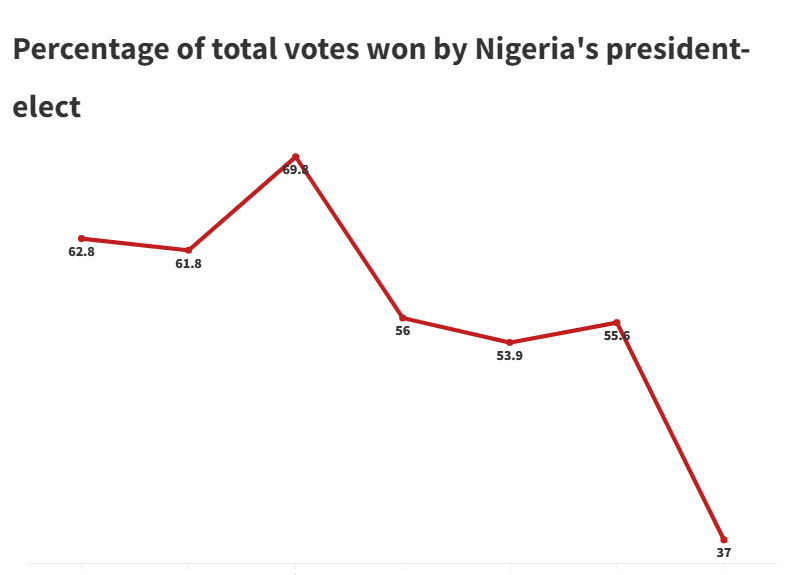 Mr Buhari scored 53.9 percent to defeat incumbent president Goodluck Jonathan in the election that brought him to office in 2015. His successor, Mr. Jonathan, got 56 percent of the vote 2011.
Meanwhile, in the first election that led to the first handover of power from one civilian leader to another, President Umaru Yar’Adua got a record 69.8 percent. total votes in 2007.
President Olusegun Obasanjo got 61.8 percent and 62.8 percent of the votes respectively 2003 and 1999 their respective elections.
The lowest number of total votes
Unlike his predecessors, Mr. Tinubu also won the presidential election with the least number of votes (8.7 million). Between 1999 and 2023, Nigeria held seven electoral cycles. All former presidents won elections by at least 15 million votes in the last six election cycles.
The 2023 election is seen as the most advanced technology in Nigeriawith INEC deploying electronic voter accreditation systems and results viewing portals that promote transparency and accessibility.
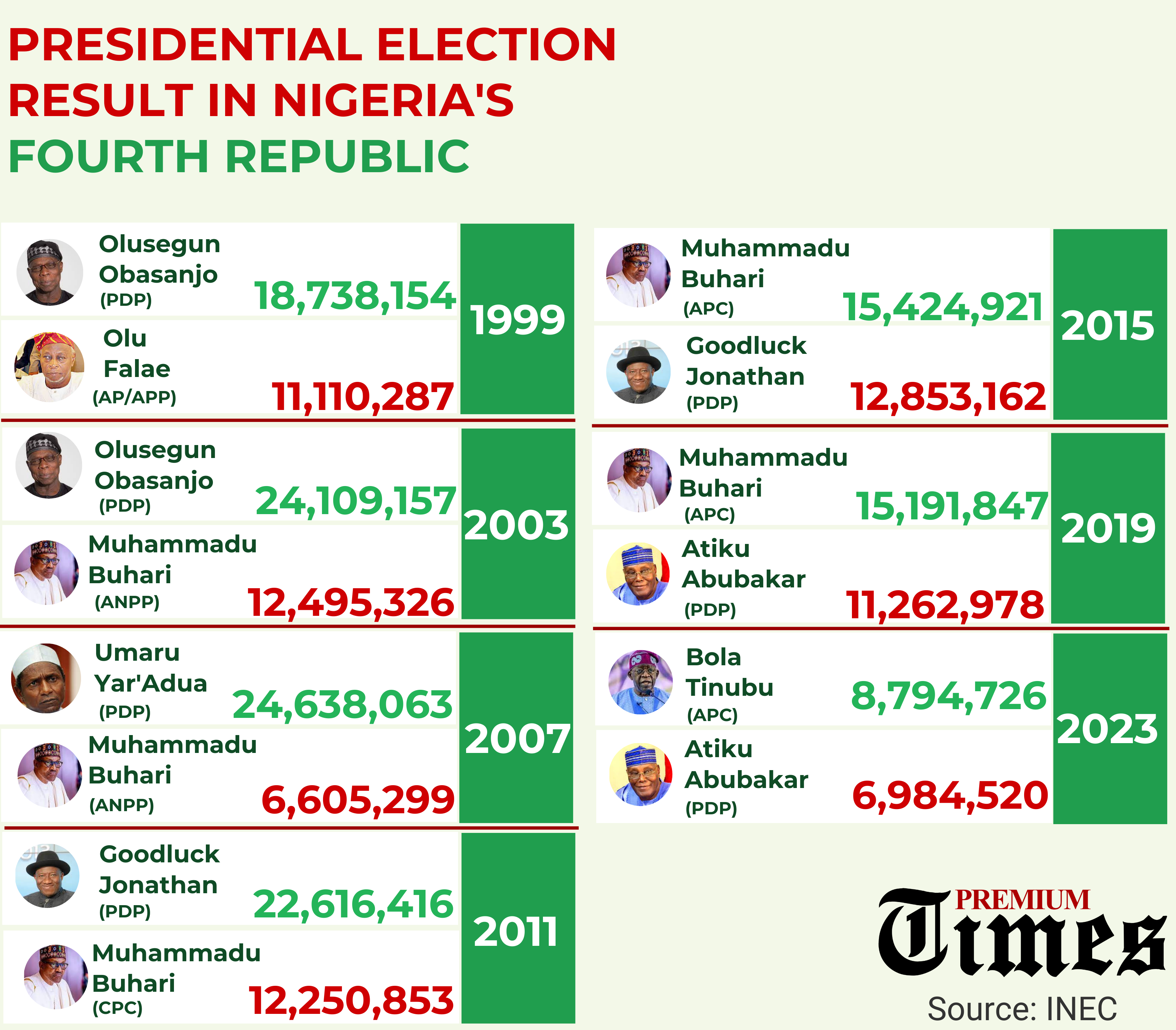
In 1999, the first election after military rule, Mr. Obasanjo won with 18.7 million votes, beating his cousin Olu Falae who polled 11.1 million votes.


In 2003, when Mr. Obasanjo sought re-election, he won the polls with 24.1 million votes to defeat the current President Buhari who ran on the platform of the then All Nigeria Peoples Party (ANPP). Mr. Buhari could only secure 12.9 million votes.
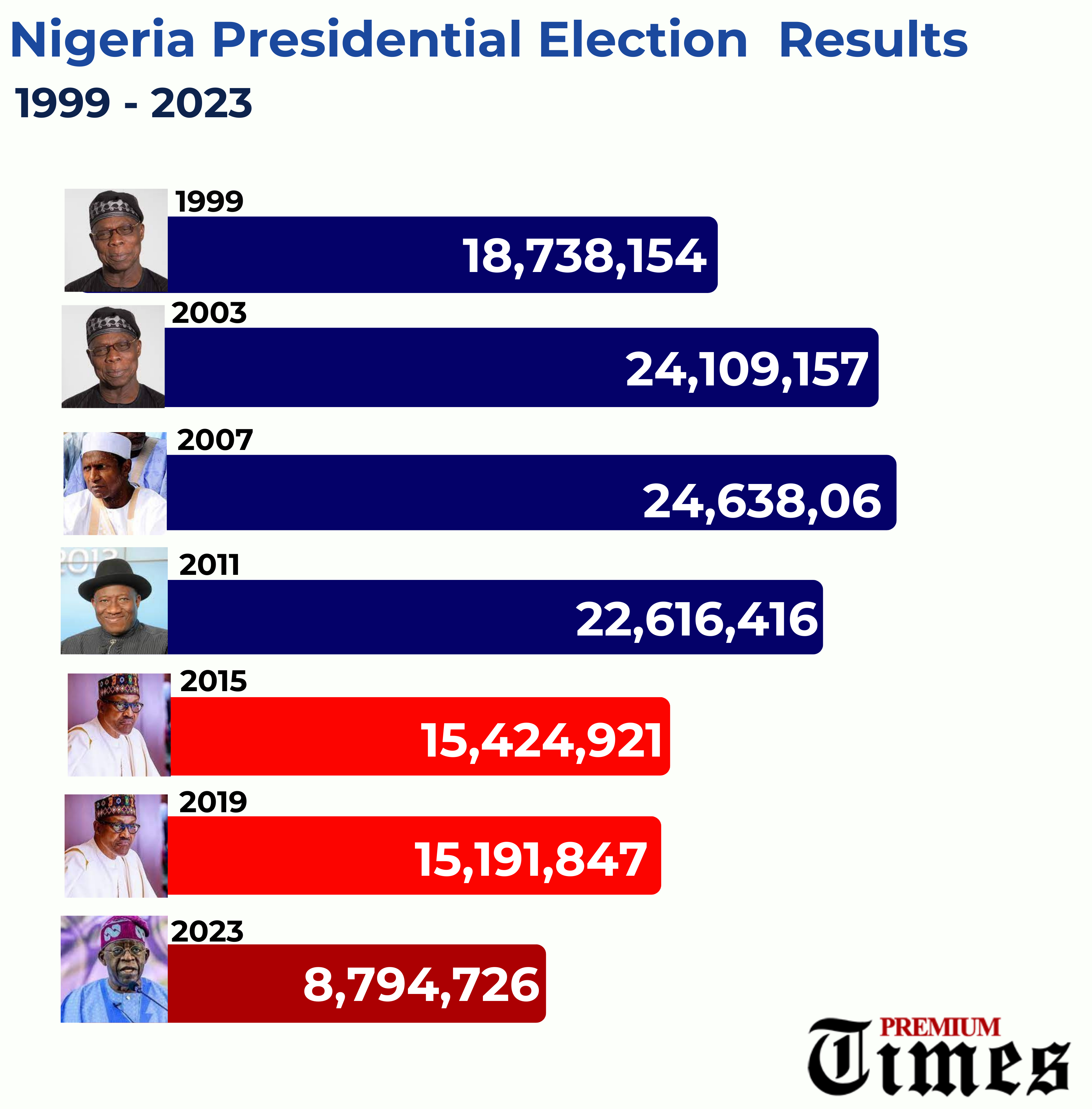 Then in 2007, Mr. Obasanjo’s chosen candidate, Mr. Yar’Adua, won the election with 24.6 million votes. The April 2007 elections were judged by most observers to have failed to meet the standards of credible, free and fair elections and were the worst in Nigeria’s post-independence electoral history.
“Currently, elections are largely for the interests of powerful elites and have no significant impact, if any, on expanding representative democracy, let alone positively changing socio-economic livelihoods. Reports of domestic and international observers confirm that all stages of elections are generally flawed, “said the Department for International Development in a post-election report.
The final result of the 2011 election gave 22.4 million votes to former President Jonathan, former governor of south-south Bayelsa state. His closest rival in the polls, Mr. Buhari, got 12.2 million votes.
Then in 2015, the results changed when Mr. Buhari defeated Mr. Jonathan by over 2.5 million votes to take the seat. The former military ruler got 15.4 million votes in the 2015 election while Mr. Jonathan got 12.8 million votes.
In 2019, Mr. Buhari was re-elected for a second term defeating former vice president Atiku. He got 15.2 million votes, and the PDP got 11.3 million.
 The lowest number of countries wins
The 2023 election is considered to be the most open presidential election in Nigeria since 1979. Moreover, the election is the most competitive and is being held at a time of tension in the country.
Mr. Tinubu won 12 states of the federation. His two closest rivals, Mr. Abubakar and Mr. Obi also won 12 states.
The dynamics of this election and voting pattern proved to be most unique when INEC announced the results. For example, Mr. Tinubu’s APC became the first opposition party to win in oil-rich Rivers State since 1999. Kwara State got another boost to say that no one can become president without winning in the north-central state.
The Labor Party flag bearer, Mr. Obi, won Mr. Tinubu’s Lagos State, together with Nasarawa and Plateau states, the home states of APC chairman Abdullahi Adamu, and the Director General of the APC Presidential Campaign Council, Governor Simon Lalong, respectively.
Overall, the 12 states that Mr. Tinubu won are Benue, Borno, Ekiti, Jigawa, Kwara, Kogi, Niger, Ogun, Ondo, Oyo, Kali, and Zamfara.
READ ALSO: SPECIAL REPORT: Nigeria spends more on elections, but voter turnout continues to decline
The 12 states won by Mr. Tinubu is the lowest number of states won by an elected president.
For the second term election in 2019, Mr. Buhari winning in 19 countries to defeat his nearest challenger, Mr. Abubakar who won in 18 states. Mr. Buhari got it in Bauchi, Borno, Ekiti, Gombe, Jigawa, Kaduna, Kano, Katsina, Kebbi, Kogi, Kwara, Lagos, Nasarawa, Niger, Ogun, Osun, Sokoto, Yobe, and Zamfara states.
In addition, in 2015, Mr. Buhari won 21 countries including Adamawa, Bauchi, Benue, Borno, Gombe, Jigawa, Kaduna, Kano, Katsina, Kebbi, Kogi, Kwara, Niger, Lagos, Ogun, Ondo, Osun, Oyo, Sokoto, Yobe and Zamfara.
In 2011, Mr. Jonathan winning in 23 countries: Abia, Akwa Ibom, Anambra, Bayelsa, Benue, Cross River, Delta, Ebonyi, Edo, Ekiti, Enugu, FCT, Imo, Kogi, Kwara, Lagos, Nasarawa, Ogun, Ondo, Osun, Oyo, Plateau, and Rivers states .
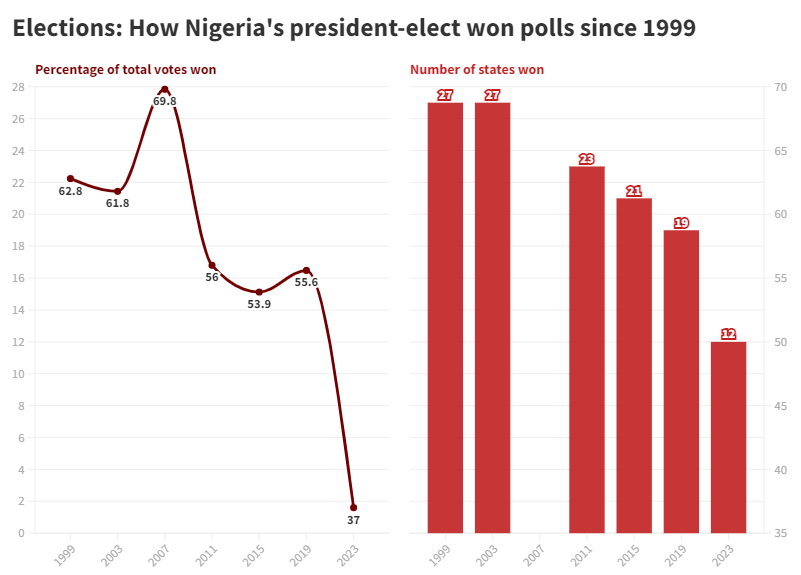 For 2003, Mr. Obasanjo won 27 states: Abia, Adamawa, Akwa Ibom, Anambra, Bayelsa, Benue, Cross River, Delta, Ebonyi, Edo, Ekiti, Enugu, FCT, Imo, Kaduna, Kogi, Kwara, Lagos, Nasarawa, Niger, Ogun, Ondo, Osun, Oyo, Plateau, Rivers, and Taraba states.
In 1999, Mr. Obasanjo won in Abia, Adamawa, Akwa Ibom, Anambra, Bauchi, Bayelsa, Benue, Borno, Cross River, Delta, Ebonyi, Edo, Enugu, Gombe, Imo, Jigawa, Kaduna, Kano, Katsina, Kebbi, Kogi, Kwara, Nasarawa, Niger, Plateau, Rivers, and Taraba states.
The lowest at the 25 percent threshold
To win the presidential election, the Nigerian constitution requires a candidate to win 25 percent of the vote in at least 24 states and the FCT.
At The election just ended, Mr. Tinubu won 25 percent of the votes in 29 states of the federation. Outgoing President Buhari got 25 percent in 33 states at 2019 elections and 25 percent in 27 countries 2015
In 2011, Mr. Jonathan, Buhari’s predecessor, got it 25 percent threshold in 34 countries. Former president Obasanjo won 25 percent of the vote in 33 states 1999 and 2003 respectively.
The trend continues of low voter turnout
One of the factors that can work against Mr. Tinubu in terms of total votes count (although not in other criteria) is the low turnout in this election.
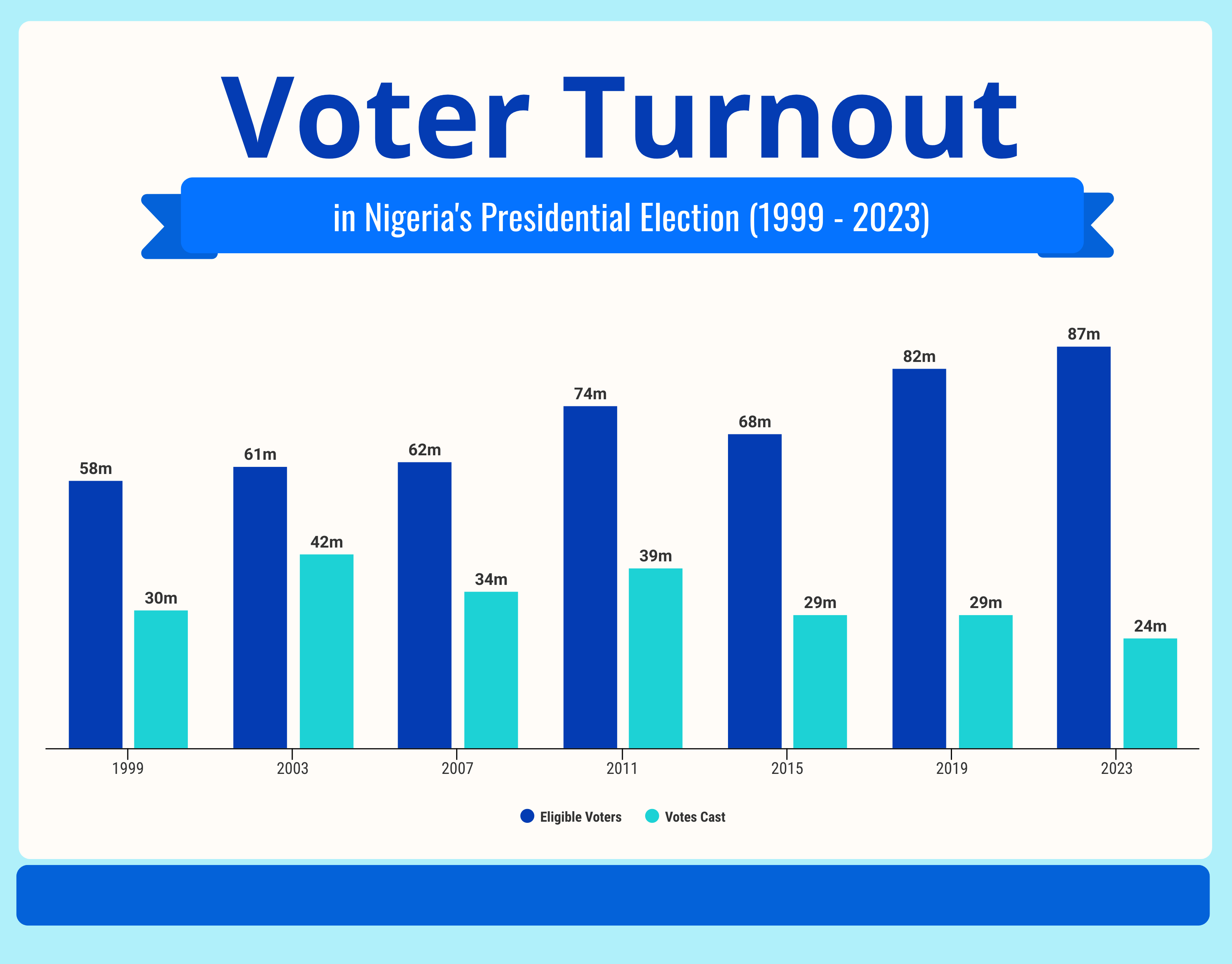
At At 27 percent, the 2023 election has the lowest turnout in a presidential election since Nigeria returned to democracy in 1999, despite being the most expensive. Before the election, INEC data showed that 87.2 million Nigerians collected PVCs and were eligible to vote and only 24.2 million voted. This means that, for every ten eligible voters, less than 3 people decide who wins in 2023 The election, Nigeria’s lowest recorded presidential election since independence.
 Commenting on the development, Carlos Lopes, honorary professor at the Mandela School of Public Governance at the University of Cape Town, described the low participation as “surprising and problematic.”
“Nigeria has a population of 220 million, based on the Worldometer elaboration of the latest United Nations data,” he wrote on Twitter, adding, “Bola Tinubu will rule 211.3 people who did not vote for him, including those who are not qualified.”
There has been a steady decline in electoral turnout since 1999, although voter turnout rose from 52 percent to 69 percent between the 1999 and 2003 elections, data from Dataphyte shows. But after the 2003 presidential election, participation in subsequent elections continued to decline, first to 57 percent in 2007, then to 54 percent in 2011, before falling to 44 percent in 2015.
This will further plummet in 2019 presidential election as only 35 percent of registered voters choose correctly, data from INEC shows.
Support the integrity and credibility of PREMIUM TIMES journalism
Good journalism costs a lot of money. But only good journalism can guarantee the possibility of a good society, responsible democracy, and transparent government.
For continued free access to the best investigative journalism in the country, we ask that you consider making a modest contribution to this noble effort.
By contributing to PREMIUM TIMES, you help keep journalism relevant and ensure it remains free and available to all.
contribute
AD TEXT: Call Willie – +2348098788999
